 UPDF
UPDF
 UPDF for Windows
 UPDF for Mac
 UPDF for iPhone/iPad
 UPDF for Android
 Nomostar
 UPDF AI Online
 UPDF Sign
 IvyCraft
 Edit PDF
 Annotate PDF
 Create PDF
 PDF Form
 Edit links
 Convert PDF
 OCR
OCR PDF to Word
 PDF to Image
 PDF to Excel
 Organize PDF
 Merge PDF
 Split PDF
 Crop PDF
 Rotate PDF
 Protect PDF
 Sign PDF
 Redact PDF
 Sanitize PDF
 Remove Security
 Read PDF
 UPDF Cloud
 Compress PDF
 Print PDF
 Batch Process
 About UPDF AI
 UPDF AI Solutions
 AI User Guide
 FAQ about UPDF AI
 Summarize PDF
 Translate PDF
 Chat with PDF
 Chat with AI
 Chat with image
 PDF to Mind Map
 Explain PDF
 PDF AI Tools
 Image AI Tools
 AI Chat Tools
 AI Writing Tools
 AI Study Tools
 AI Working Tools
 Other AI Tools
 AI Bookmark Generation
 AI Bookmark Summary
 AI Watermark Generation
 AI Background Generation
 AI Sticker Generation
 AI Stamp Generation
 AI Editing Suite
 UPDF Copilot
 AI Page Management
 AI Semantic Search
 PDF to Word
 PDF to Excel
 PDF to PowerPoint
 Enterprise Solution
 Enterprise Sign
 Enterprise AI
 Enterprise Plan
 Enterprise User Guide
 Enterprise Webinar
 IT
IT Education
 Construction
 Financial Service
 Healthcare
 Insurance
 Legal
Legal Manufacturing
 Government
 Researchers & PhDs
 Solopreneurs & Freelancers
 Lawyers & Legal Professionals
 Real Estate Agents & Brokers
 Education Solution
 Customer Stories
 User Guide
 UPDF Tricks
 FAQs
FAQs UPDF Reviews
 Download Center
 Blog
Blog Newsroom
 Tech Spec
 Updates
 UPDF vs. Adobe Acrobat
 UPDF vs. Foxit
 UPDF vs. PDF Expert

Quick answer:
Where UPDF pulls ahead of a free browser converter is fidelity: on a multi-column statement it keeps dates, references, debits, credits, and the running balance in their own columns, instead of collapsing a whole row into one mangled cell — which is the cleanup job that eats your afternoon.
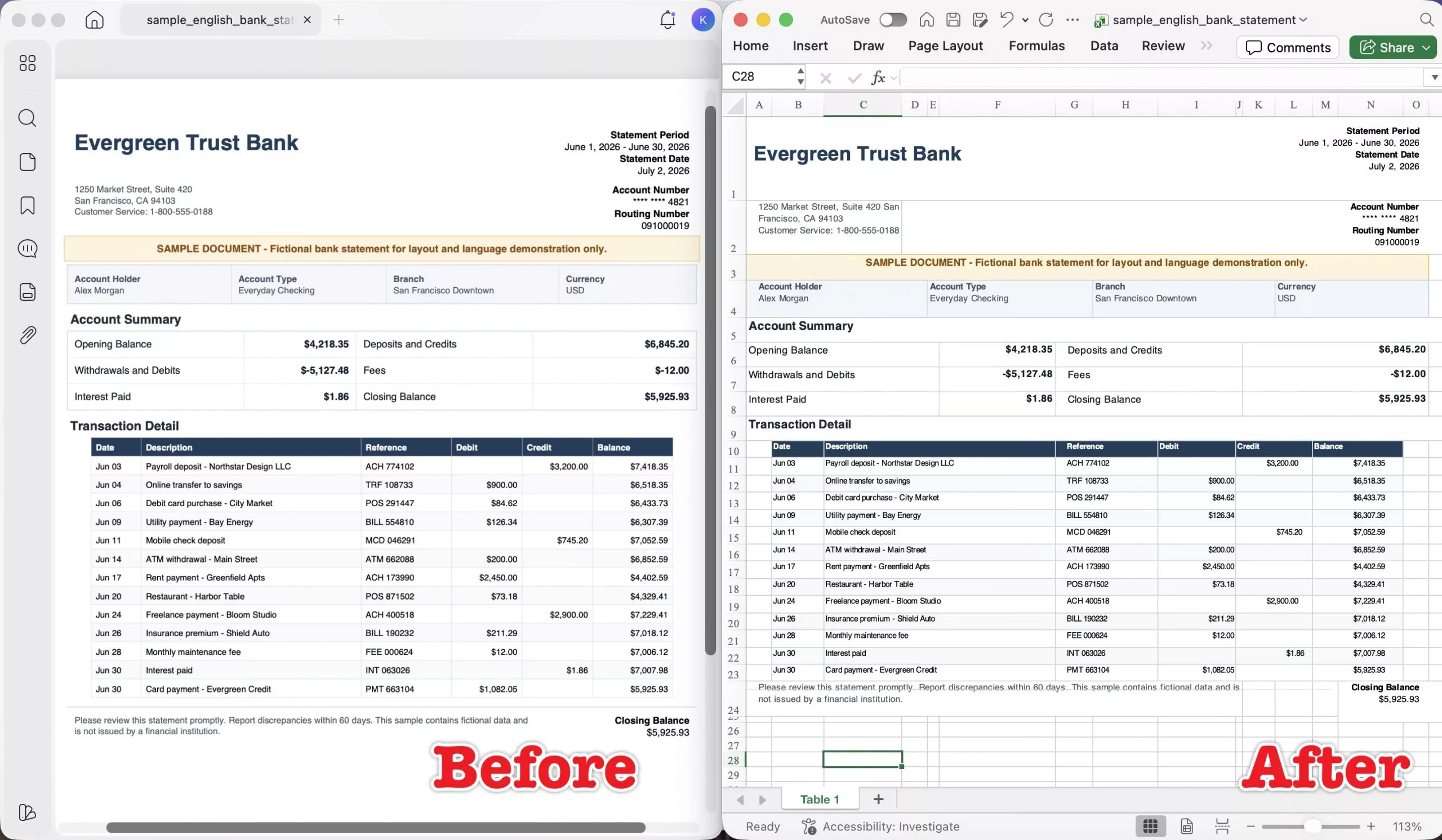
This guide covers every version of the task: a single statement, a folder of them at once, a scanned paper statement, mobile (iPhone, iPad, Android), and the browser-based online converter. It also shows a route for people who don't actually want a spreadsheet at all — they want the analysis a spreadsheet is usually just a means to.
Part 1. Which Method Should You Use?
Bank-statement conversion isn't one job — the right path depends on where you're working and how many statements you have. A scanned or photographed statement isn't a separate method; it's the same conversion with OCR Text Recognition toggled on. Use this to self-route:
| What you're dealing with | Method | Best for |
|---|---|---|
| One statement, on a computer (digital or scanned) | Tools → Excel (Part 2) | A single month you want to reconcile or chart |
| A folder of statements (multiple months/accounts) | Batch PDFs → Convert (Part 3) | Year-end, tax prep, multi-account bookkeeping |
| On your phone, away from a desk | UPDF iOS / Android (Part 4) | A statement that landed in your email on the move |
| No install allowed / a shared computer | Online converter (Part 5) | A quick one-off on a locked-down machine |
Part 2. Convert a Single PDF Bank Statement to Excel or CSV (Windows & Mac)
This is the core workflow, and it's identical on Windows and Mac.
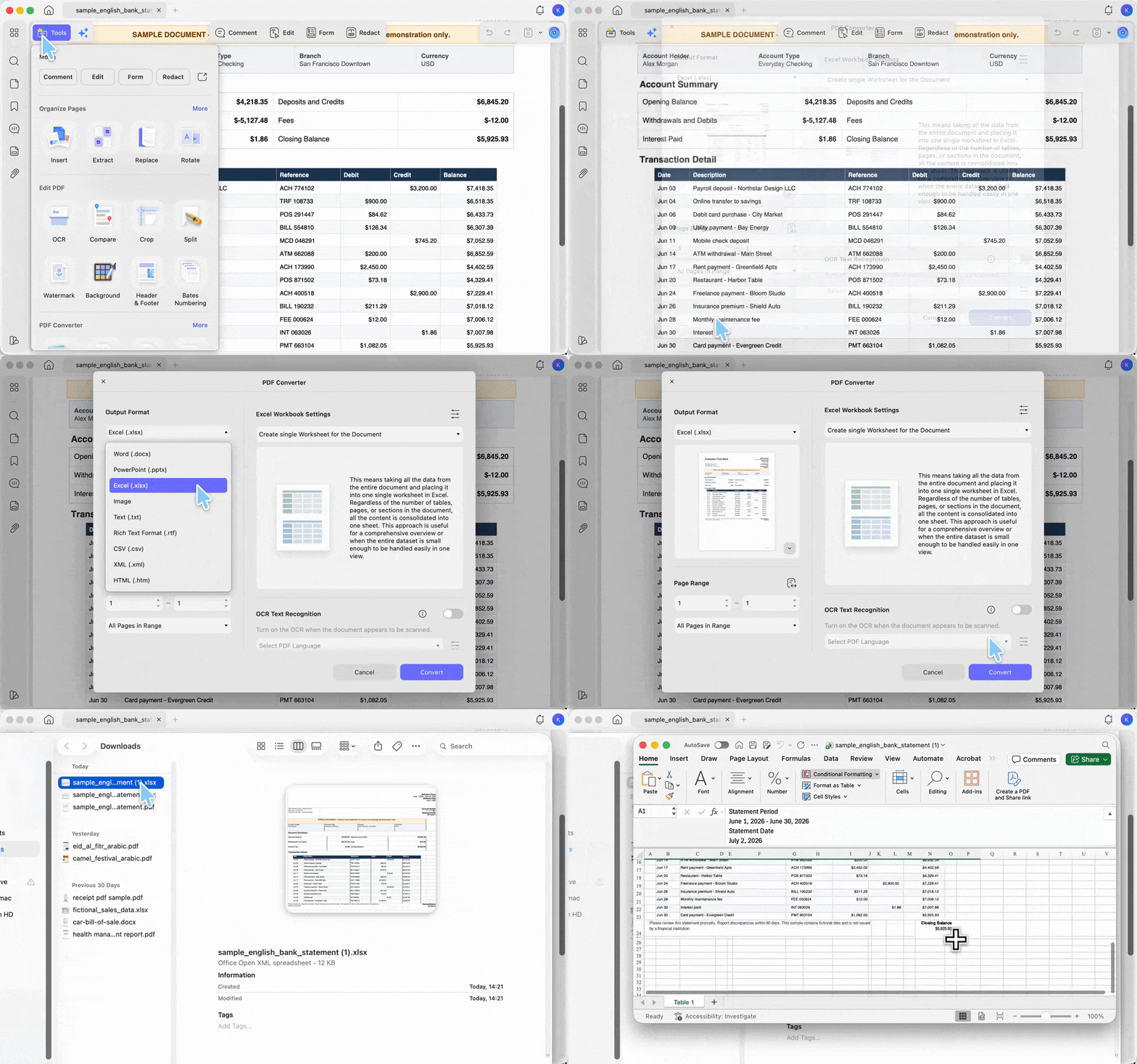
Step 1. Open UPDF and load the statement. If you do not have it installed yet, download UPDF for free by clicking the button below. Click Open File and select it, or drag the PDF straight into the window.
Windows • macOS • iOS • Android 100% secure
Step 2. Click Tools in the top-left, and under PDF Converter choose Excel. The PDF Converter window opens.
Step 3. In the Output Format dropdown, keep Excel (.xlsx) for a workbook, or switch to CSV if you're importing into accounting software like QuickBooks or Xero. Set the Page Range below if you only need certain pages.
Step 4. If your statement is scanned or a phone photo — a picture of text rather than a digital PDF — toggle OCR Text Recognition on in the lower right of the same window and set Select PDF Language to match the statement. This recognizes the numbers in the same pass, so there's no separate OCR step; skip it on a scanned file and the spreadsheet opens with empty rows. UPDF's OCR supports 38+ languages.
Step 5. Click Convert, pick a save location, and UPDF writes the spreadsheet.
Platform note for OCR: UPDF's OCR runs on Windows, on Apple Silicon Macs using the version downloaded directly from updf.com, and on iOS and Android. It is not available on Intel Macs or the Mac App Store build — if OCR is critical on a Mac, install from updf.com.
Excel vs. CSV — which to pick: Excel (.xlsx) keeps a formatted, multi-sheet grid you can immediately sort, filter, and run formulas on. CSV is plain comma-separated text with no formatting — lighter, and the format most banking and bookkeeping tools expect on import. Rule of thumb: choose Excel to read and analyze, CSV to feed another system.
Best for:
- any single statement you have on a computer — digital or scanned.
Not for:
- a single scanned file over 300 pages, which is UPDF's single-file OCR ceiling — split it, convert each part, then merge the spreadsheets.
The broader how to convert PDF guide is useful if some files should go to Word while others should go to Excel, image, HTML, or text.
Video guide on How to Convert PDF into multiple different format
Part 3. Batch Convert Multiple Bank Statements at Once
Tax season and bookkeeping rarely involve one statement. UPDF converts a whole stack in a single pass.
Step 1. From the UPDF home screen, click Tools, then under Batch PDFs choose Convert.
Step 2. Click Add Files and select every statement you want to convert. You can also drag them in, or use the arrow beside Add Files to choose Add Folders and pull in an entire folder. Reorder them by dragging if the sequence matters.
Step 3. On the right, open the Output Format dropdown and pick Excel or CSV, then click Apply.
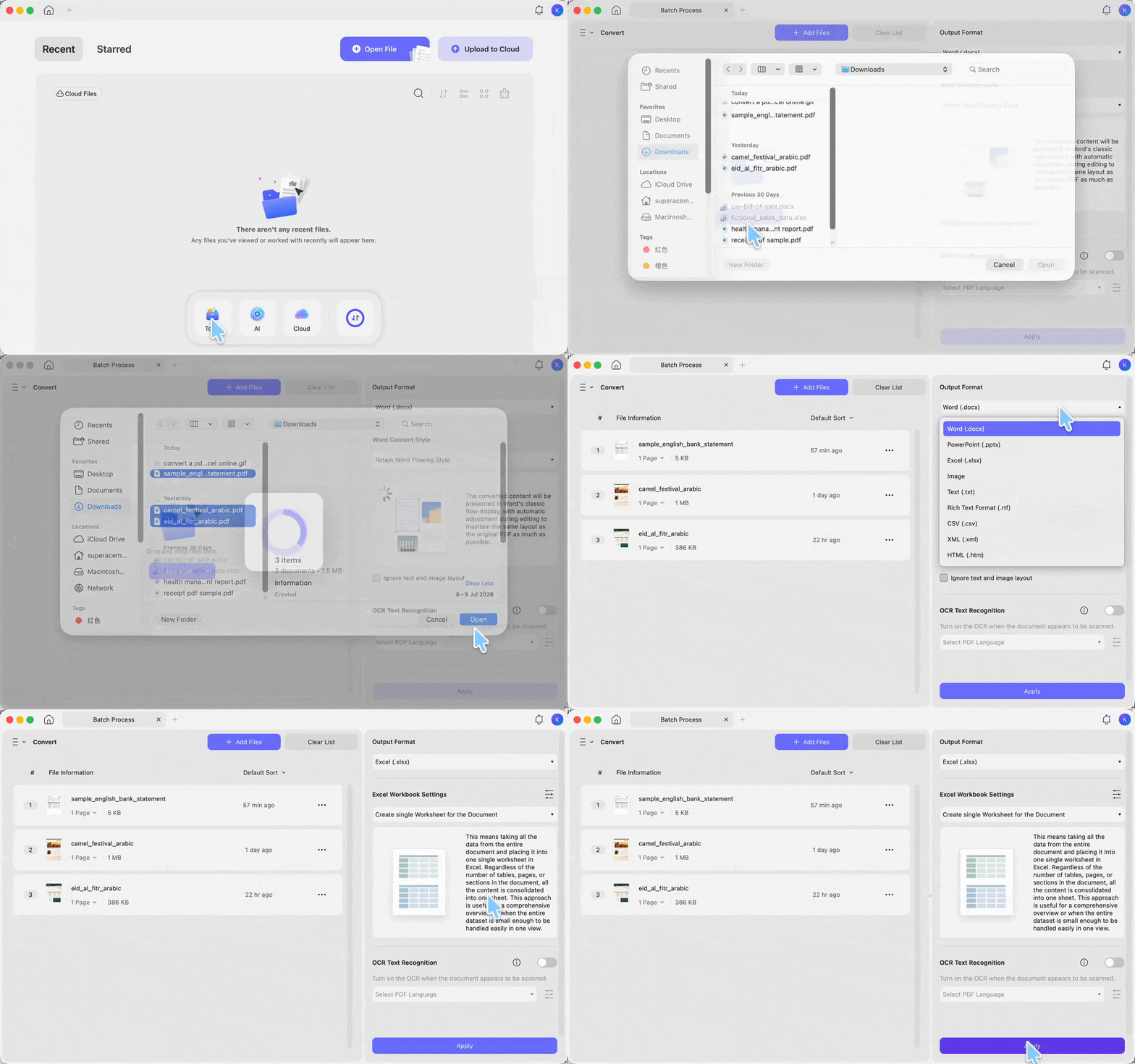
Every statement is exported to your chosen format at once, so twelve months of statements takes about as long as one.
If any of the statements are scanned, toggle OCR Text Recognition on in this same panel and set Select PDF Language before you click Apply — use Apply to run recognition across every scanned file in the queue. There's no need to OCR them separately first.
Best for:
- processing a year of statements, or several accounts, before reconciliation or a loan application.
Not for:
- a stack where every file needs a different output setting — batch applies one output format and one page-range rule to the whole queue, so genuinely one-off conversions are quicker done individually.
Part 4. Convert a Bank Statement to Excel on iPhone, iPad & Android
When a statement lands in your email and you're not at a desk, you don't need to wait. UPDF's mobile apps handle the full conversion, not a stripped-down camera scan.
On iOS (iPhone/iPad) and Android: open the statement in UPDF, tap Convert in the bottom menu, and choose Excel as the output format. If your statement is scanned or a photo, toggle OCR Recognition on in the same pop-up and set the language — just like on desktop. Confirm, and the spreadsheet saves to your device.
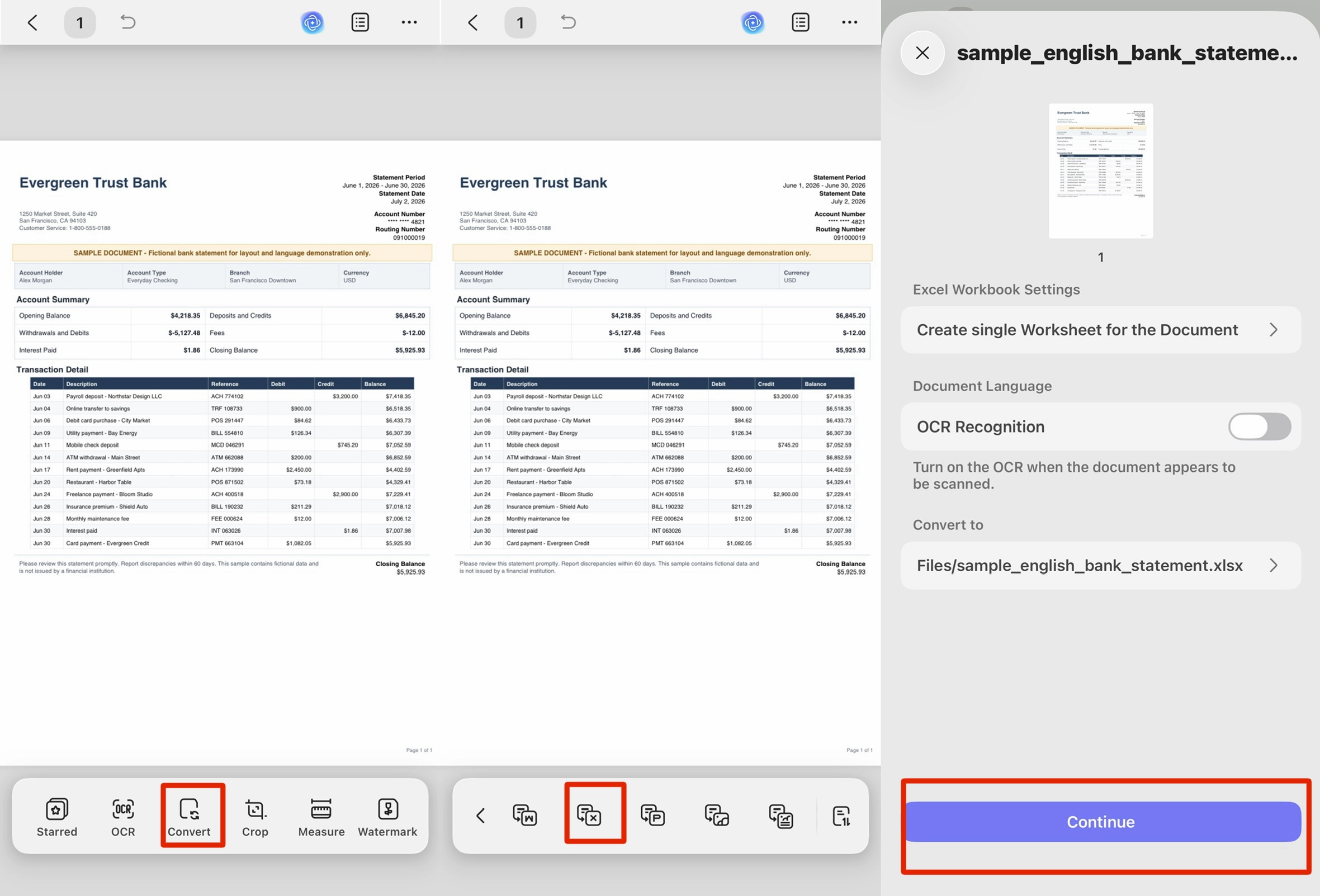
A phone photo of a paper statement converts just as cleanly this way as it would on a computer, because mobile conversion uses the same recognition engine.
Best for:
- converting on the move, straight from an email attachment.
Not for:
- heavy multi-file batch jobs — a desktop handles a folder of statements far faster.
Part 5. Convert a PDF Bank Statement to Excel Online (No Install)
On a locked-down or shared computer where you can't install software, UPDF's online PDF to Excel converter runs entirely in the browser and works on Windows, Mac, Linux, Android, and iOS.
Step 1. Open the online converter by clicking the button below and click Upload File, or drag your statement in.
Step 2. Click Convert PDF or type "convert this PDF to Excel" in the input box. For a scanned statement, the online tool recognizes the content automatically and produces an editable Excel file.
Step 3. When it finishes, click the download icon to save the spreadsheet.
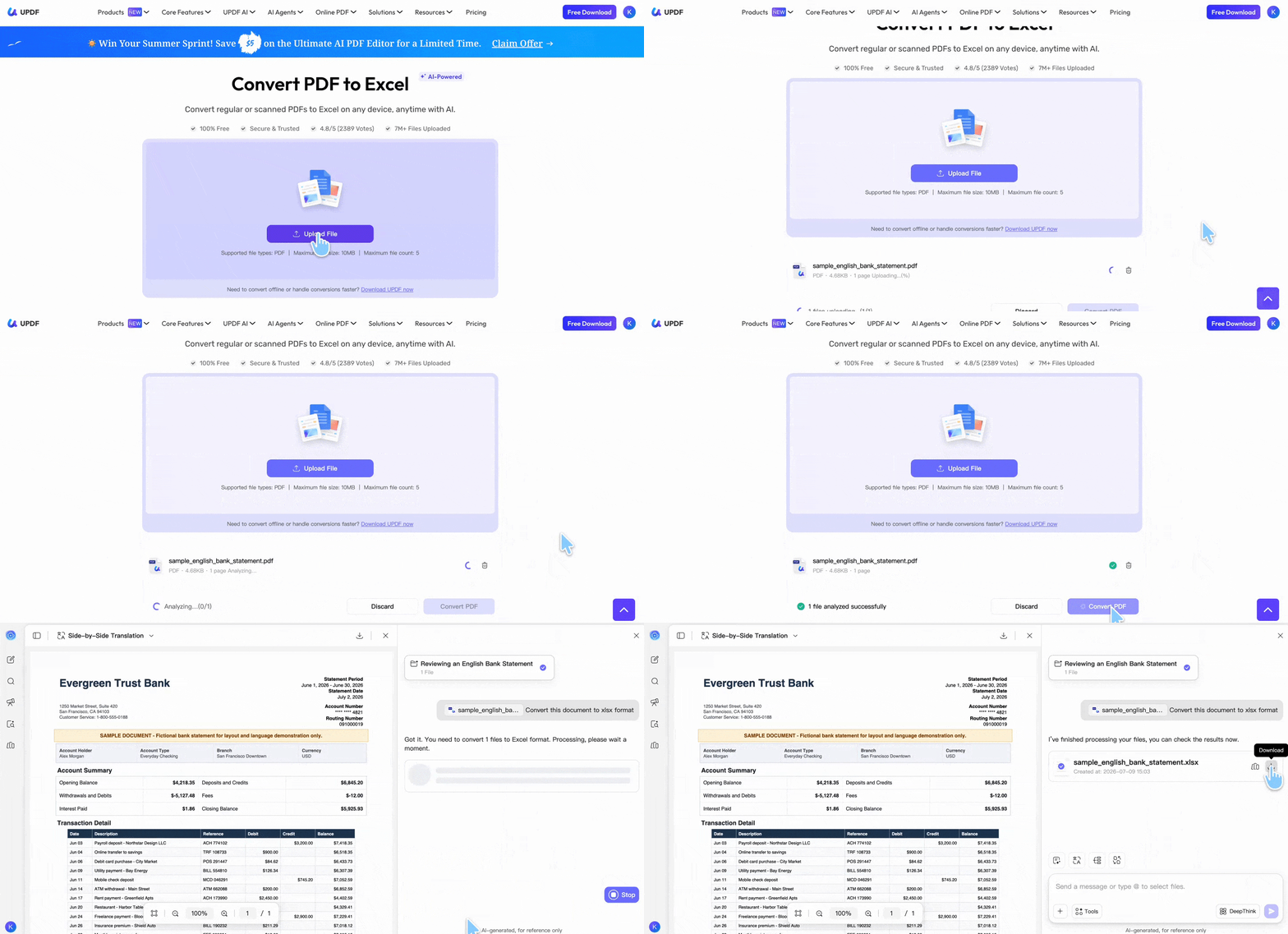
The online converter's free tier allows 2 conversions per day, files up to 10 MB and 100 pages each, and 1 scanned file; the paid tier lifts those to 100 MB, 300 pages, and batch uploads of up to 100 files. Because files are uploaded to a server for processing, the desktop app is the better choice for sensitive statements you'd rather keep entirely on your own device.
Best for:
- a fast one-off on a machine where you can't install anything.
Not for:
- confidential statements you don't want leaving your device — use the offline desktop app for those.
Part 6. Skip the Spreadsheet: Get the Answer Directly with UPDF AI
Often the spreadsheet is just a means to an end — you convert to Excel only so you can then add up what you spent on groceries, or check the bank's math. UPDF AI can give you that answer straight from the PDF, no export required.
Open the statement, click UPDF AI in the top-right corner, and ask in plain language — for example, "Categorize these transactions into groceries, rent, loan payments, and entertainment, and total each," or "What was my largest expense this month?" UPDF AI reads the statement in place and answers, so you skip the convert-then-build-formulas cycle entirely. UPDF AI is also available on the web, so you can run the same analysis in a browser.
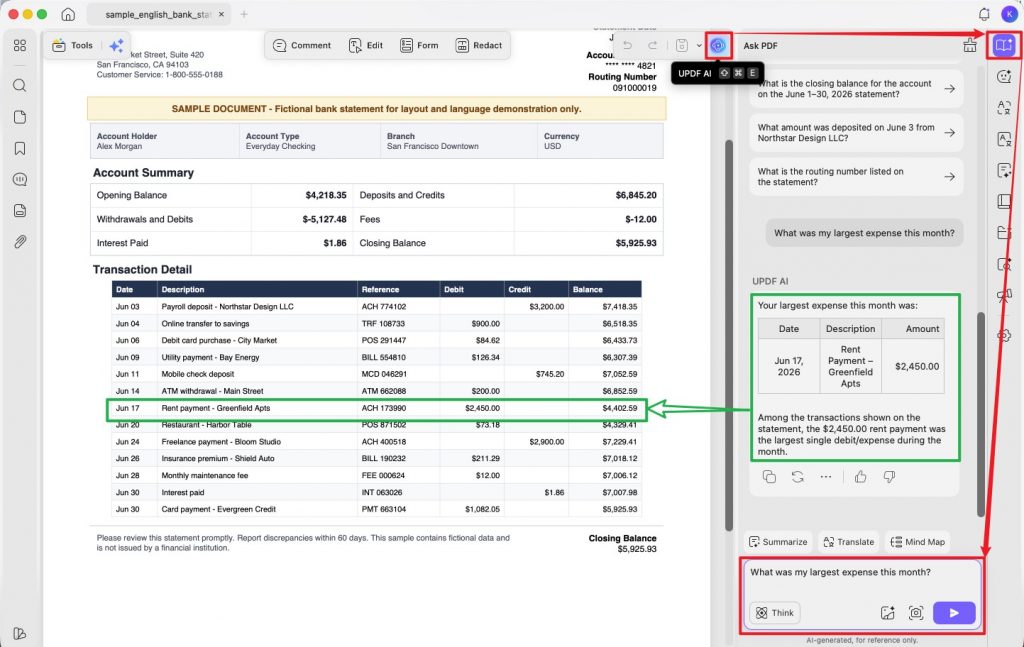
Best for:
- budgeting, expense categorization, and spotting your biggest outflows.
Not for:
- situations where you specifically need the raw data in a .xlsx file to hand to an accountant or import elsewhere — convert it (Part 2) for that.
Part 7. Method Comparison
| Method | Handles scans? | Multiple files? | Works offline? | Best use |
|---|---|---|---|---|
| Tools → Excel (desktop) | ✓ — toggle OCR in converter | One at a time | ✓ | Single digital or scanned statement |
| Batch PDFs → Convert (desktop) | ✓ — toggle OCR + Apply to All | ✓ | ✓ | Year-end, multi-account |
| Mobile (iOS/Android) | Yes — toggle OCR in Convert | One at a time | ✓ | On the move |
| Online converter | ✓ (auto) | Paid tier: up to 100 | ✗ — uploads to server | Quick one-off, no install |
| UPDF AI | Reads scans | Per document | Desktop yes / web no | Analysis instead of a spreadsheet |
Part 8. Edge Cases: When Bank Statement Conversion Doesn't Come Out Clean
- A password-protected statement won't open for conversion. Banks routinely send statements encrypted with your date of birth or account number as the open password. Enter it when UPDF prompts, then convert normally — this only works for statements you're authorized to access.
- The bank's PDF has no real tables, just aligned text. Some banks lay transactions out as spaced text rather than a true table, so even a clean digital PDF can convert with columns slightly off. Widening the conversion page range to a single page at a time, or running OCR Text Recognition even on a digital file, often forces cleaner column detection.
- Rows split across two pages get broken up. A transaction that wraps from the bottom of one page to the top of the next can land as two half-rows in Excel. Convert the affected pages as their own range, then stitch them back in the spreadsheet.
- A statement over 300 pages won't OCR in one go. That's UPDF's single-file OCR page ceiling. Split the file, convert each part with OCR on, then merge the spreadsheets.
- Negative amounts or credits lose their sign. Parentheses-style negatives —
(1,082.05)— sometimes import as positive numbers. Sort the converted column and spot-check against the statement's closing balance before you rely on the totals.
Part 9. FAQ
1. Should I convert my bank statement to Excel or to CSV for QuickBooks or Xero?
For QuickBooks and Xero imports, choose CSV — those tools read comma-separated transaction lists directly, and Excel's extra formatting can trip up the import mapping. Keep Excel (.xlsx) when the file is for your own analysis, sorting, or formulas rather than feeding another program.
2. How do I check the converted spreadsheet is accurate before I rely on it?
Compare the converted file's final running balance against the closing balance printed on the original statement. If the two tie out, the transaction rows in between are almost certainly complete; if they don't, a row was dropped or misread and needs a manual fix.
3. Does bank statement conversion work for any bank, or only certain ones?
UPDF reads the layout of the PDF itself rather than matching a fixed template per bank, so statements from Chase, Bank of America, Wells Fargo, HSBC, or a small regional bank all convert the same way. Layout complexity matters more than the bank's name — a dense multi-column statement is harder to convert cleanly than a simple one, regardless of who issued it.
4. Can I clean up the data before converting, or only after in Excel?
Both. Because UPDF opens the statement as a PDF first, you can crop out a promotional page or delete a blank one before converting, so it never reaches the spreadsheet. Anything left — a merged cell, a stray header row — is fixed in Excel afterward like any other spreadsheet.
5. Is UPDF cheaper than Adobe Acrobat for converting bank statements to Excel?
Both convert statements to Excel with OCR, but the cost differs sharply: UPDF is $49.99/year or a $79.99 one-time lifetime license covering Windows, Mac, iOS, and Android, while Adobe Acrobat Pro is about $239.88/year as a subscription with no one-time option.
Conclusion
Converting a PDF bank statement to Excel or CSV comes down to one distinction: a digital statement converts directly, while a scanned one needs OCR toggled on to turn its picture-of-text into real cells. Once you match the method to your statement — single, batch, scanned, mobile, or online — the spreadsheet takes seconds, and UPDF AI can even skip the spreadsheet and answer your budgeting questions from the PDF directly.
Download UPDF for free to try converting your bank statement on your own file — installation is free, and Pro features are available when you need watermark-free export or unlimited batch conversion.
Windows • macOS • iOS • Android 100% secure








 Enrica Taylor
 Enya Moore