 UPDF
 UPDF for Windows
 UPDF for Mac
 UPDF for iPhone/iPad
 UPDF for Android
 Nomostar
 UPDF AI Online
 UPDF Sign
 IvyCraft
 Edit PDF
 Annotate PDF
 Create PDF
 PDF Form
 Edit links
 Convert PDF
 OCR
 PDF to Word
 PDF to Image
 PDF to Excel
 Organize PDF
 Merge PDF
 Split PDF
 Crop PDF
 Rotate PDF
 Protect PDF
 Sign PDF
 Redact PDF
 Sanitize PDF
 Remove Security
 Read PDF
 UPDF Cloud
 Compress PDF
 Print PDF
 Batch Process

 About UPDF AI
 UPDF AI Solutions
 AI User Guide
 FAQ about UPDF AI
 Summarize PDF
 Translate PDF
 Chat with PDF
 Chat with AI
 Chat with image
 PDF to Mind Map
 Explain PDF
 PDF AI Tools
 Image AI Tools
 AI Chat Tools
 AI Writing Tools
 AI Study Tools
 AI Working Tools
 Other AI Tools
 AI Bookmark Generation
 AI Bookmark Summary
 AI Watermark Generation
 AI Background Generation
 AI Sticker Generation
 AI Stamp Generation
 AI Editing Suite
 UPDF Copilot
 AI Page Management
 AI Semantic Search
 PDF to Word
 PDF to Excel
 PDF to PowerPoint
 Enterprise Solution
 Enterprise Sign
 Enterprise AI
 Enterprise Plan
 Enterprise User Guide
 Enterprise Webinar
 IT
 Education
 Construction
 Financial Service
 Healthcare
 Insurance
 Legal
 Manufacturing
 Government
 Researchers & PhDs
 Solopreneurs & Freelancers
 Lawyers & Legal Professionals
 Real Estate Agents & Brokers
 Education Solution
 Customer Stories
 User Guide
 UPDF Tricks
 FAQs
 UPDF Reviews
 Download Center
 Blog
 Newsroom
 Tech Spec
 Updates
 UPDF vs. Adobe Acrobat
 UPDF vs. Foxit
 UPDF vs. PDF Expert


Batch Process
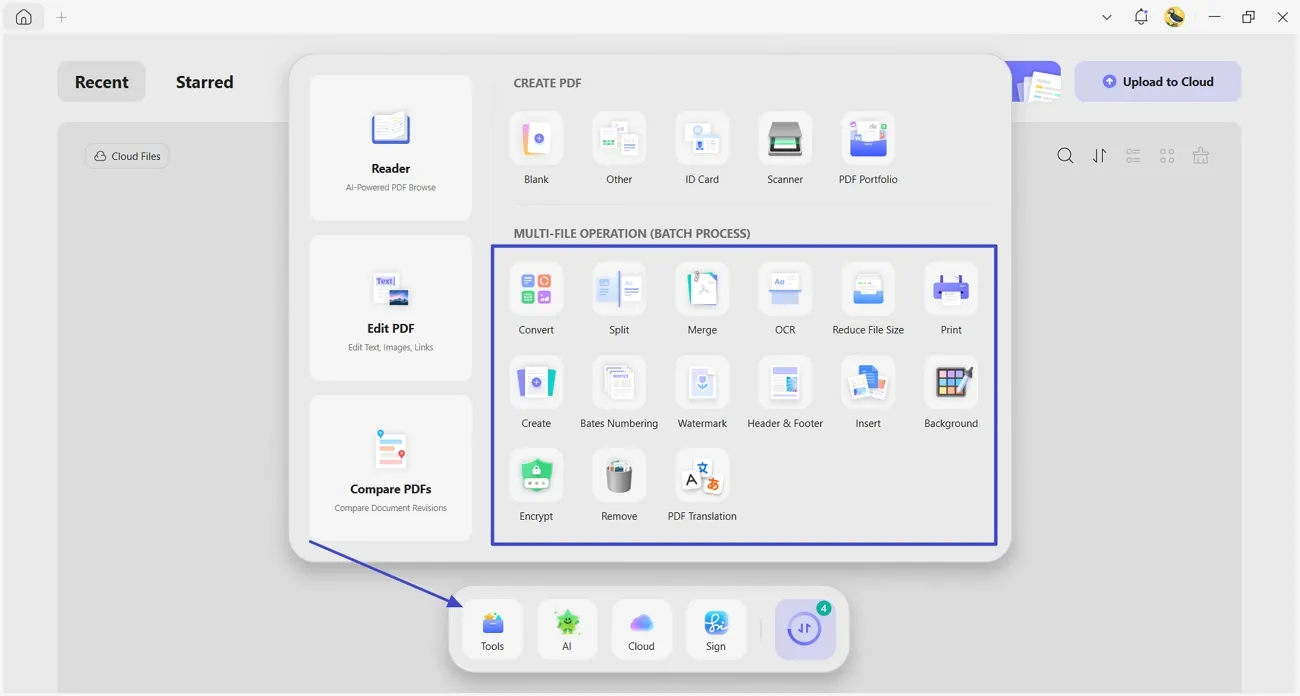
UPDF offers 15 batch processing features and assists users in converting, OCR, compressing, combining, inserting, printing, etc. To execute the process, open UPDF on your Windows device and click the “Tools” option to choose the features under “Batch Process.” In the following content, we'll guide you through how to use these batch tools in UPDF.
Batch Convert
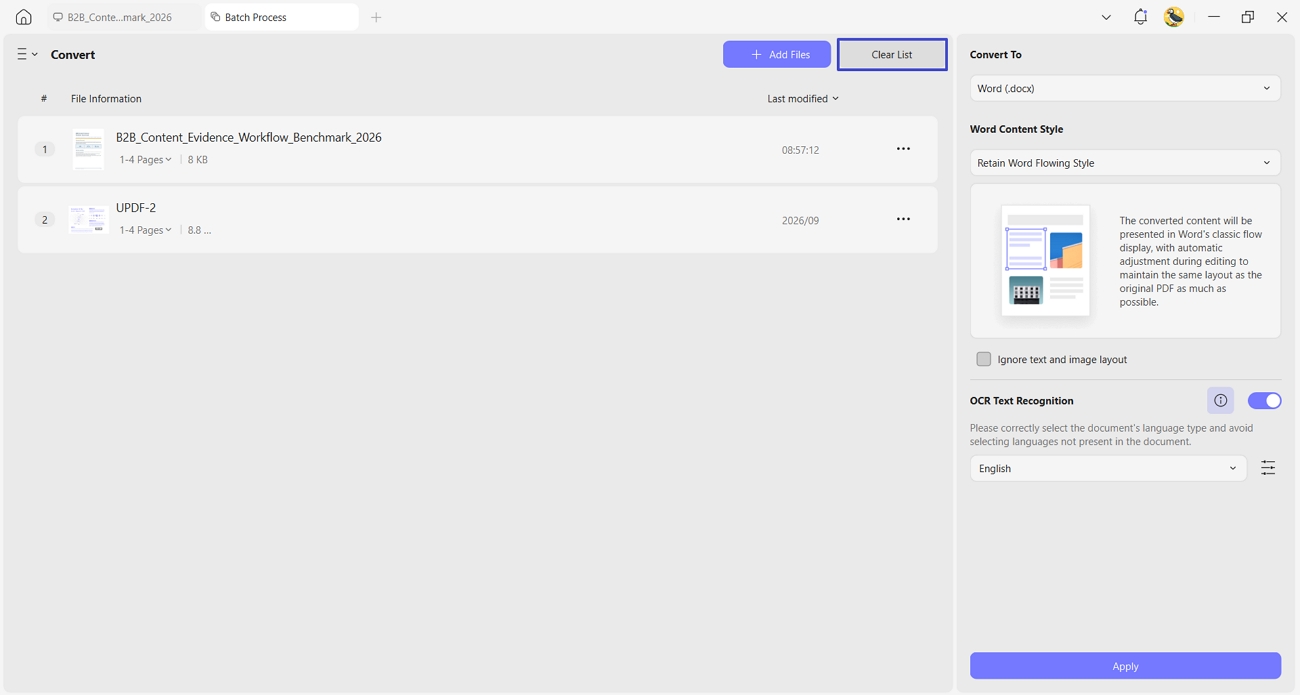
For those who seek to convert multiple PDF files to different file formats, they can consider using the batch conversion feature offered by UPDF. Click the “Tools” tab. As a new window opens on the front, select “Convert” from the options to proceed next. Now, look at the steps below to see how it works:
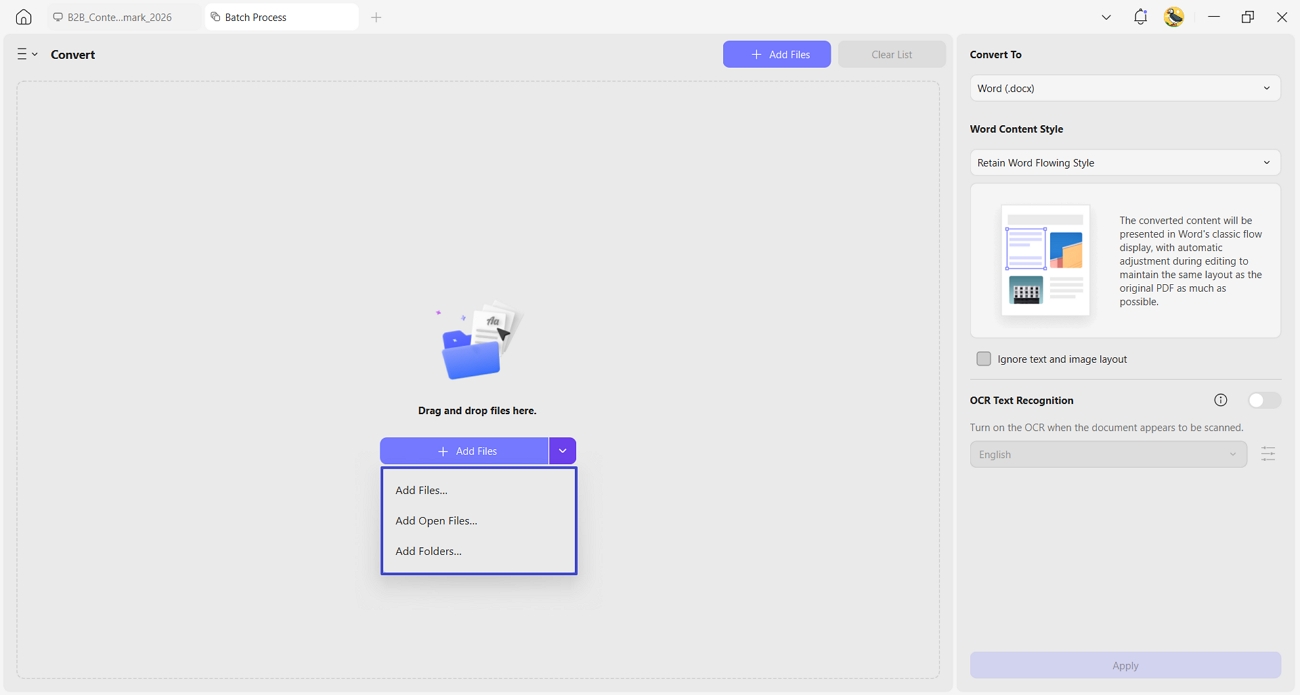
Step 1. First, click the “Add Files” button to import PDF files into UPDF. To include PDFs already open in UPDF, click the arrow icon next to the button and select “Add Open Files”. You can also select “Add Folders” from the drop-down menu to import an entire folder.
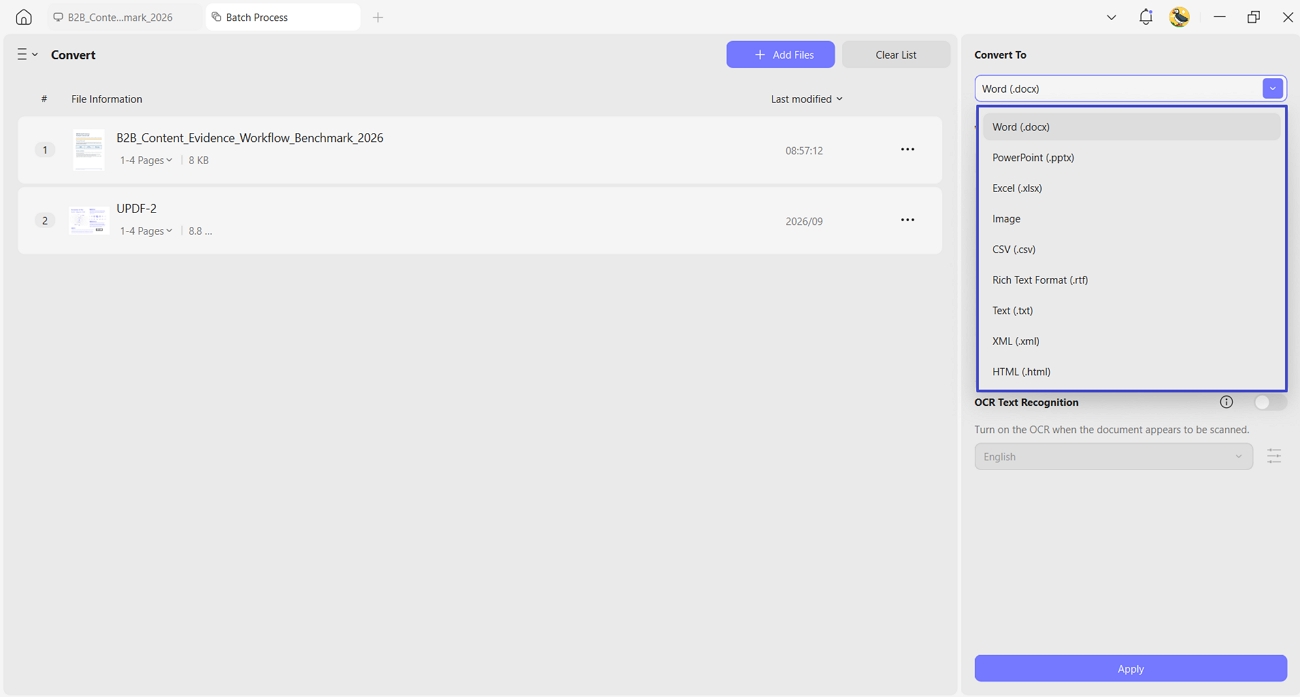
Step 2. Once the files are added, open the “Convert to” drop-down menu and choose your preferred output format. Available options include Word, PowerPoint, Excel, CSV, RTF, Image (BMP, JPEG, PNG, TIFF, GIF), XML, and HTML.
Step 3. If you are converting scanned PDFs, enable “OCR Text Recognition” to recognize the text and make it editable in the converted Word documents. This option is particularly useful when processing multiple scanned PDFs at once.
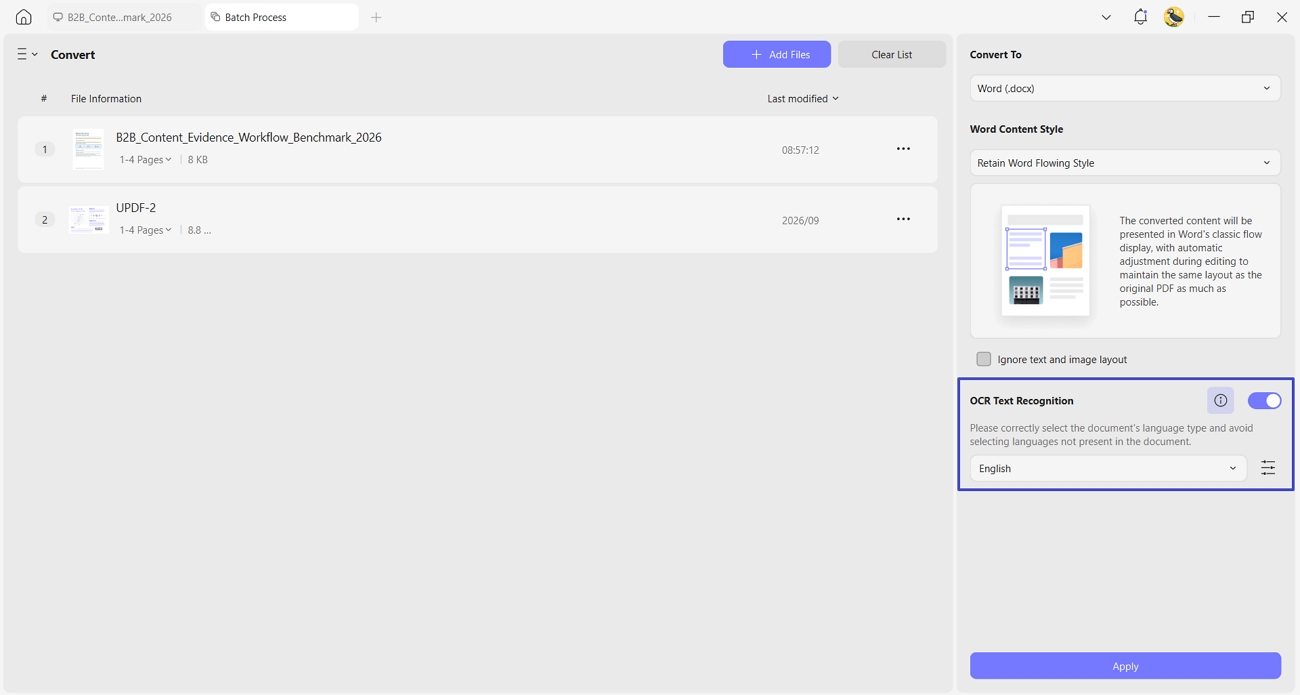
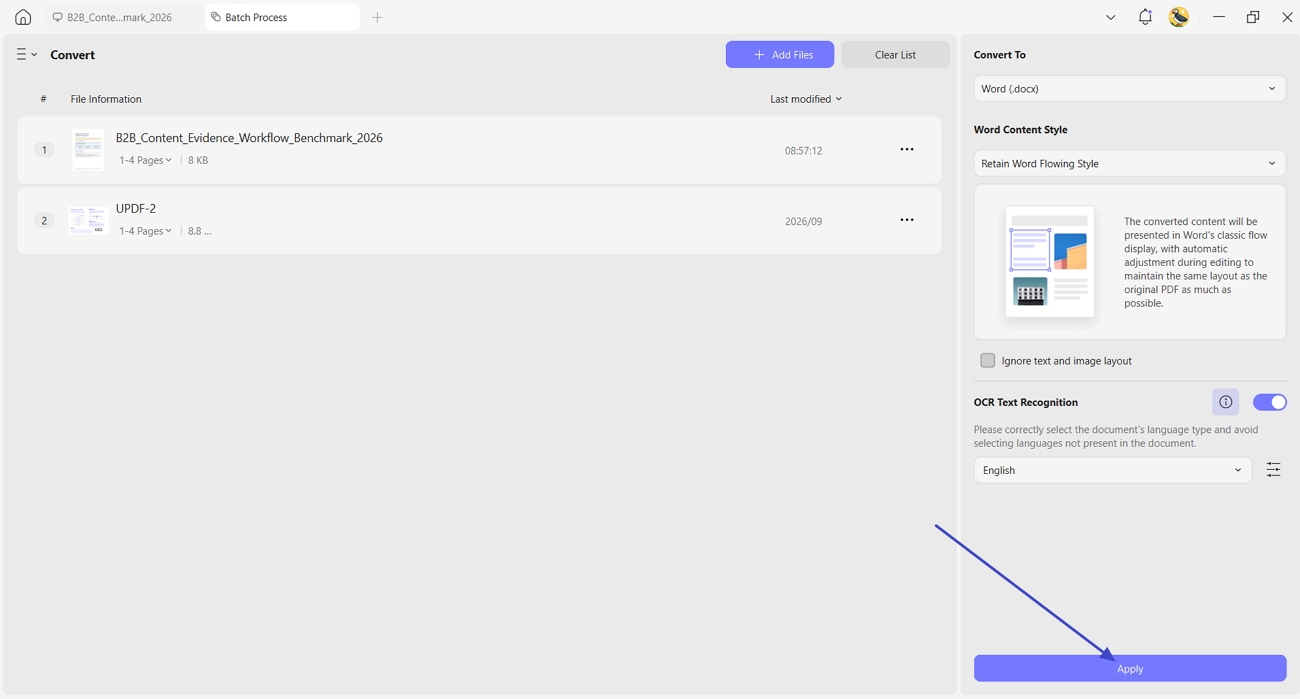
Step 4. After configuring the conversion settings, click “Apply” to proceed. Choose a destination folder for the converted files and click “Select Folder” to confirm the location.
Other Settings of the Files
UPDF provides several options to manage PDF files within the Batch Convert feature. You can remove files, preview documents, check file information, locate files, or clear the entire list.
Remove
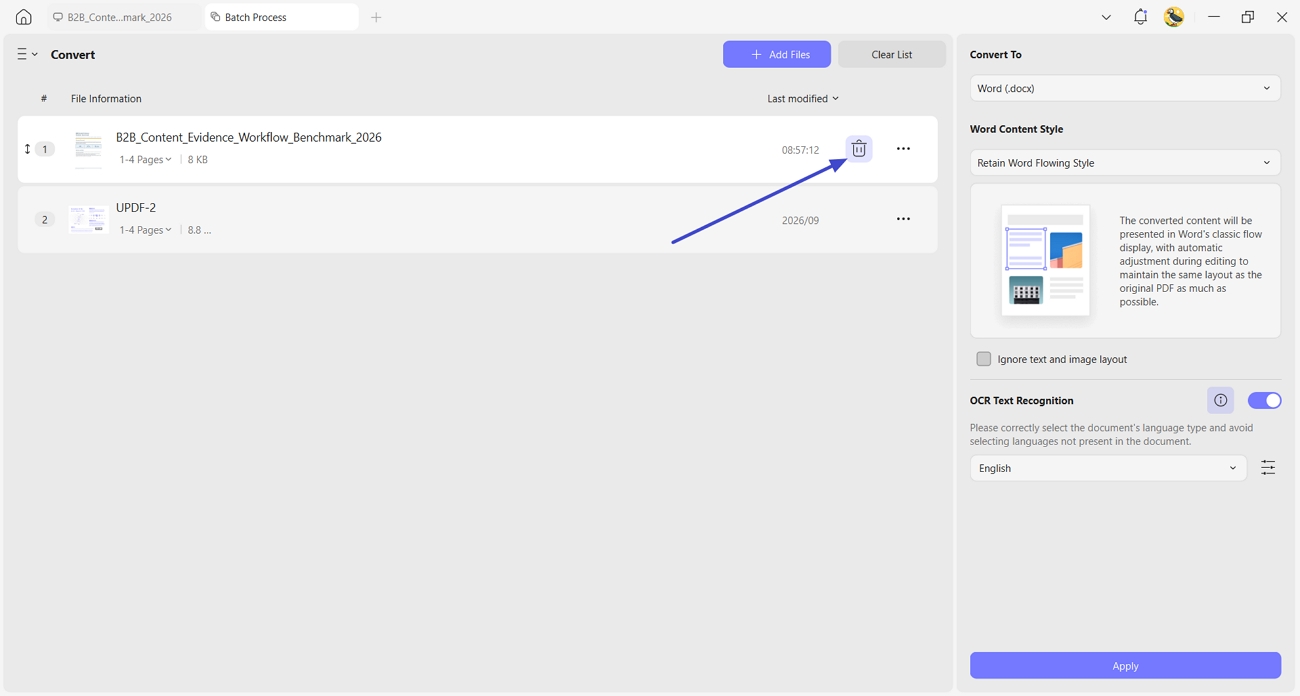
To remove an unnecessary PDF, hover over the file and click the “Remove” (trash) icon.
Preview
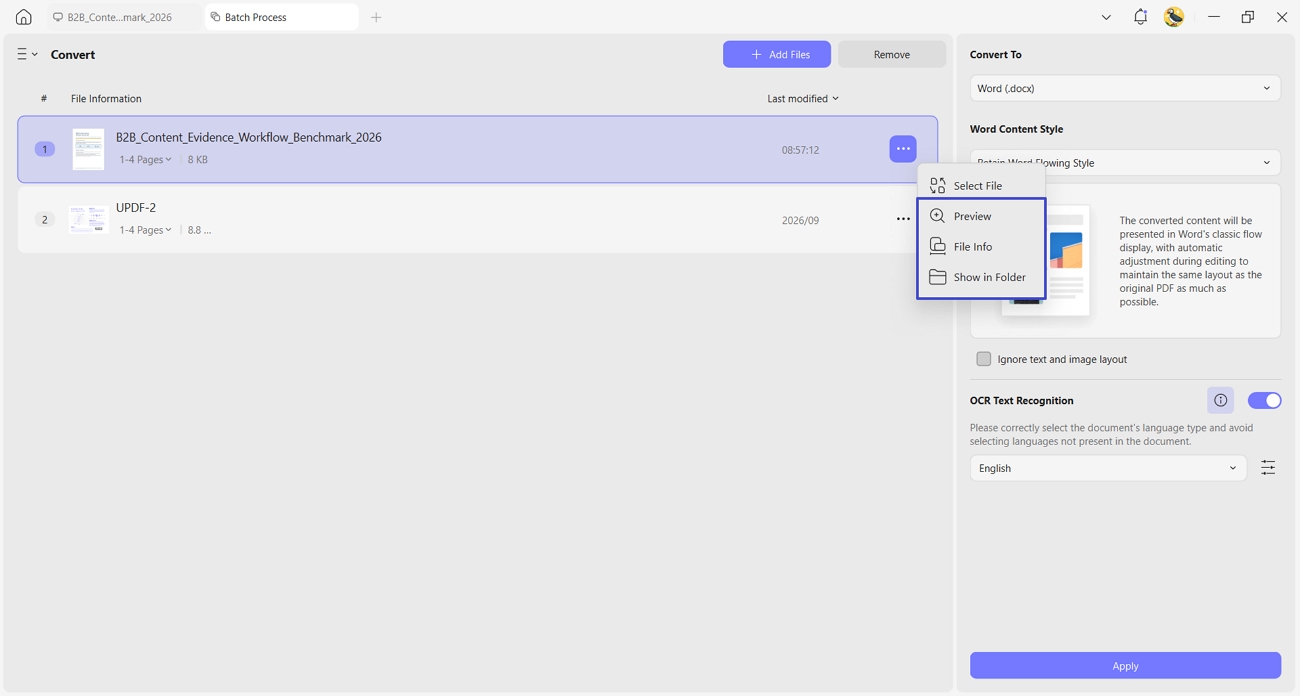
To verify that you have added the correct PDF, click the three-dot icon next to the file and select “Preview”. A pop-up window will display the document for review.
File Info
To view the details of a specific PDF, click the three-dot icon and select “File Info”. A new window will open, displaying the file information.
Show in Folder
To locate a PDF on your computer, click the three-dot icon next to the file and select “Show in Folder”. This will open the folder containing the selected PDF.
Clear List
To remove all added PDFs from the Batch Convert list, click the “Clear List” button at the top of the window.
Batch Split
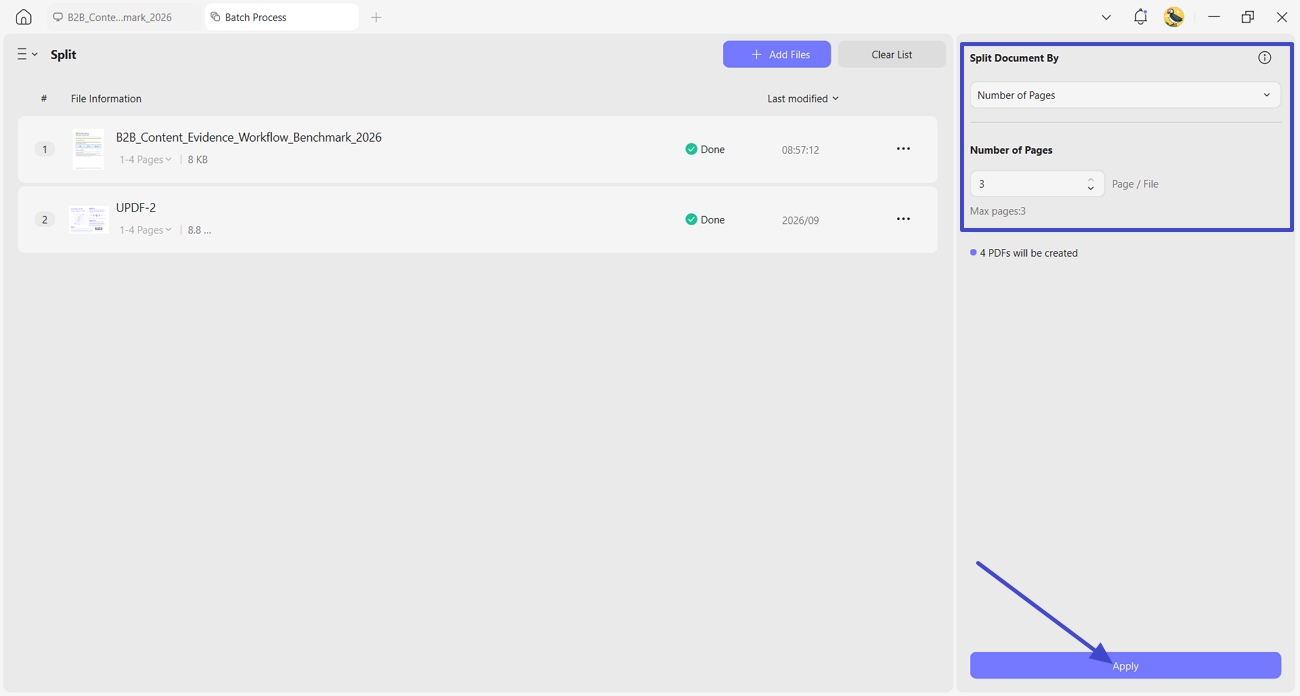
UPDF also offers a Batch Split feature that allows you to split multiple PDF files based on the number of pages, file size, or top-level bookmarks. Use the instructions below to split your PDFs:
Instructions. First, add your PDF files and choose the correct split method. Then, select number of pages you want in a PDF and click the “Apply” button.
Batch Merge
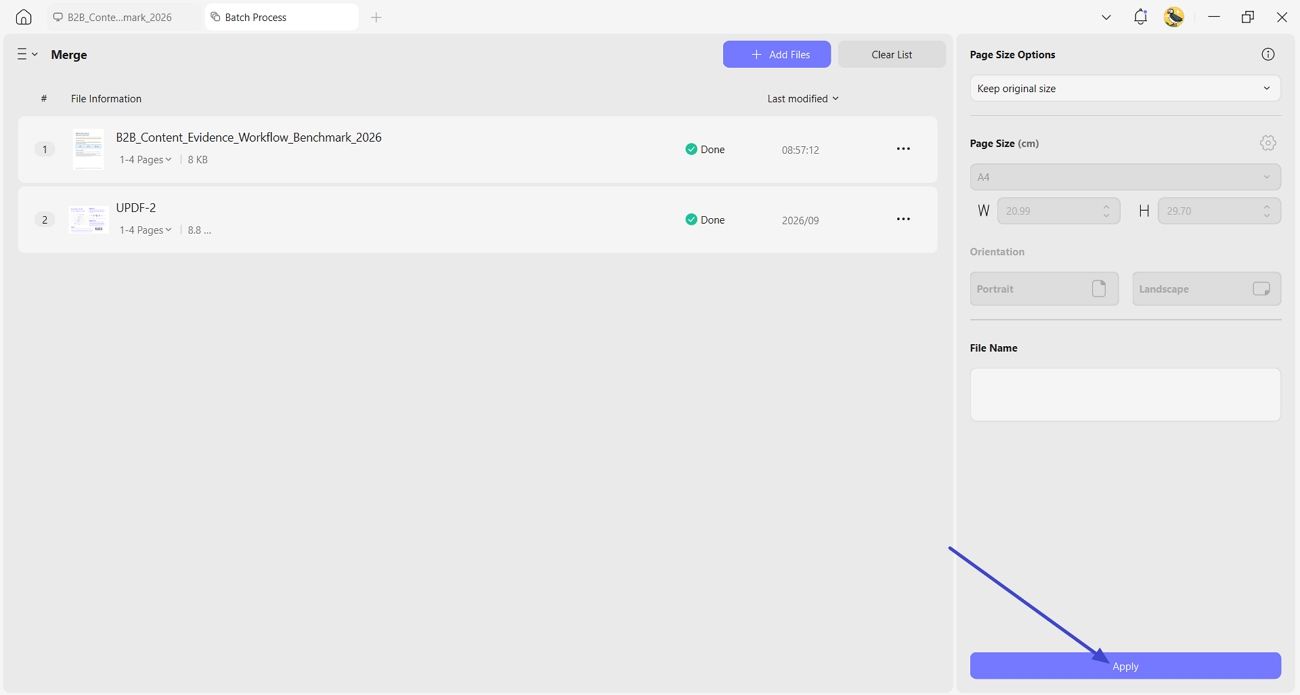
UPDF provides a comprehensive function of combining PDF or image files into a single PDF using its batch merge feature. Follow the guidelines below to know how to utilize it properly:
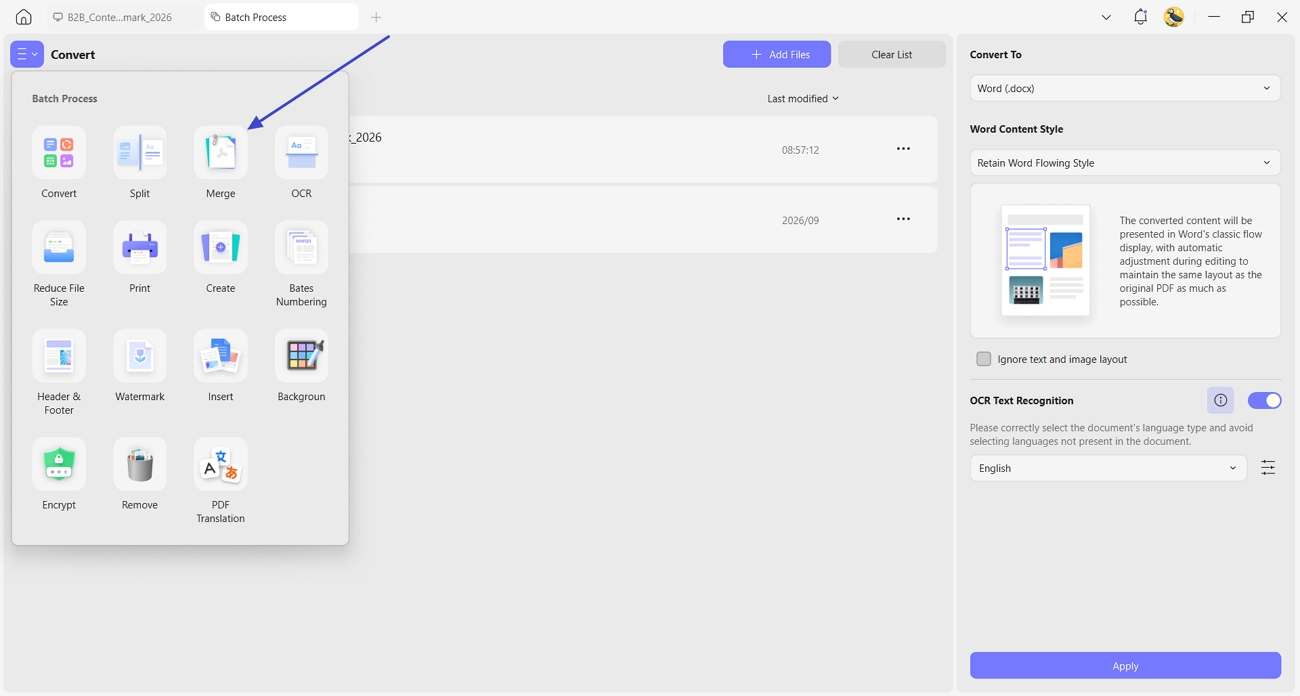
Step 1. Proceed to click the “Three Lines” of Batch PDF. Continue to select “Merge” from the options to activate the “Batch Merge” feature.
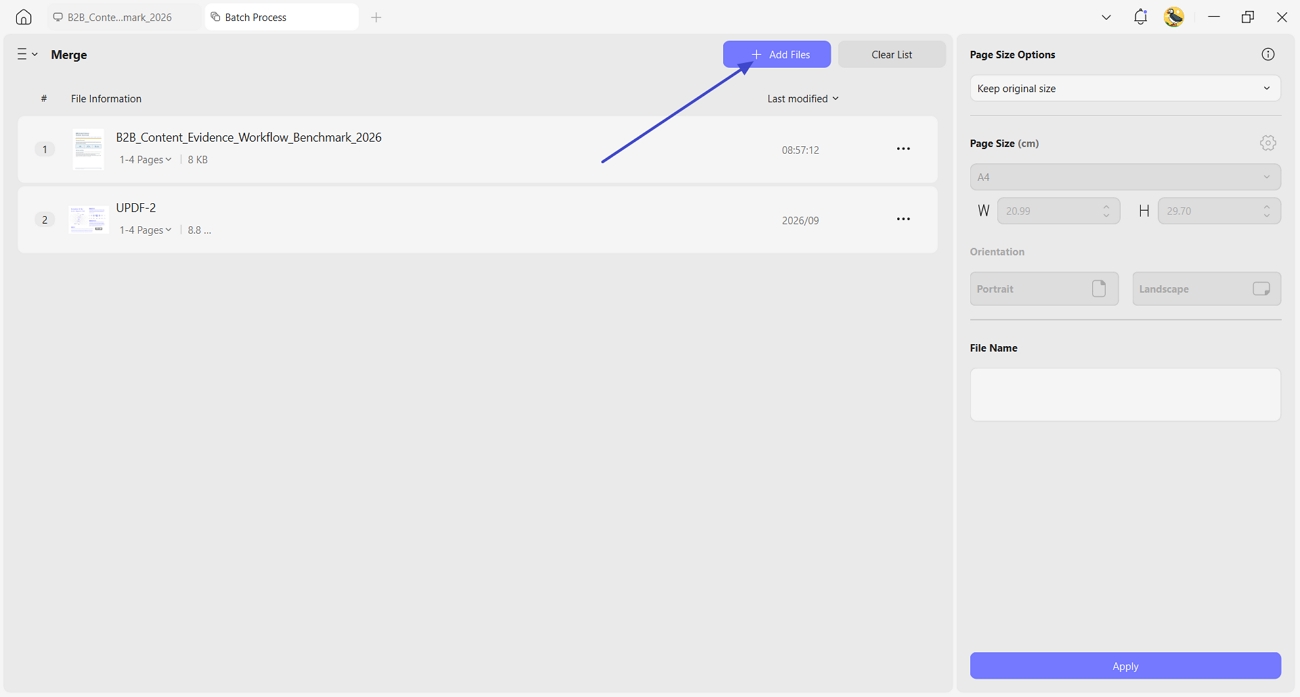
Step 2. Use the “Add Files” button or the arrowhead alongside it to add files, opened files on UPDF, or folders.
Step 3. After adding the files, change their positions by drag and drop, if needed. Continue to click “Apply” to browse a location for your output file and execute the process by clicking “Save.”
Batch OCR
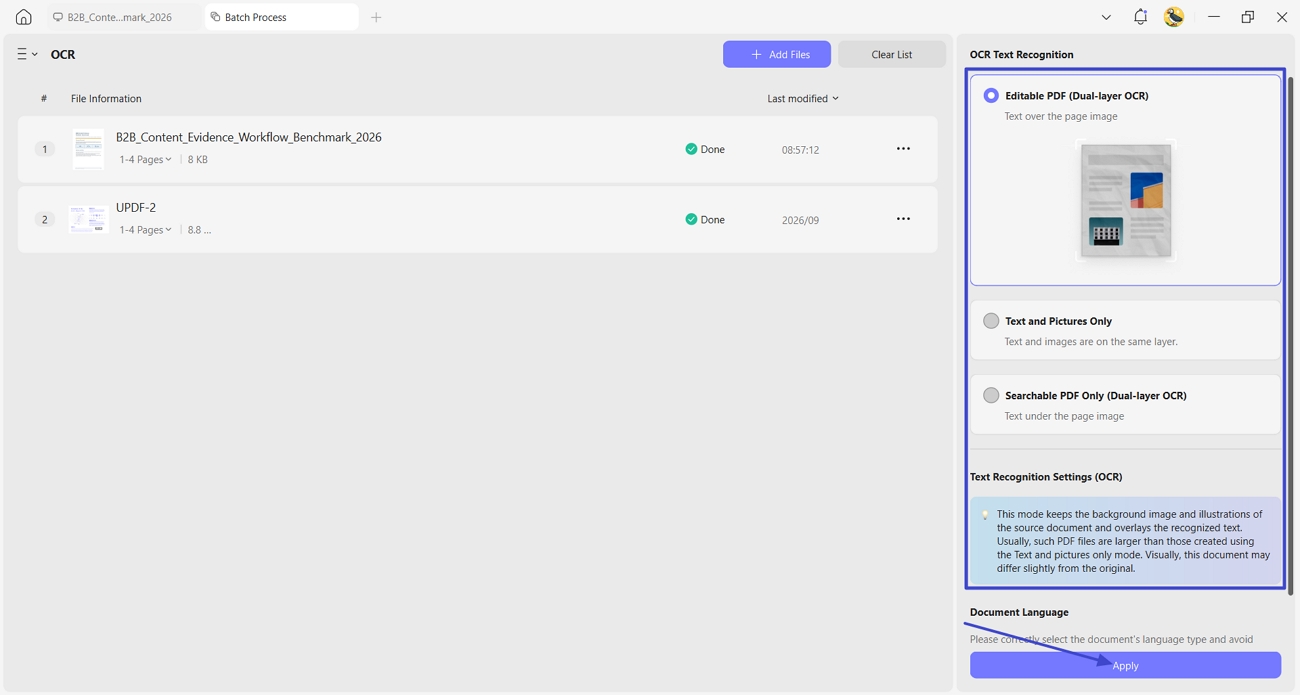
If you have multiple scanned PDF files and want to convert them into editable documents, you can use UPDF’s Batch OCR feature. Use the instructions below to complete the process:
Instructions. Now, select “OCR” this time. “Add File” to select all the scanned PDF files, select “Editable PDF (Dual-layer OCR),” “Text and pictures Only,” or “Searchable PDF Only (Dual-layer OCR)” per your needs, choose the document language, and click “Apply” to batch convert your non-editable PDF files into editable or searchable ones.
Batch Compress
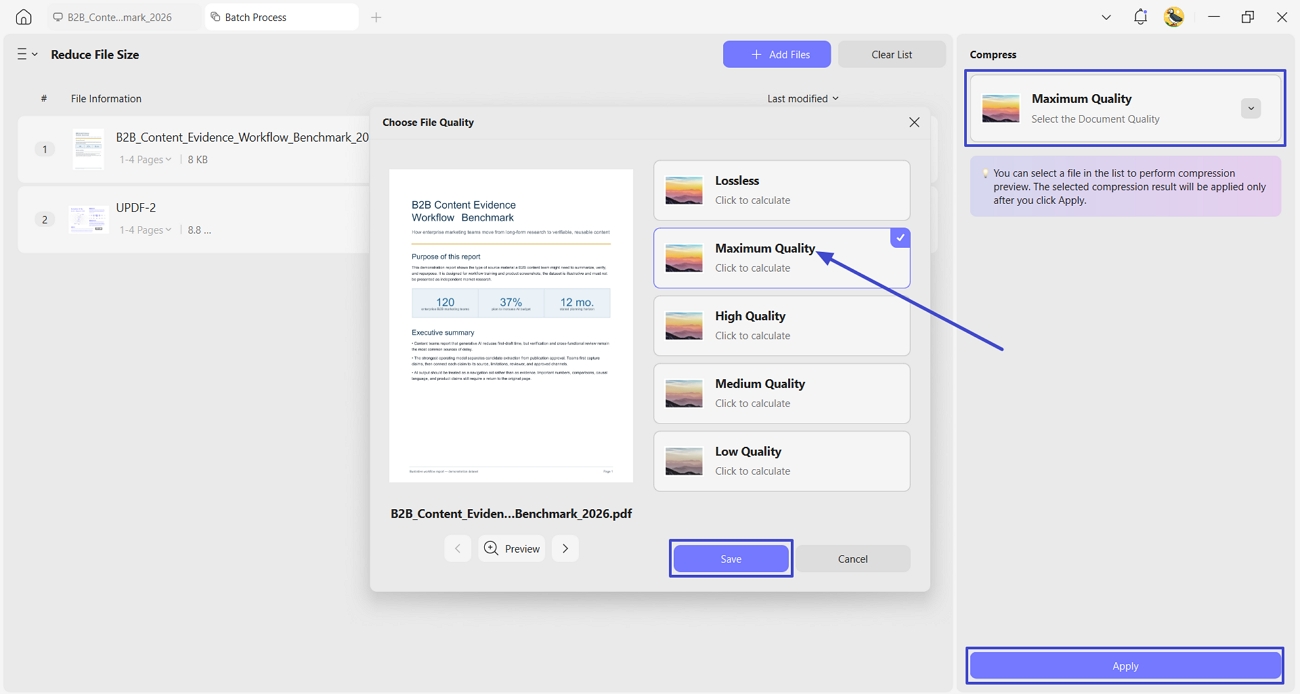
Have many large files and want to compress them at once to share or upload? You can follow this guide.
Instructions. Switch to “Reduce File Size” now, click on “Add File" to upload the PDF files on your computer, click on “Maximum Quality,” select the quality you need, click on “Save,” then click on “Apply.”
Batch Insert
You can try inserting your required PDFs into a single file collectively with the help of the Batch Insert feature. Learn more on how it is done properly with UPDF:
Step 1. Select “Insert” from the available options to open the Batch Insert feature.
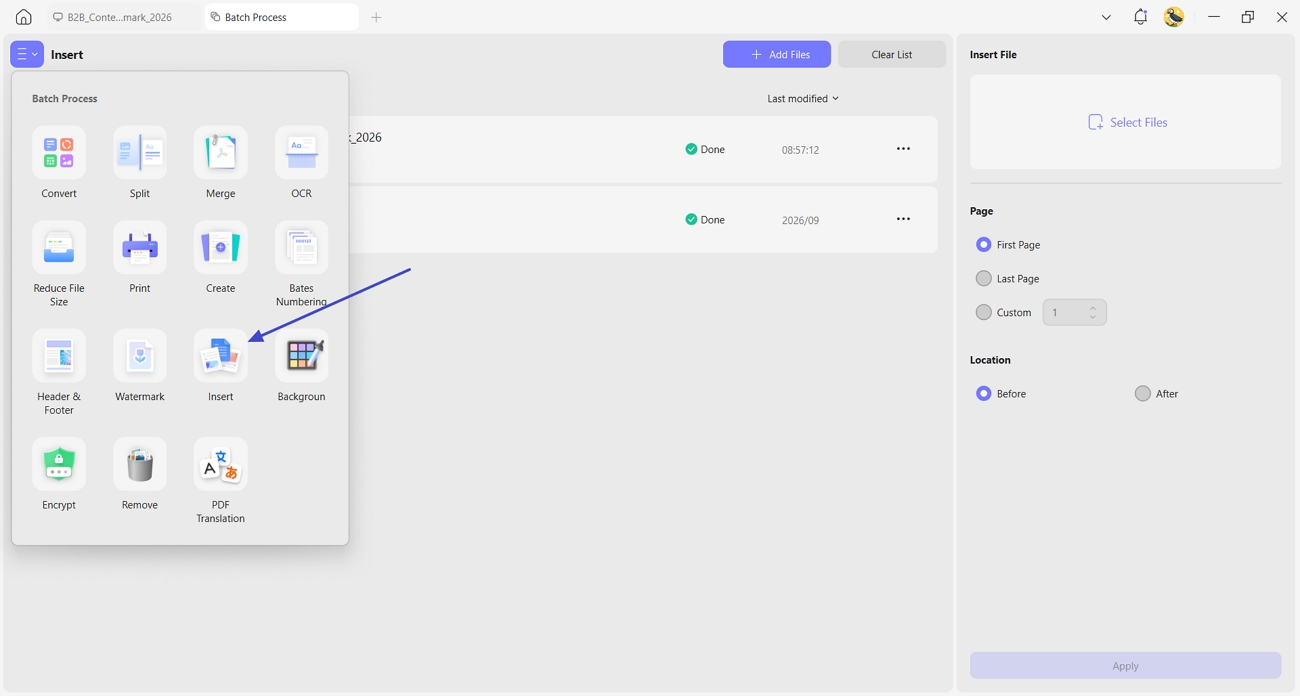
Step 2. Click “Add Files” to import the PDF files you want to process.
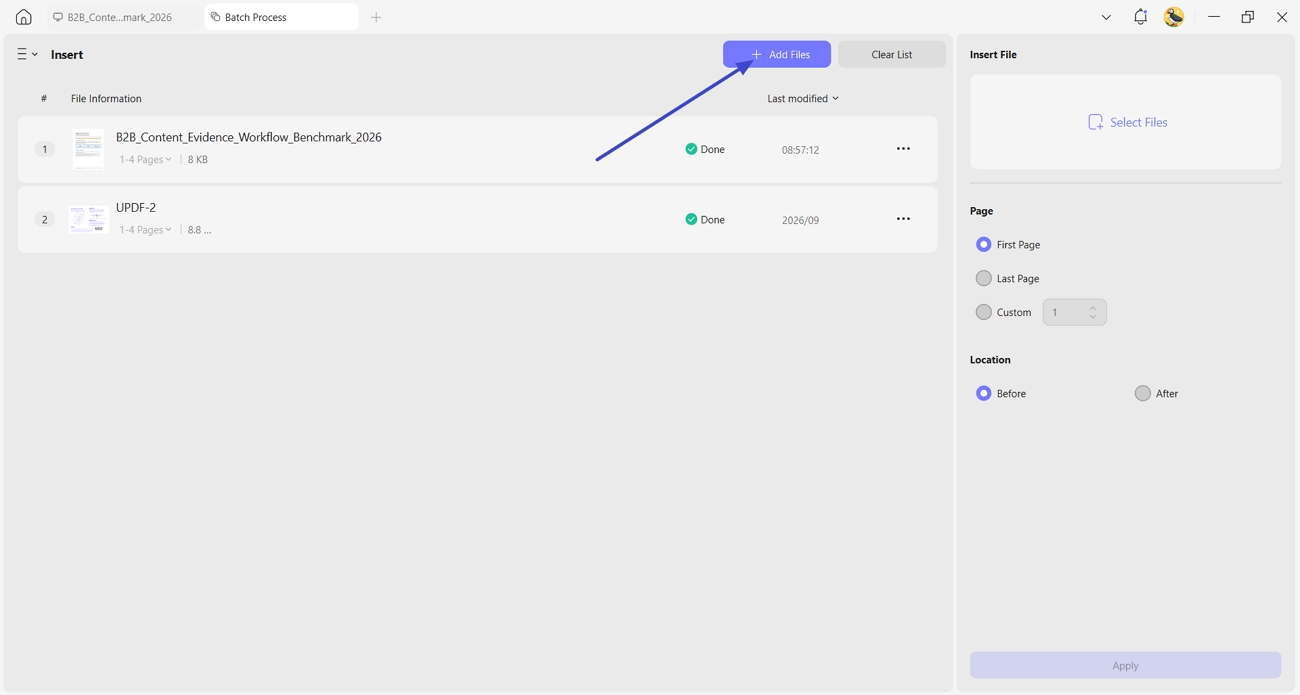
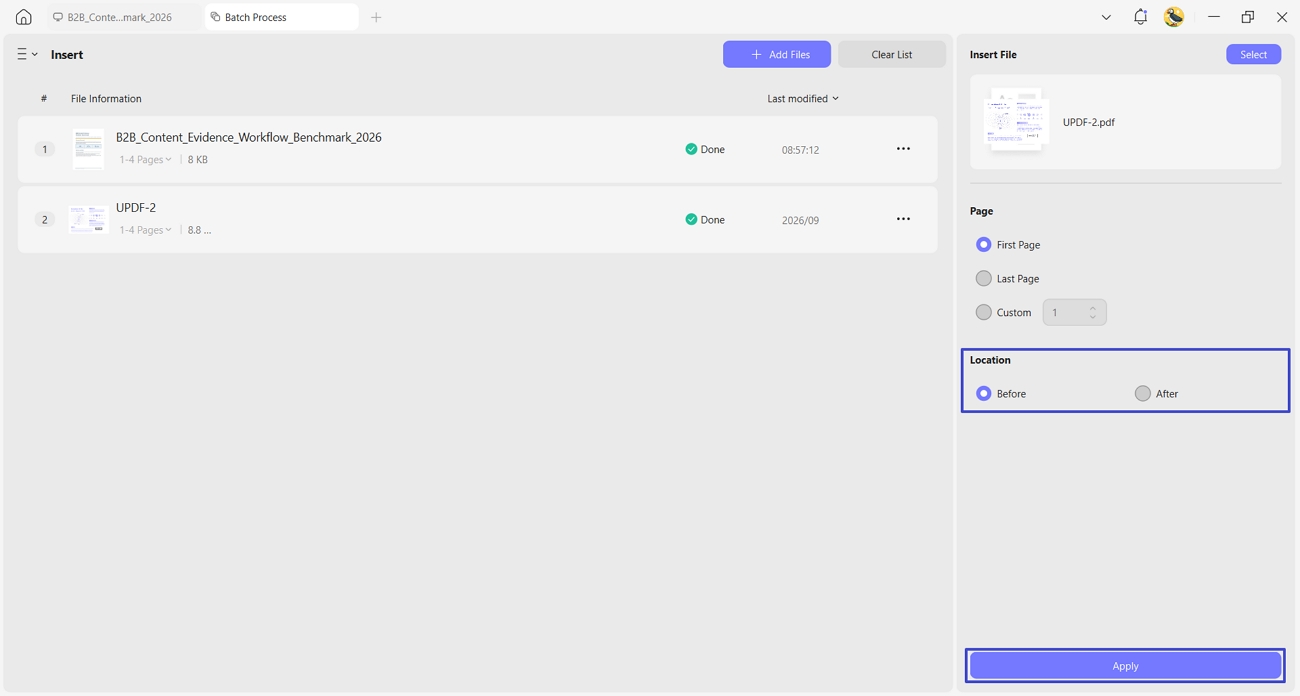
Step 3. Under the “Insert File” tab, browse and select the PDF file you want to insert into all imported documents. Then, choose the insertion position under “Location” and click “Apply”. Select a destination folder and click “Save” to save the updated files.
You can also use the “Insert Page” section to specify where the pages should be inserted. Available options include “First Page”, “Last Page”, and “Custom”, which allows you to enter specific page numbers manually.
Batch Print
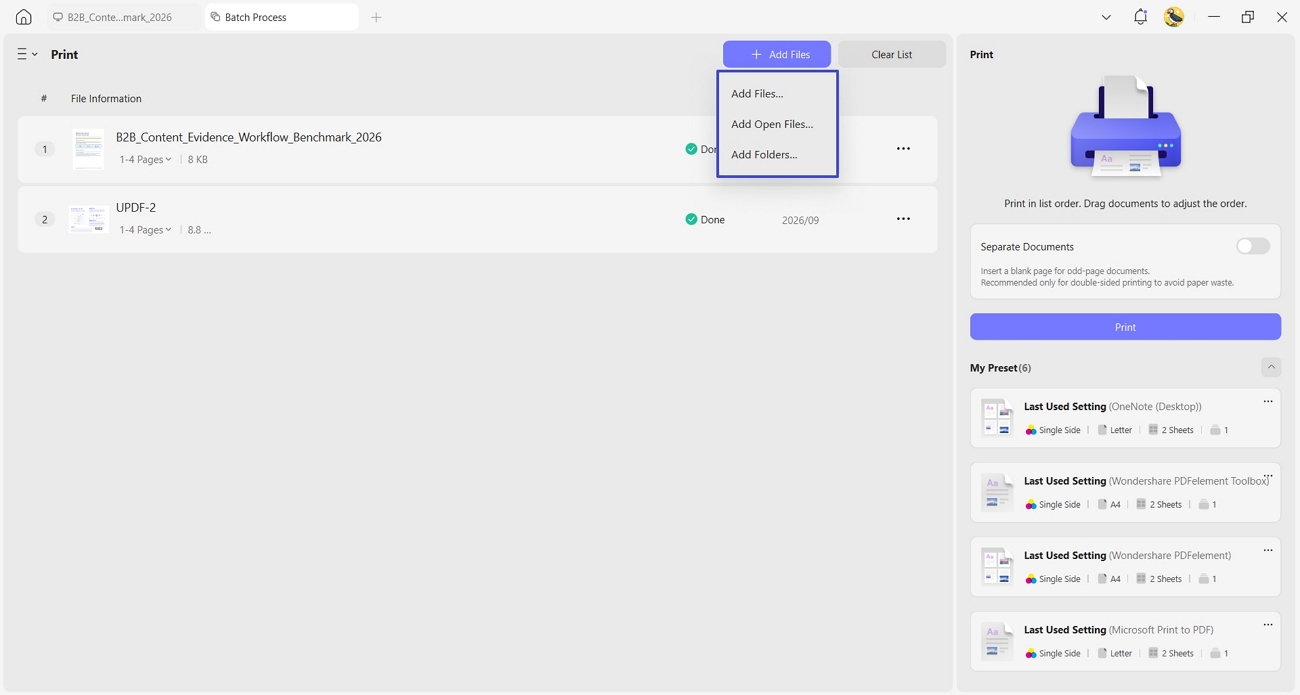
If you have a collection of PDF documents with you, UPDF offers a progressive tool in the form of batch printing. Click the Three Lines of Batch PDFs. Continue to select the “Print” option from the list to activate the “Batch Print” feature.
Step 1. Click the “Add Files” button to import the PDF documents you want to print. You can also click the arrow icon next to the button and select “Add Open Files” to include PDFs already open in UPDF. To import an entire folder, select “Add Folders.”
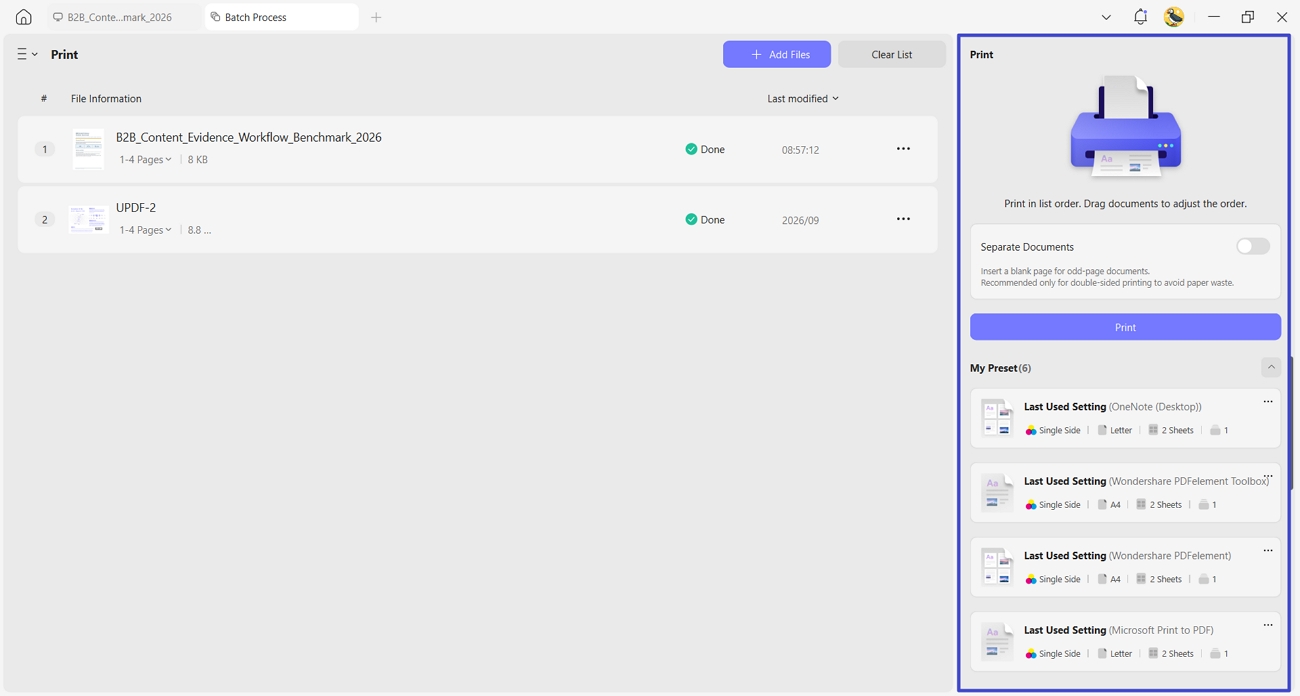
Step 2. Choose your preferred print preset from the available options, including “Fit to Page Size Printing,” “Multiple Pages Per Sheet,” “Print as A Poster,” and “Print as A Booklet.” Once you have configured the settings, click “Print” to start batch printing.
Batch Encrypt
For those who want to put an encryption or password on their PDF files to protect a complete set of documents, they can consider the batch encrypt option provided by UPDF. After opening the “Batch PDFs” from the “Tool” feature, click the Three Lines on the left side. Then, select the “Encrypt” option.
Step 1. Click the “Add Files” button to import the PDF documents you want to encrypt. You can also click the arrow icon next to the button and select “Add Open Files” to include PDFs already open in UPDF. To import an entire folder, select “Add Folders”.
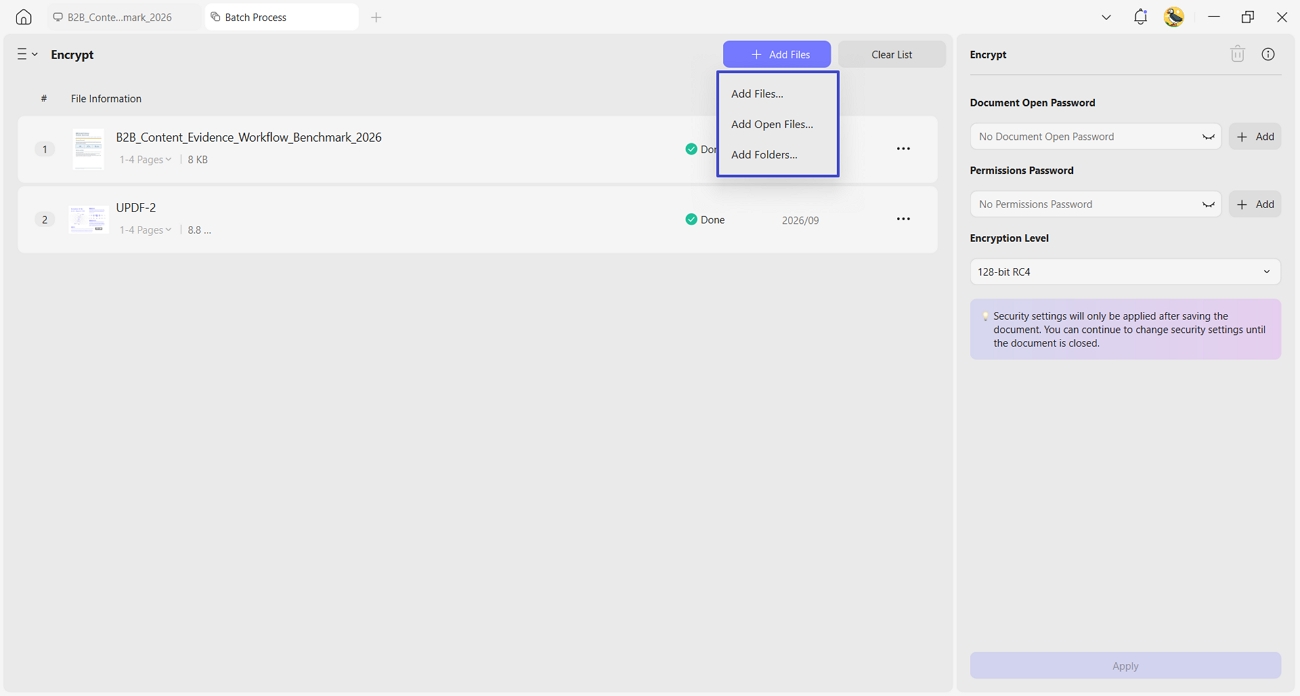
Step 2. Configure the encryption settings from the right panel using the following options:
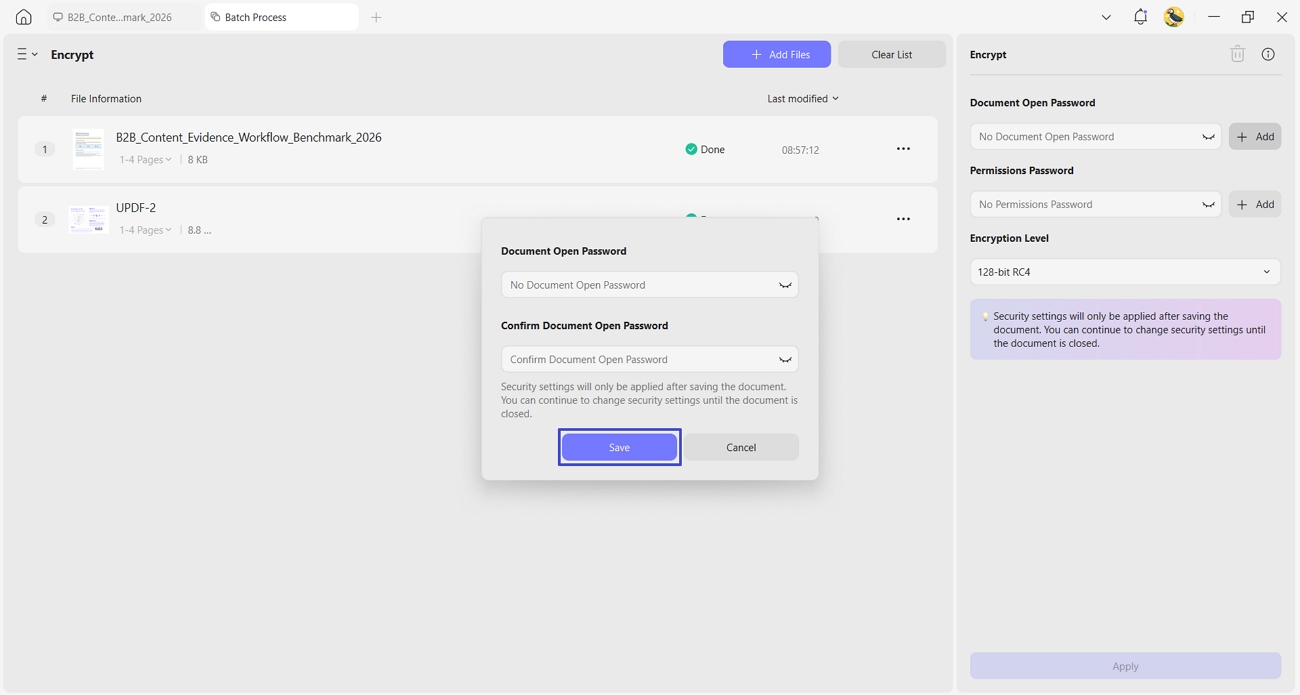
Set Open Passwords: Under “Document Open Password”, click “+Add” to set a password. In the pop-up window, enter your desired password in “New Open Password” and re-enter it in “Confirm Open Password”. Then, click “Save” to confirm.
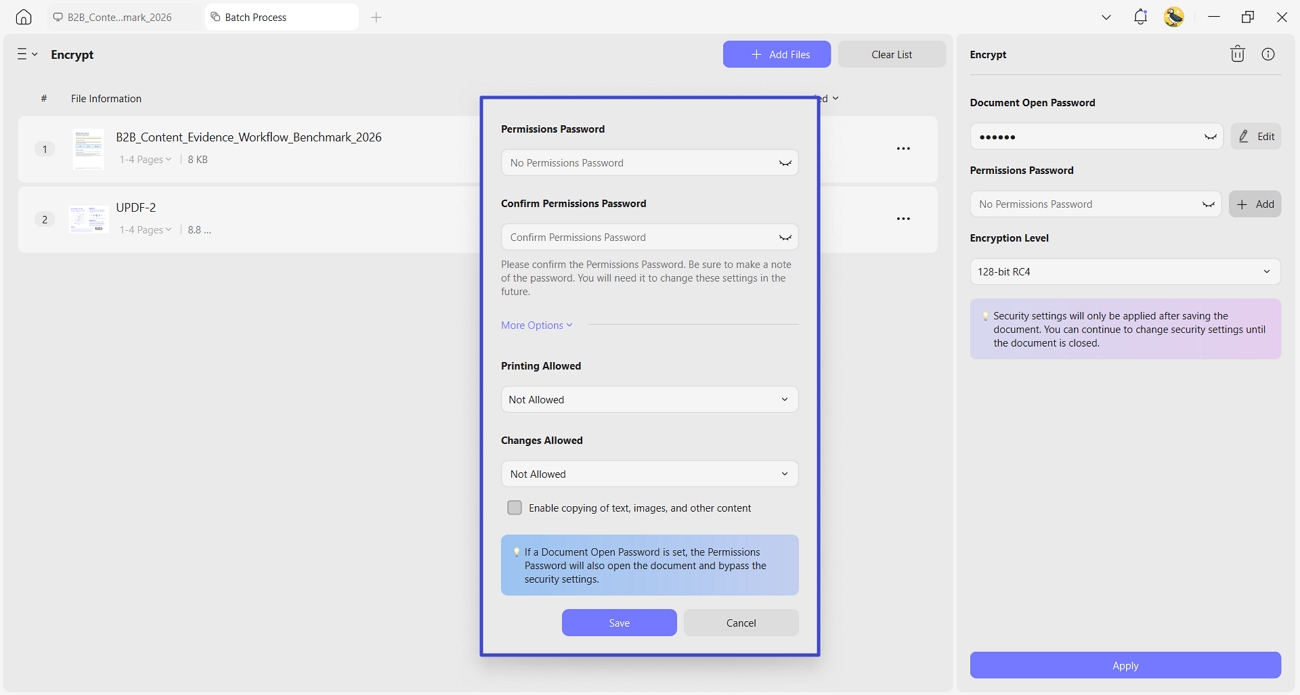
Set Permissions Passwords: Set a permissions password to restrict access to specific PDF functions. Enter your desired password and re-enter it in the “Confirmed Password” field for verification.
More Options: Expand “More Options” to manage document permissions. Use “Printing Allowed” and “Changes Allowed” to control whether users can print or modify the protected PDFs.
Enable Editing: You can also adjust the “Enable Copying of Text, Images, and Other Content” option to allow or restrict content copying. Once you have configured the permissions, click “Save” to apply the settings.
Bates Numbering
Have you received a task to add Bates numbers to multiple files and wondered how hectic it would be to deal with each manually? With UPDF, you can skip all the hassle of adding Bates numbering to multiple files simultaneously. Simply launch UPDF, hit the "Tools" option, and choose "Bates Numbering" in the Batch PDFs section. Hop on below to learn what you will have to do next:
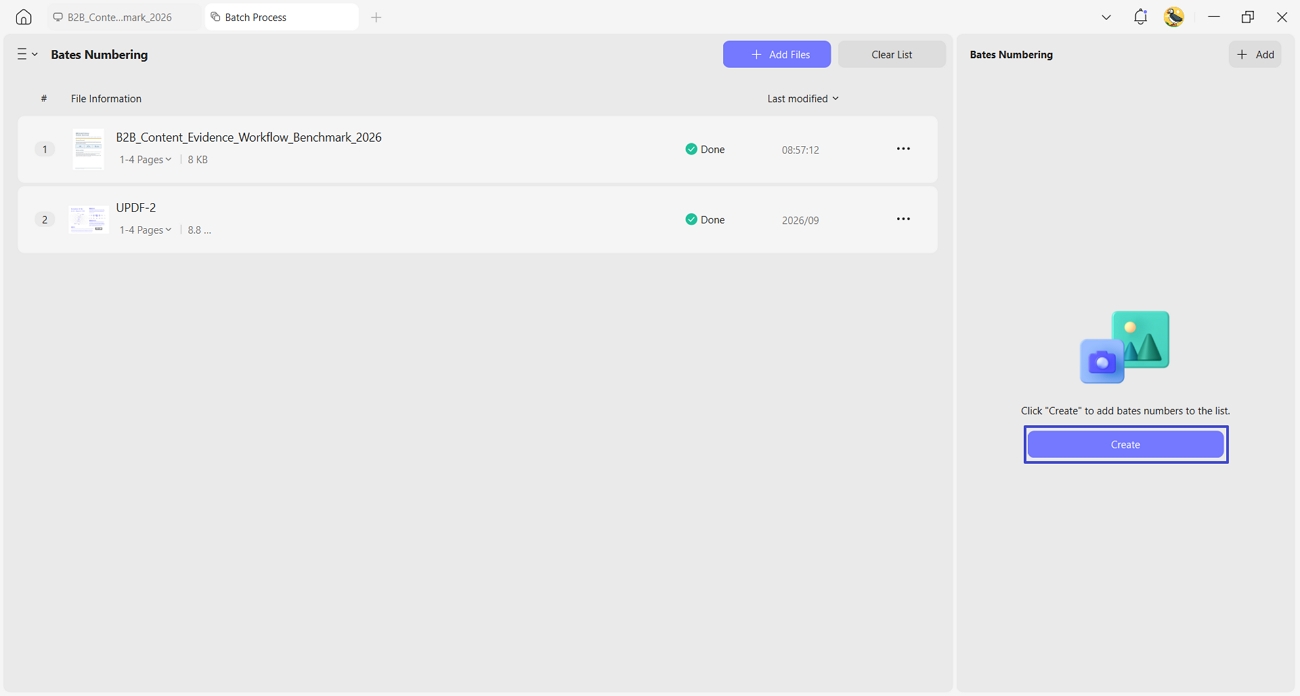
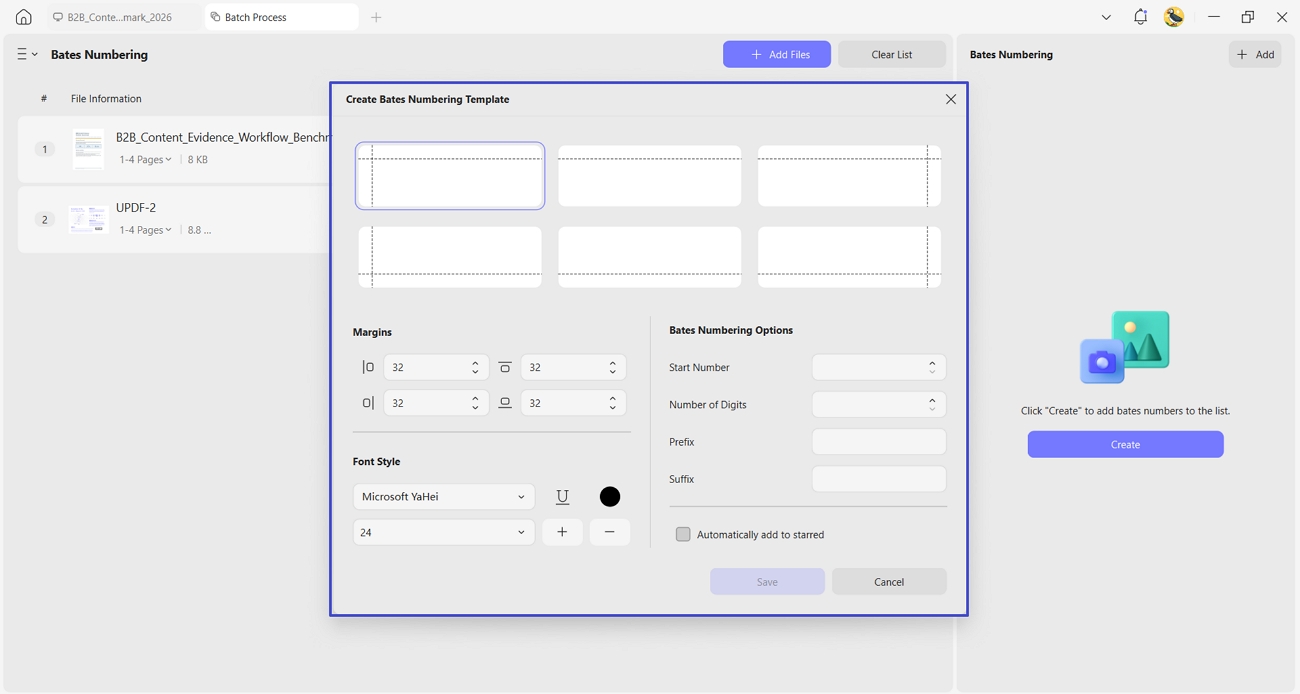
Step 1. Click “Add Files” to import the PDFs you want to number, then click “Create” on the right panel to customize the Bates numbering settings.
Create Bates Numbering Template: Choose from six available numbering templates.
Start Number Format: Enter the number from which you want to begin the Bates numbering sequence.
Number of Digits: Specify the number of digits to include in each Bates number.
Prefix and Suffix: Add custom text before or after the Bates numbers as needed.
Font Style: Choose your preferred font, text color, and formatting options.
Font Size: Adjust the font size using the available options or the “+” and “−” buttons.
Automatically Add to Starred: Enable this option to save the template for future use. Once you have configured the settings, click “Save” to confirm.
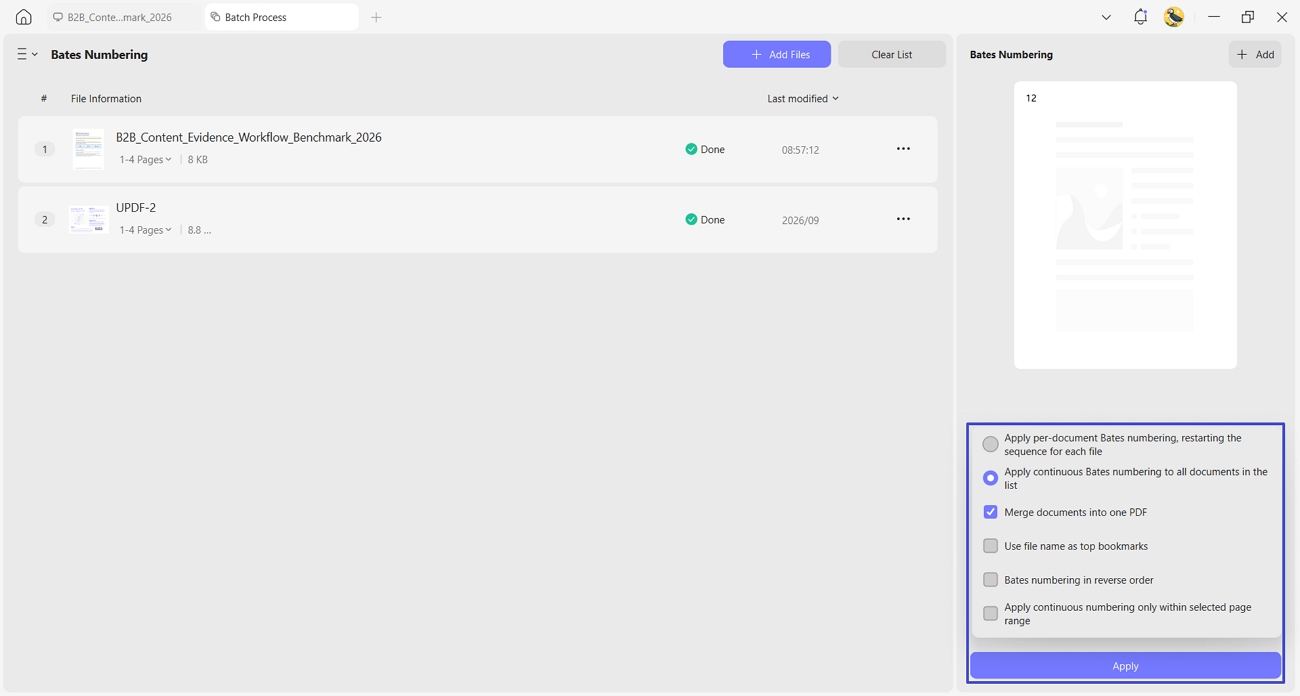
Step 2. Configure any additional options, such as “Successive addition of documents to the list” or “Merge documents into one PDF”, based on your requirements. You can also choose to restart Bates numbering for each file, use file names as top-level bookmarks, apply numbering in reverse order, or limit continuous numbering to a selected page range. Finally, click “Apply” to add Bates numbering to your PDF files.
Batch Create
UPDF for Windows also offers a Batch Create feature that allows you to create multiple PDF files at once. Follow the steps below to use this feature:
Step 1. Click “Add Files” to import files from your device, or drag and drop them into UPDF. You can also select “Add Folders” from the drop-down menu to import an entire folder. UPDF supports multiple file formats, including images, Word, Excel, PowerPoint, Visio, and CAJ files.
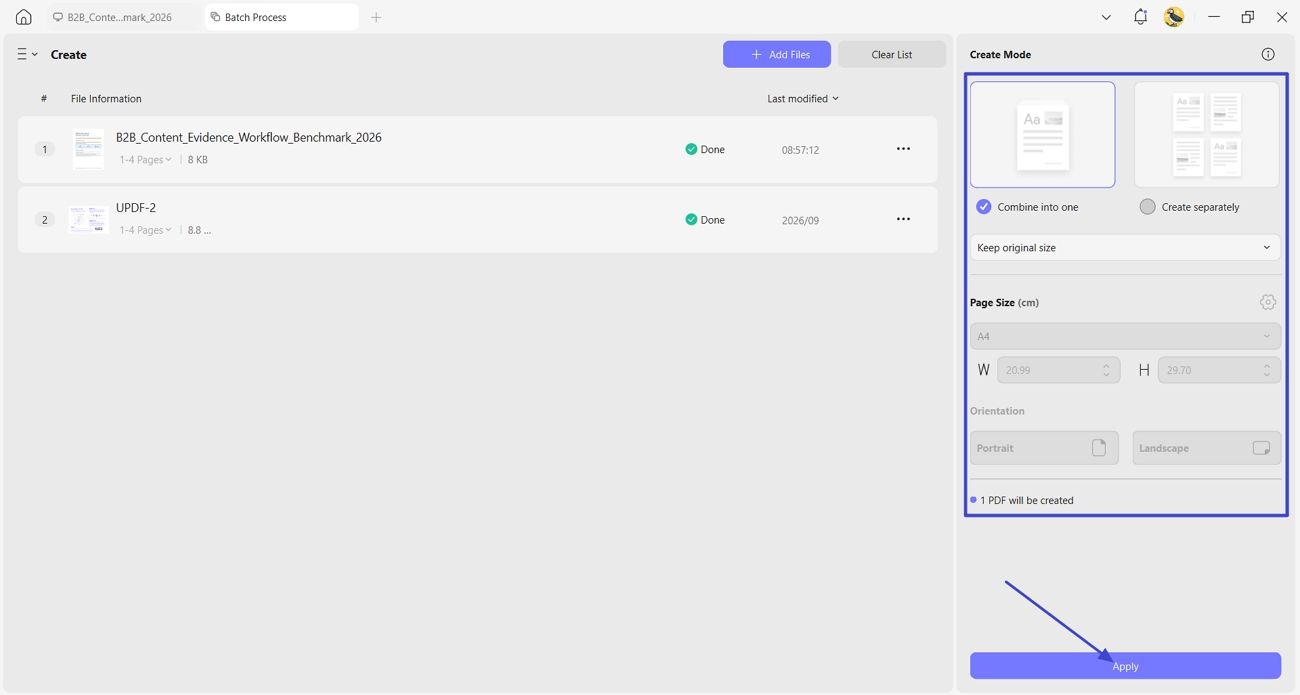
Step 2. Configure the PDF creation settings from the right panel. You can adjust the following options:
Create Mode: Select “As One PDF” to combine all files into a single PDF or “As Multiple PDFs” to create separate documents.
Sort Files: Arrange imported files using options such as “By File Size”.
Page Size: Keep the default A4 size or click the gear icon to customize it.
Dimensions: Adjust the “Width (W)” and “Height (H)” as needed.
Orientation: Choose “Portrait” or “Landscape” for your PDF pages.
Once you have configured the settings, click “Apply” and select a destination folder to save the PDFs. The created files will open in separate tabs in UPDF for further editing.
Batch Watermark
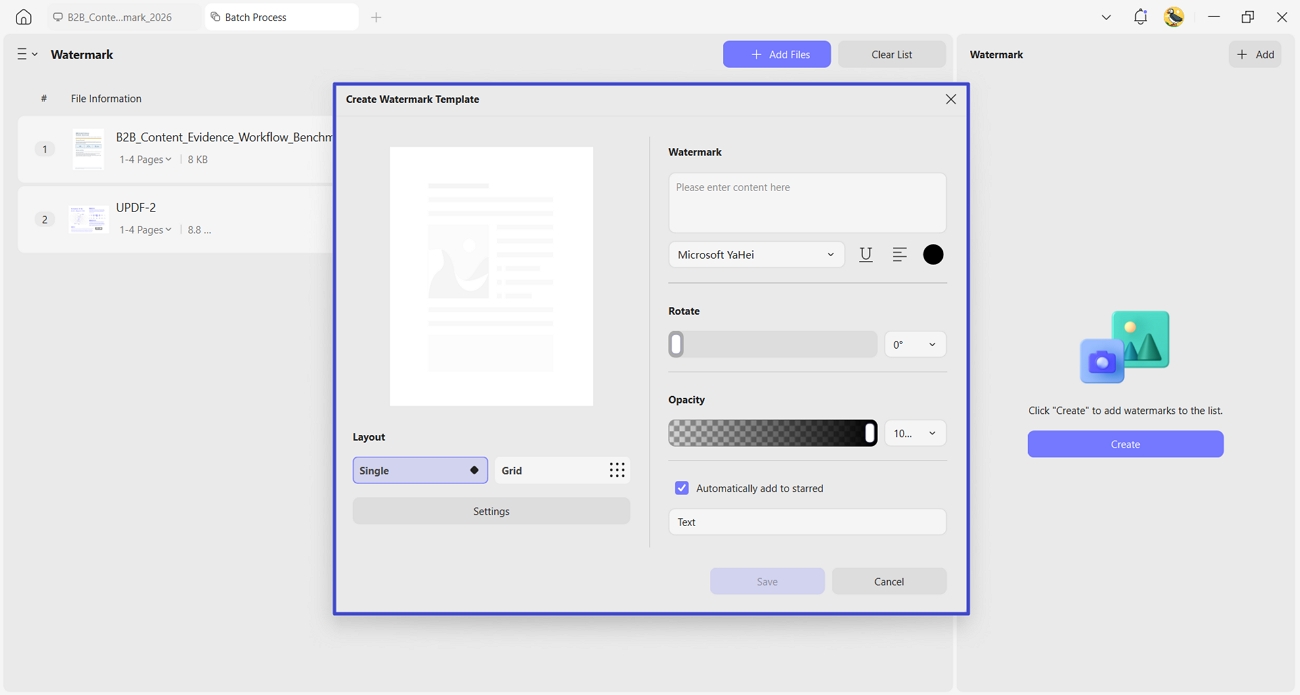
Want to add watermarks to multiple PDF files? You should download UPDF on your Windows and follow the guide below.
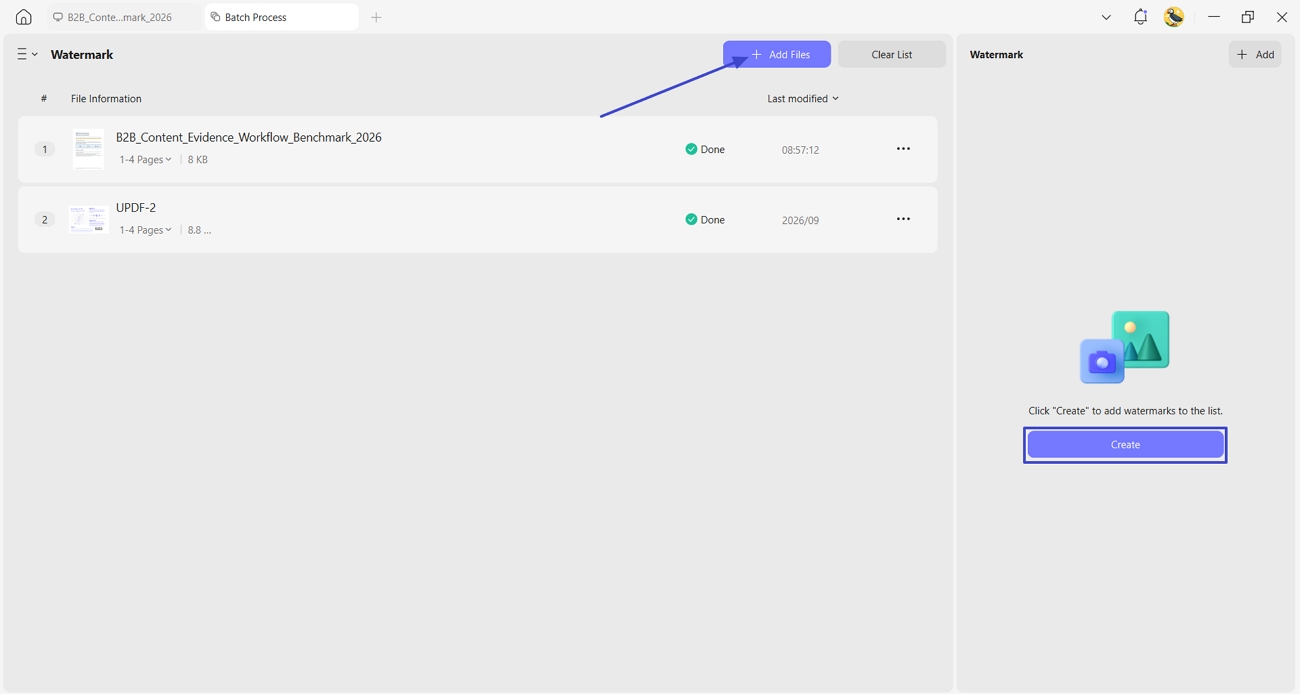
Step 1. Switch to “Watermark” here, click on the “Add File” to upload the PDF files, then, click on the “Create” and select “Text Watermark” or “File Watermark.”
Step 2. In the pop up window, enter the watermark, choose “Single” or “Grid” for the layout, make other settings like the text font, color, opacity, and more. Then, click on the “Save” and “Apply.”
Batch Header and Footer
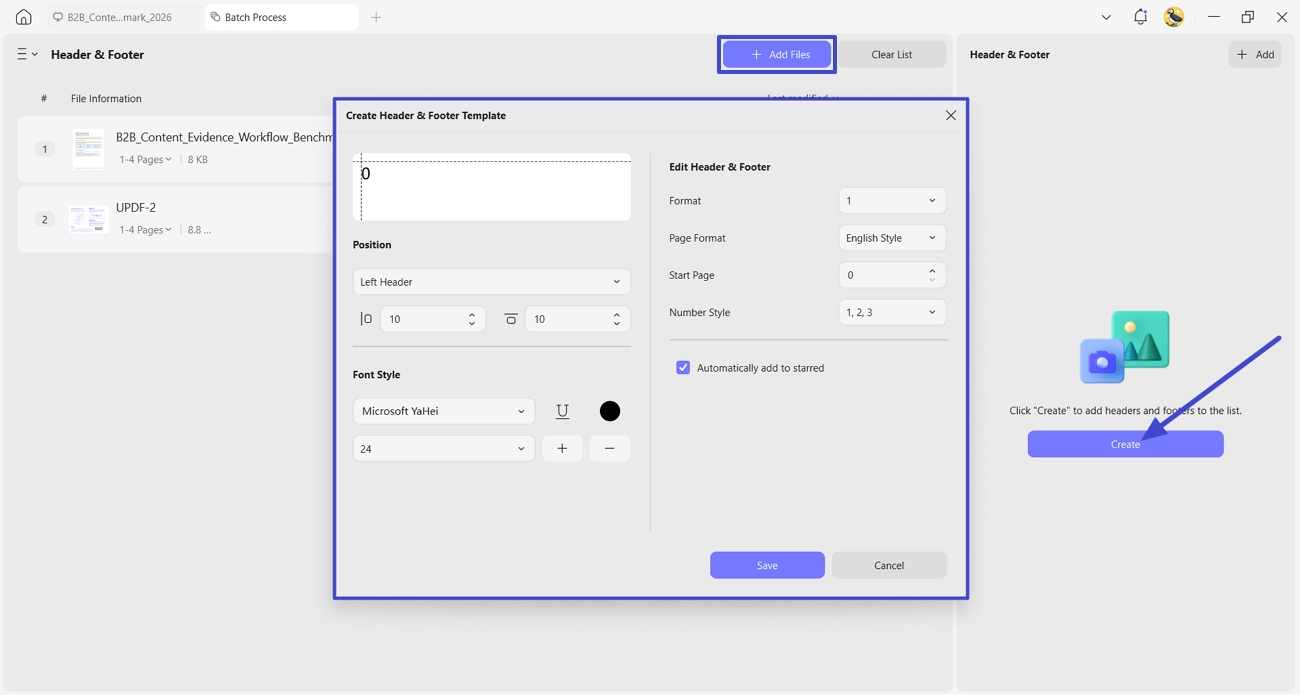
UPDF also allows you to add headers and footers to multiple PDF files at once. You can insert page numbers, text, dates, or images and customize their appearance. Look at these instructions below to complete the process:
Instructions. You can also add the header and footer to PDF files in batch. The guide is also simple. Just go to “Header and footer”, “Add File”, “Create”, select “Page Number”, “Text”, “Date”, or “Image”, then, customize the position, style, and format, click on the “Save” and “Apply.”
Batch Background
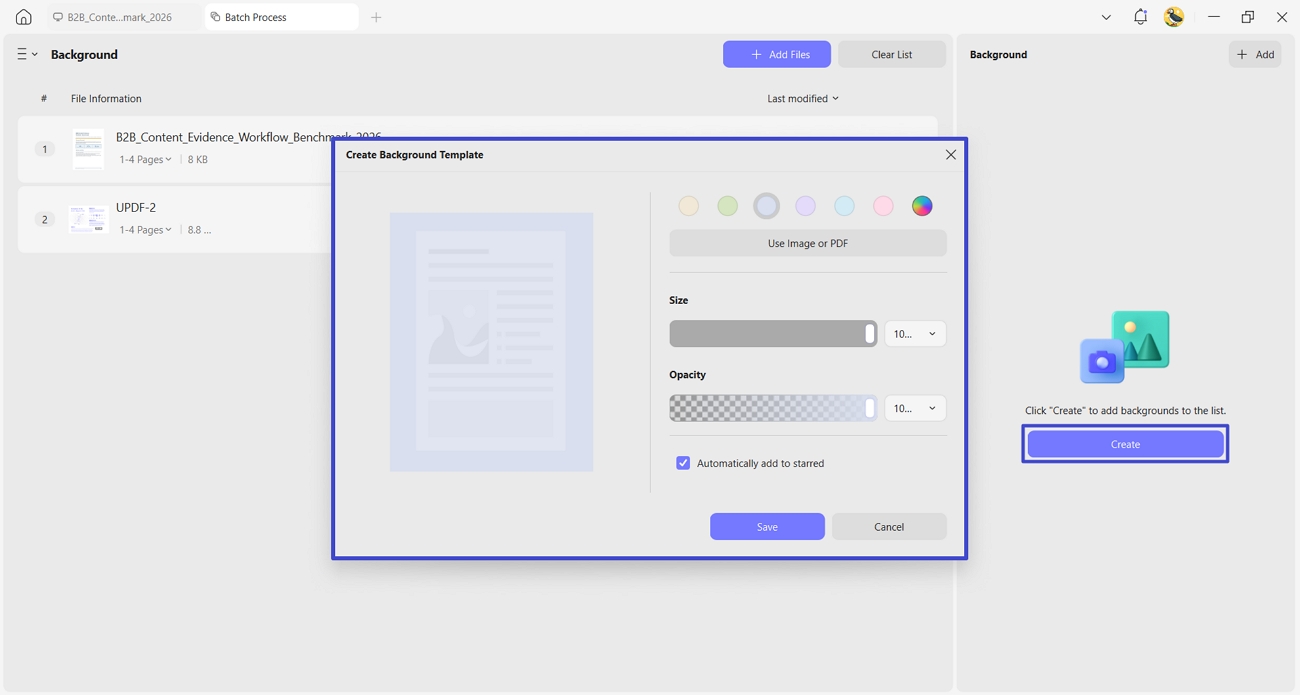
You can also add backgrounds to multiple PDF files at once using UPDF’s Batch Background feature.
Instructions. To add background to different PDF files, you need to go to “Background”, “Add Files”, “Create”, customize the background by changing its size, opacity, and more, click on the “Save” and “Apply.”
Batch Remove
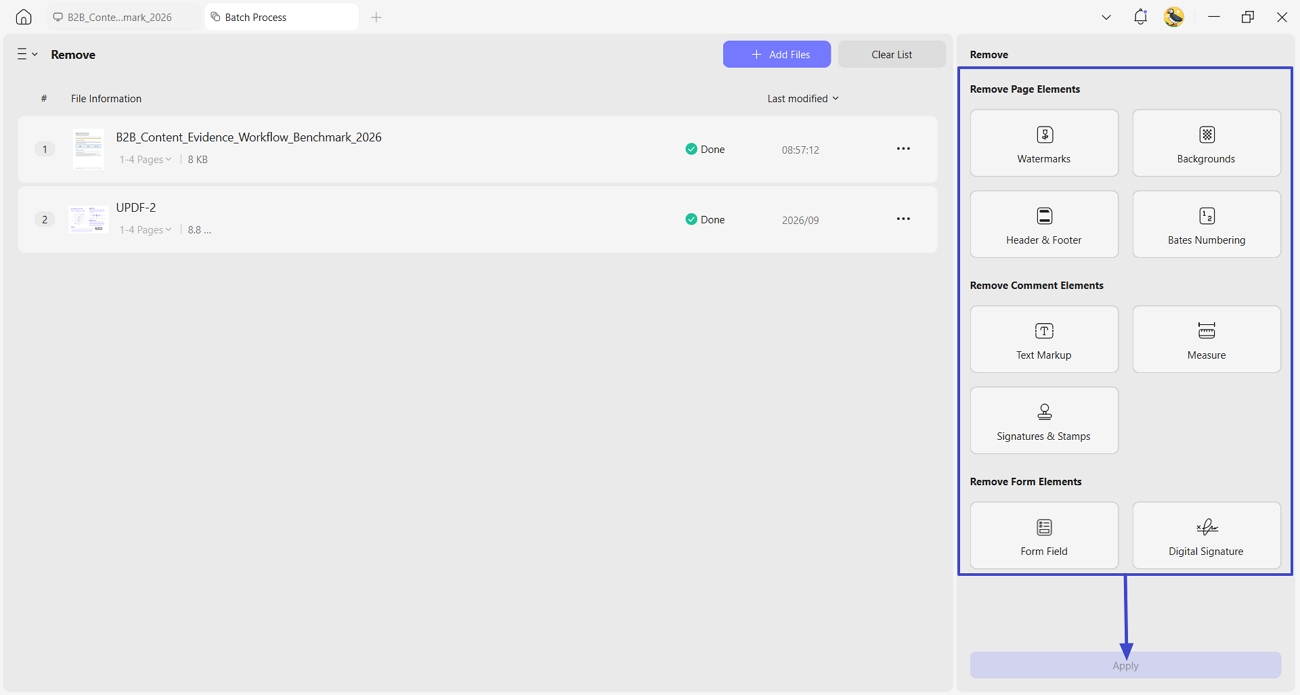
With UPDF on Windows, you can also batch remove all the watermarks, backgrounds, headers and footers, Bates number, text markup, measurements, signatures and stamps, form field, and digital signatures.
Instructions. Click on “Remove,” then click “Add File” to upload the files you need, select the elements that you want to remove, and click on “Apply” to remove them all.
PDF Translation
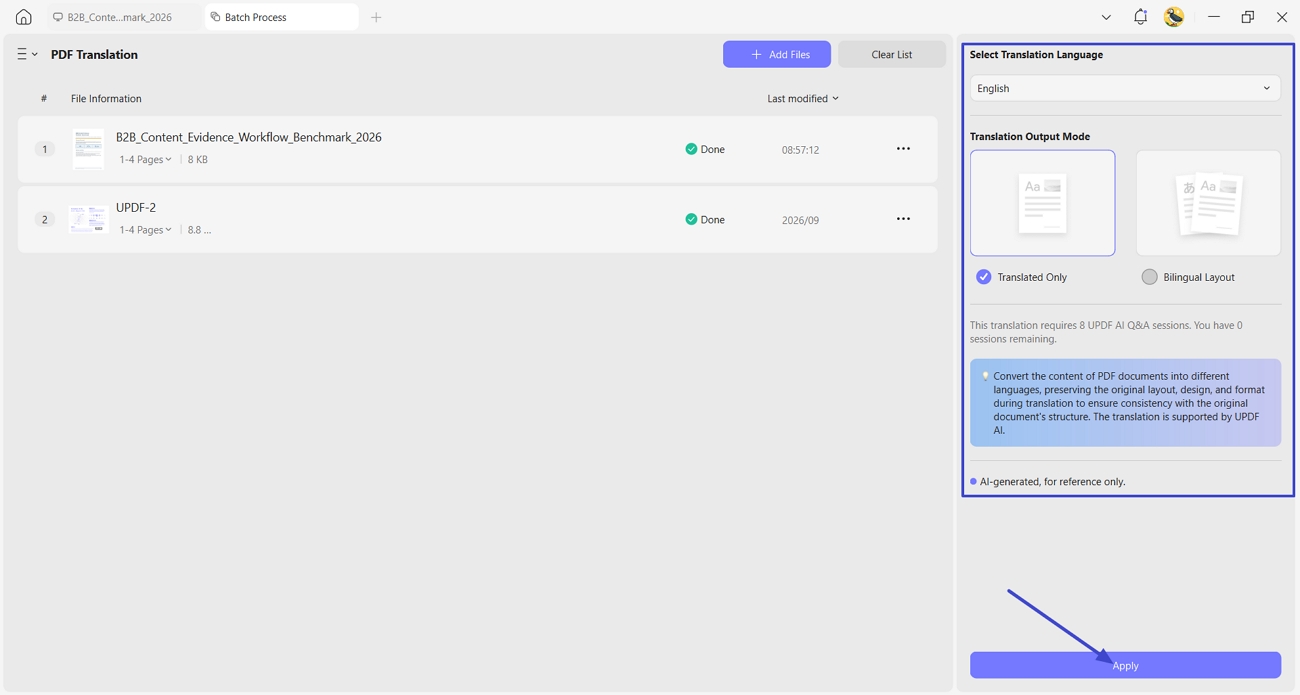
UPDF also allows you to translate PDF files into 15 languages using its PDF Translation feature. You can choose between two modes: “Translated Only” to view the translated content or “Bilingual Layout” to display the original and translated text together. Follow the instructions below to translate your PDFs:
Instructions. Once you add your PDF, choose the “Language” from the right-side panel and pick a “Translation Output Mode.” Then, press the “Apply” button and select a location to save your PDF.