 UPDF
UPDF
 UPDF for Windows
 UPDF for Mac
 UPDF for iPhone/iPad
 UPDF for Android
 Nomostar
 UPDF AI Online
 UPDF Sign
 IvyCraft
 Edit PDF
 Annotate PDF
 Create PDF
 PDF Form
 Edit links
 Convert PDF
 OCR
OCR PDF to Word
 PDF to Image
 PDF to Excel
 Organize PDF
 Merge PDF
 Split PDF
 Crop PDF
 Rotate PDF
 Protect PDF
 Sign PDF
 Redact PDF
 Sanitize PDF
 Remove Security
 Read PDF
 UPDF Cloud
 Compress PDF
 Print PDF
 Batch Process
 About UPDF AI
 UPDF AI Solutions
 AI User Guide
 FAQ about UPDF AI
 Summarize PDF
 Translate PDF
 Chat with PDF
 Chat with AI
 Chat with image
 PDF to Mind Map
 Explain PDF
 PDF AI Tools
 Image AI Tools
 AI Chat Tools
 AI Writing Tools
 AI Study Tools
 AI Working Tools
 Other AI Tools
 AI Bookmark Generation
 AI Bookmark Summary
 AI Watermark Generation
 AI Background Generation
 AI Sticker Generation
 AI Stamp Generation
 AI Editing Suite
 UPDF Copilot
 AI Page Management
 AI Semantic Search
 PDF to Word
 PDF to Excel
 PDF to PowerPoint
 Enterprise Solution
 Enterprise Sign
 Enterprise AI
 Enterprise Plan
 Enterprise User Guide
 Enterprise Webinar
 IT
IT Education
 Construction
 Financial Service
 Healthcare
 Insurance
 Legal
Legal Manufacturing
 Government
 Researchers & PhDs
 Solopreneurs & Freelancers
 Lawyers & Legal Professionals
 Real Estate Agents & Brokers
 Education Solution
 Customer Stories
 User Guide
 UPDF Tricks
 FAQs
FAQs UPDF Reviews
 Download Center
 Blog
Blog Newsroom
 Tech Spec
 Updates
 UPDF vs. Adobe Acrobat
 UPDF vs. Foxit
 UPDF vs. PDF Expert

Quick answer:
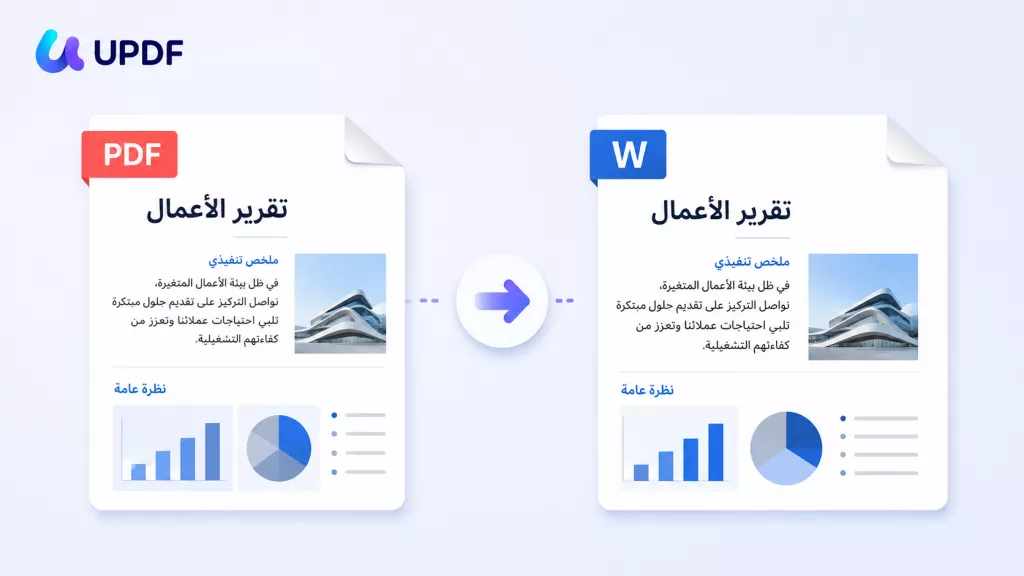
Arabic PDFs fail in ways English files usually do not. Arabic runs right to left, its letters change shape depending on where they sit in a word, and mixed Arabic-English lines can move numbers, URLs, or names to the wrong side after export. For example, when a bilingual invoice has an Arabic company name beside an English tax ID, check both strings and their order in the exported Word file. If you only need to correct one word in the original PDF, edit selectable Arabic PDF text directly instead of converting the whole file.
This guide covers three practical methods: desktop conversion on Windows and Mac, mobile conversion on iPhone, iPad, and Android, and UPDF's online PDF to Word converter. Batch conversion is included under the desktop workflow because it uses the same conversion logic. For non-Arabic conversion tasks, use the broader Convert PDF pillar guide.
Part 1. Which Arabic PDF to Word Method Should You Use?
| Your Arabic file | Use this method | Best for |
|---|---|---|
| Digital PDF with selectable Arabic text | Method 1: Desktop conversion | Contracts, invoices, reports, forms, and files that need layout review on a larger screen. |
| Many Arabic PDFs with similar layouts | Method 1 batch conversion | Monthly files, folders of reports, course handouts, or invoice packets. |
| You are away from your computer | Method 2: Mobile conversion | Quick single-file conversion on iPhone, iPad, or Android. |
| You need a quick browser-based conversion | Method 3: UPDF Online PDF to Word | Non-sensitive, selectable Arabic PDFs when you do not want to install software. |
Part 2. Method 1: Convert Arabic PDF to Word on Windows and Mac
This is the strongest route when you can work on a computer. UPDF's desktop converter gives you page-range control, Word output settings, and a larger screen for checking right-to-left layout after export.
Best for:
- electable Arabic PDFs where layout, tables, Arabic shaping, and mixed-language lines matter.
Not for:
- image-only scanned Arabic pages where dragging across the page highlights no text.
Step 1. Open the Arabic PDF in UPDF. If you do not have it installed yet, download UPDF for free and open the file on your Windows PC or Mac.
Windows • macOS • iOS • Android 100% secure
Step 2. Click Tools and choose Word under the conversion options.
Step 3. In the PDF Converter window, choose Word (.docx) as the output format. Keep a layout-preserving Word content style, such as Retain Word Flowing Style, when you want the Word file to remain editable while staying close to the original PDF layout.
Step 4. Choose the page range. For a long Arabic file, test 2-3 pages first, especially if the PDF contains tables, footnotes, stamps, or mixed Arabic-English text.
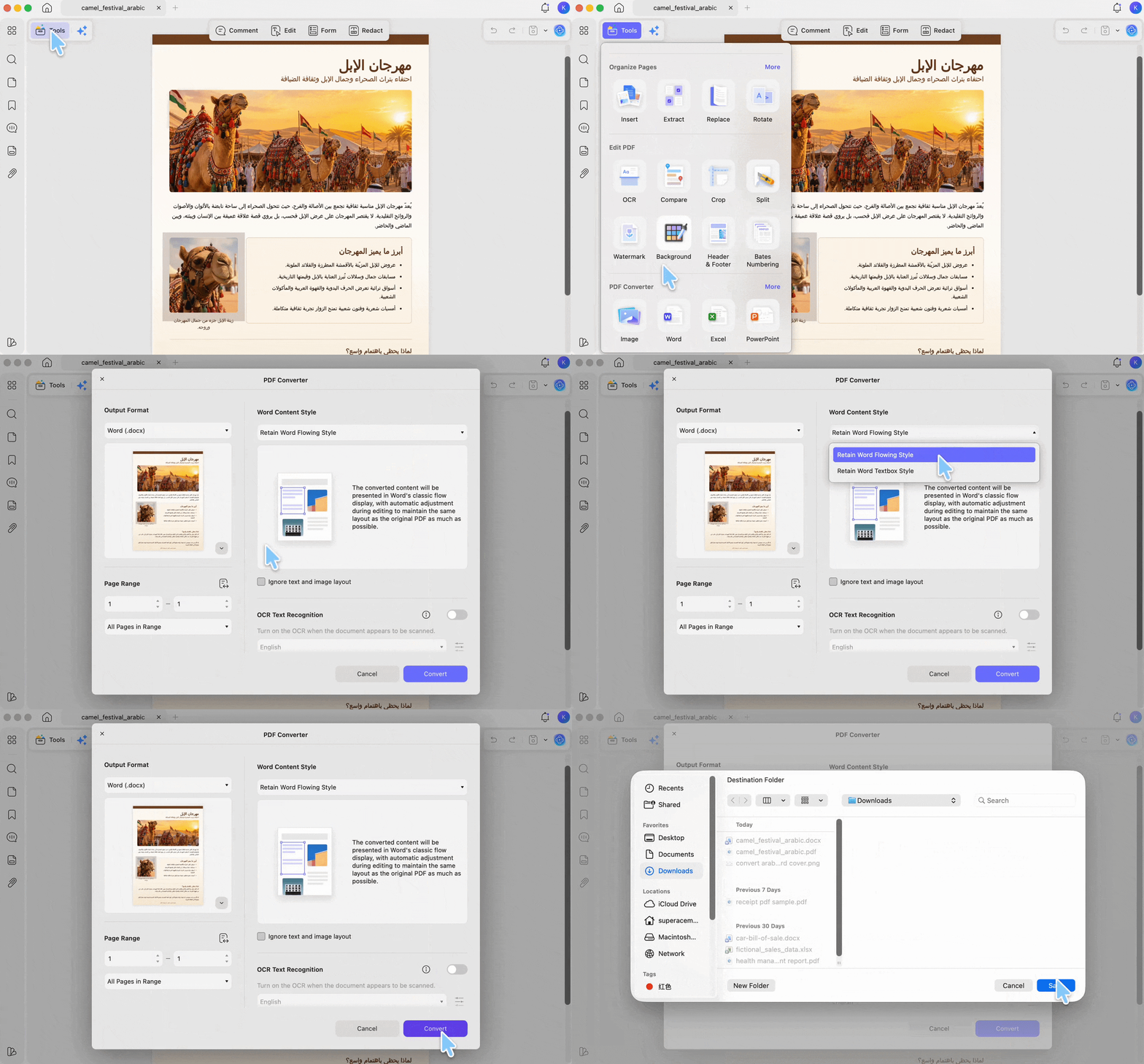
Step 5. Click Convert, choose a folder, and save the Word file.
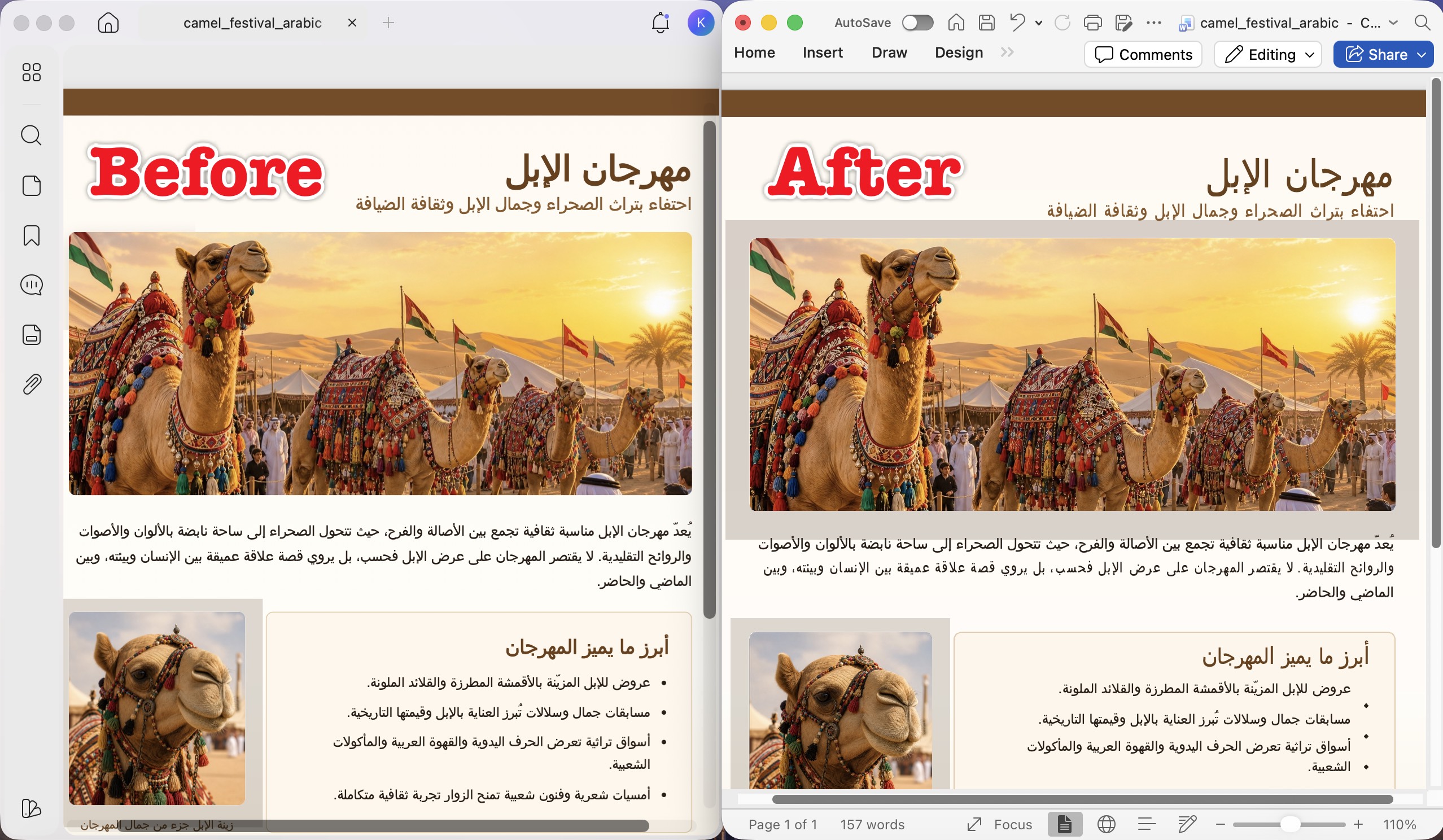
Step 6. Open the .docx file in Microsoft Word and inspect the fragile parts: right-to-left paragraphs, table columns, Arabic numerals, page numbers, diacritics, and mixed Arabic-English lines.
If a paragraph looks left-aligned after export, select it in Word and set the paragraph direction to right-to-left. That is a Word display/editing correction, not necessarily a failed PDF conversion.
How to Batch Convert Arabic PDFs to Word
Batch conversion is useful when an Arabic PDF-to-Word task involves folders of invoices, reports, or course packets. It stays under the desktop method because it is the same Word export applied to multiple files.
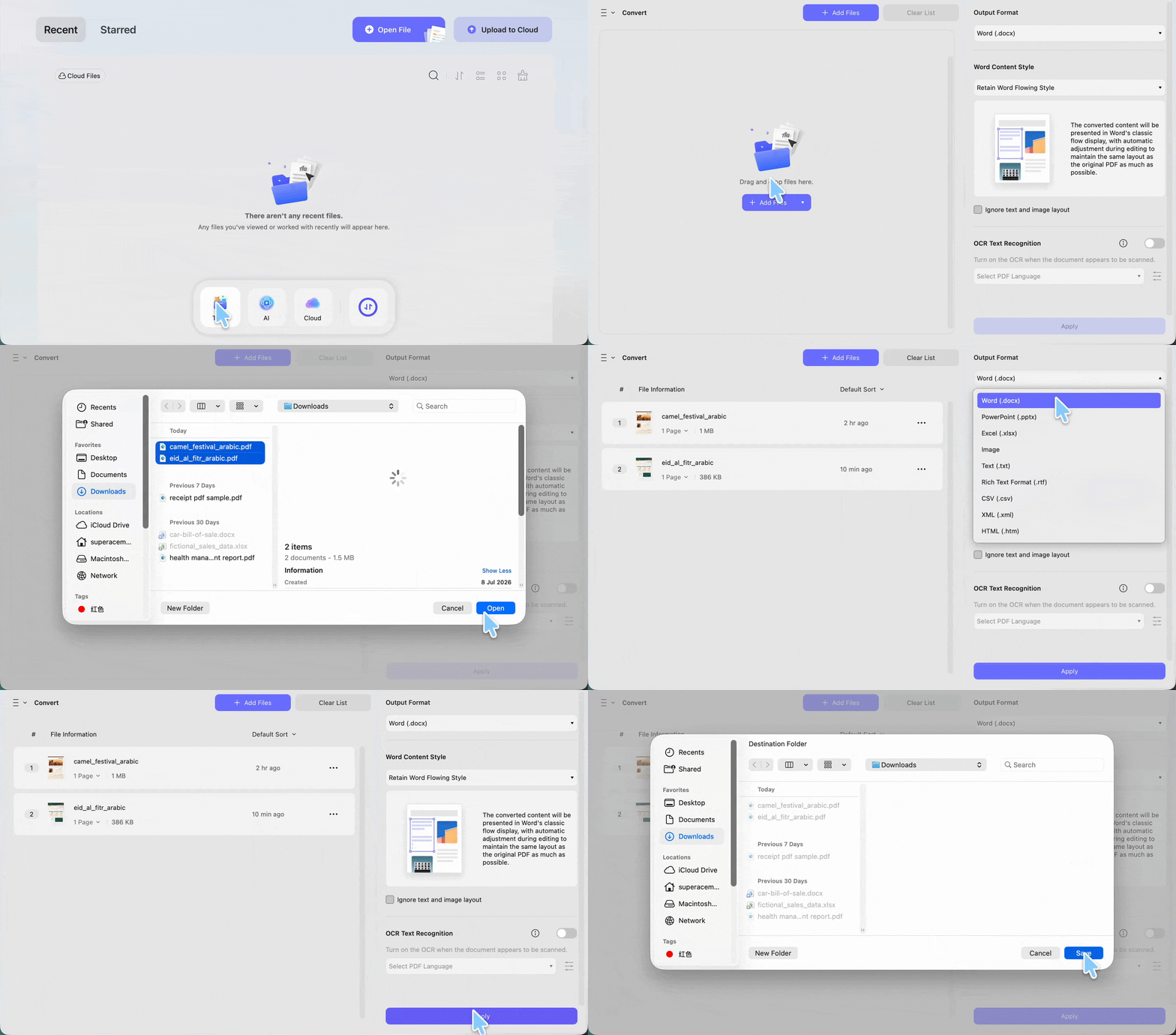
Step 1. Open UPDF on Windows or Mac.
Step 2. From the home interface, go to Tools and select Convert, then add the Arabic PDF files.
Step 3. Choose Word as the output format.
Step 4. Click Apply and choose the output folder.
The broader how to convert PDF guide is useful if some files should go to Word while others should go to Excel, image, HTML, or text.
Video guide on How to Convert PDF into multiple different format
Download UPDF for free to try converting an Arabic PDF to Word on your file, installation is free, and Pro features are available when you need watermark-free export or advanced tools
Windows • macOS • iOS • Android 100% secure
Part 3. Method 2: Convert Arabic PDF to Word on iPhone, iPad, and Android
Mobile conversion is best when an Arabic PDF reaches you by email, chat, or cloud storage and you need a Word version quickly. Use it for clean, selectable PDFs rather than complex scanned archives.
Best for:
- quick single-file conversion, reviewing an Arabic PDF on the go, or sending an editable Word version from your phone.
Not for:
- heavy batch jobs, image-only scans, or detailed layout repair; use desktop for those.
On iPhone, iPad, and Android
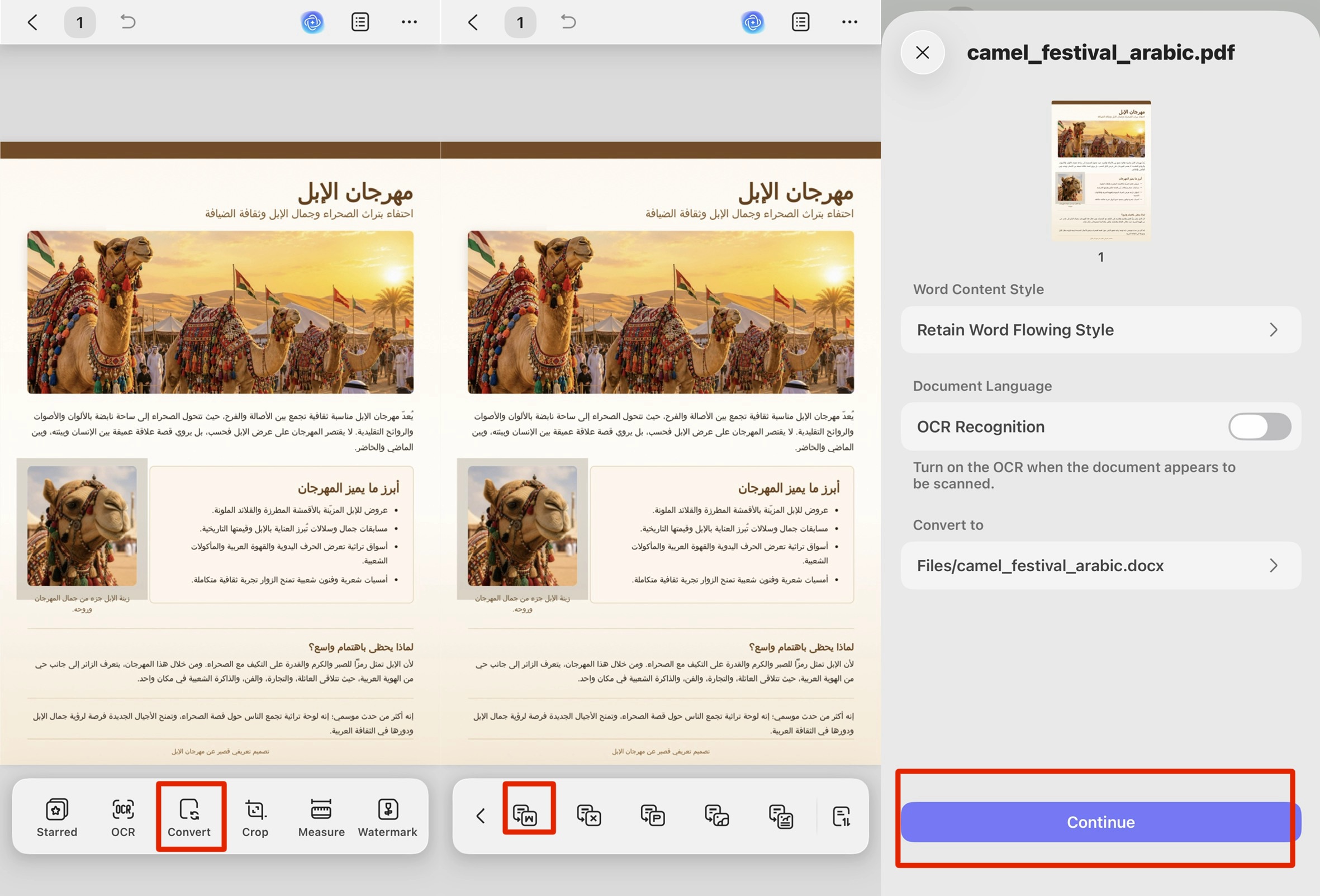
Step 1. Open UPDF on your iPhone, iPad, or Android device and tap the + button to import the Arabic PDF.
Step 2. Open the file and tap the conversion tool.
Step 3. Choose Word as the target format.
Step 4. Continue the conversion, then save or share the Word file.
Step 5. Open the converted file and check whether Arabic paragraphs, table cells, numbers, and mixed-language lines read in the correct order.
Part 4. Method 3: Convert Arabic PDF to Word Online with UPDF
UPDF also provides an online PDF to Word converter at UPDF Online PDF to Word. Use this method when you need a quick browser-based conversion and the file is not confidential.
Best for:
- simple, selectable Arabic PDFs that are not sensitive and do not require batch proofing on your desktop.
Not for:
- contracts, IDs, invoices, internal reports, password-protected PDFs, or files where you cannot upload the document to a server.
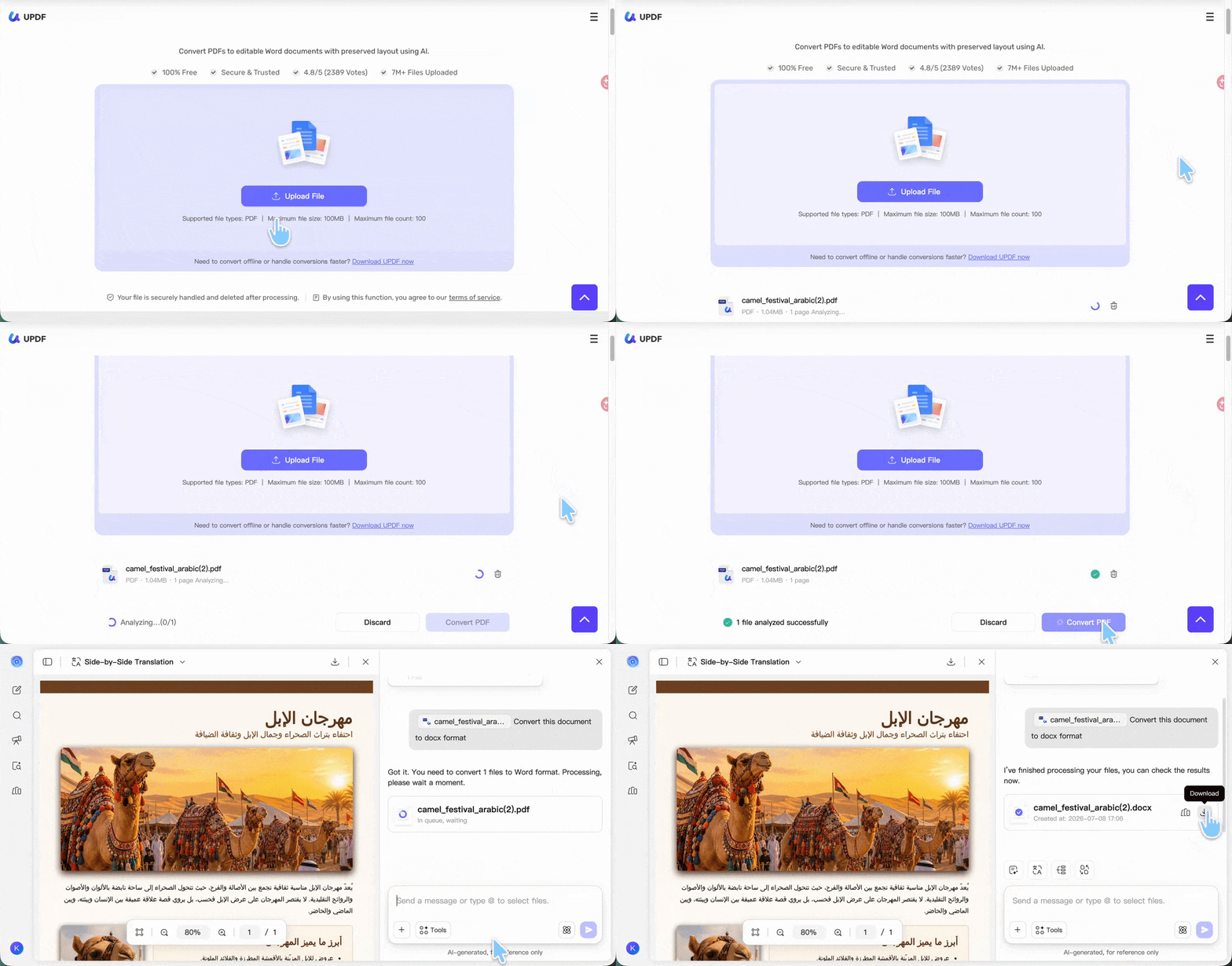
Step 1. Open the UPDF Online PDF to Word page in your browser or click the button below to access.
Step 2. Click Upload File or drag your Arabic PDF into the online converter.
Step 3. Click Convert PDF and wait for the conversion to finish, then click Download to save the Word file.
UPDF's online page states that uploaded files are processed on a server and deleted after conversion. That can be convenient for ordinary files, but offline desktop conversion is still the safer default for legal, financial, identity, or internal Arabic documents. The same page lists online limits: Free users get 10MB per PDF and 100 pages per PDF, while paid users get 100MB per PDF and 300 pages per PDF; online batch conversion supports up to 100 PDFs.
Part 5. Comparison: Which Route Is Best?
| Route | Platform | Best when | Main risk |
|---|---|---|---|
| Desktop conversion | Windows, Mac | You need the most control over layout and proofing | Word may still need RTL paragraph cleanup. |
| Desktop batch conversion | Windows, Mac | You have many similar Arabic PDFs | Mixed source types can create inconsistent results. |
| Mobile conversion | iOS, Android | You need a quick Word file away from your desk | Complex layout is harder to inspect on a small screen. |
| Online browser converters | Web | You need a quick conversion without installing software | File upload, size/page limits, and privacy concerns for sensitive files. |
Part 6. Edge Cases When Converting Arabic PDF to Word
"I converted the file, but the Arabic text is still not editable."
Underlying mechanism: the page may be image-only, so the PDF does not contain Arabic text that a normal Word export can carry over. Use a source file with selectable Arabic text when possible, or recreate the document from a cleaner source before expecting editable Word paragraphs.
"The Arabic sentence is readable, but numbers and English words jump to the wrong side."
Underlying mechanism: Arabic is right-to-left, while English words, URLs, and many numbers are left-to-right. Word has to resolve both directions inside one paragraph. After conversion, select the affected paragraph in Word, set the paragraph direction to right-to-left, and manually check mixed strings such as dates, invoice numbers, emails, and URLs.
"The Word file opens, but the Arabic font looks different from the PDF."
Underlying mechanism: PDF files can embed fonts that Word may not have installed. If Word substitutes a different font, line breaks and spacing can change. Install the needed Arabic font if you have the rights to use it, or choose a compatible Arabic font in Word and recheck the layout.
Part 7. FAQs About Converting Arabic PDF to Word
1. Can I convert an Arabic PDF to Word online for free?
Yes. UPDF Online converts native Arabic PDFs free, no signup — up to 10 MB / 100 pages, 2 tasks per day.
2. Does Adobe Acrobat convert Arabic PDF to Word?
Yes. Adobe Acrobat can export PDFs to Word, and Adobe's pricing page lists Acrobat Pro at US$19.99/month on an annual billed-monthly plan. If you only need occasional Arabic PDF-to-Word conversion, compare the cost, workflow, and RTL output before committing.
3. Why do Arabic letters look disconnected after conversion?
The source PDF may not store Arabic as clean text, or Word may substitute fonts and reshape the line differently. Try the desktop converter, keep a layout-preserving output style, install the needed Arabic font if available, and proofread the Word file.
4. Can I convert a scanned Arabic PDF straight to Word?
Not directly — a scan has no text layer. Run it through an Arabic-capable OCR tool first, then convert the resulting text PDF to Word.
Conclusion
Converting Arabic PDF to Word comes down to two things: making sure your file has selectable text, and picking the route that fits where you're working — UPDF Online for a fast one-off, the Windows and Mac app for sensitive or bulk files kept offline, and the iPhone, iPad, and Android apps for converting on the go. All three preserve the right-to-left direction and cursive shaping that trip up lesser converters.
Try UPDF Online to convert a native Arabic PDF in your browser, or download UPDF for free for offline and batch conversion — installation is free, and Pro features are available when you need watermark-free export or advanced tools.
Windows • macOS • iOS • Android 100% secure




 Enola Miller

 Enrica Taylor