 UPDF
UPDF
 UPDF for Windows
 UPDF for Mac
 UPDF for iPhone/iPad
 UPDF for Android
 Nomostar
 UPDF AI Online
 UPDF Sign
 IvyCraft
 Edit PDF
 Annotate PDF
 Create PDF
 PDF Form
 Edit links
 Convert PDF
 OCR
OCR PDF to Word
 PDF to Image
 PDF to Excel
 Organize PDF
 Merge PDF
 Split PDF
 Crop PDF
 Rotate PDF
 Protect PDF
 Sign PDF
 Redact PDF
 Sanitize PDF
 Remove Security
 Read PDF
 UPDF Cloud
 Compress PDF
 Print PDF
 Batch Process
 About UPDF AI
 UPDF AI Solutions
 AI User Guide
 FAQ about UPDF AI
 Summarize PDF
 Translate PDF
 Chat with PDF
 Chat with AI
 Chat with image
 PDF to Mind Map
 Explain PDF
 PDF AI Tools
 Image AI Tools
 AI Chat Tools
 AI Writing Tools
 AI Study Tools
 AI Working Tools
 Other AI Tools
 AI Bookmark Generation
 AI Bookmark Summary
 AI Watermark Generation
 AI Background Generation
 AI Sticker Generation
 AI Stamp Generation
 AI Editing Suite
 UPDF Copilot
 AI Page Management
 AI Semantic Search
 PDF to Word
 PDF to Excel
 PDF to PowerPoint
 Enterprise Solution
 Enterprise Sign
 Enterprise AI
 Enterprise Plan
 Enterprise User Guide
 Enterprise Webinar
 IT
IT Education
 Construction
 Financial Service
 Healthcare
 Insurance
 Legal
Legal Manufacturing
 Government
 Researchers & PhDs
 Solopreneurs & Freelancers
 Lawyers & Legal Professionals
 Real Estate Agents & Brokers
 Education Solution
 Customer Stories
 User Guide
 UPDF Tricks
 FAQs
FAQs UPDF Reviews
 Download Center
 Blog
Blog Newsroom
 Tech Spec
 Updates
 UPDF vs. Adobe Acrobat
 UPDF vs. Foxit
 UPDF vs. PDF Expert

Quick Answer:
One thing most guides skip: organizing PDF pages is really six different jobs, and picking the wrong one wastes time. For example, dragging thumbnails reorders pages; extract pulls pages into a new file; split breaks one file into many. Match the action to the goal first — the routing table below does that in one glance — then jump to the exact section you need. Everything here works without Adobe Acrobat, and the page tools are free to try on your own file.
Which Organize Tool Do You Need? (Quick Routing Table)
Find your goal in the left column, then jump to the matching section.
| What you want to do | Tool to use | Best for |
| 1. Change the page order | Drag thumbnails / Rearrange pages in PDF | A report where the appendix ended up before the summary |
| 2. Add pages to PDF | Insert | Dropping a signed cover page into a contract |
| 3. Swap a page for a corrected one | Replace | Replacing page 3 after a typo fix, keeping page count |
| 4. Pull pages into a separate file | Extract | Sending only the invoice pages from a 60-page packet |
| 5. Break one PDF into several | Split | Splitting a scanned book into per-chapter files |
| 6. Turn a sideways scan upright | Rotate | A landscape scan that opens rotated 90° |
| 7. Remove unwanted pages | Delete | Deleting blank separator pages after a merge |
| 8. Auto-find blank / reversed pages | AI Check Pages | Cleaning a merged bid document before you send it |
| 9. Organize PDF on Moible | UPDF for iOS/Android | Organising PDF pages on the go |
Part 1. How to Organize PDF Pages with UPDF (Windows & Mac)
Every page action lives in one place. Open the document in UPDF — if you don’t have it yet, download UPDF for free and install it in under a minute — then click Organize Pages in the left sidebar. You’ll see Insert, Replace, Extract, Split, Rotate, Delete, plus the AI Check Pages tool. The steps below are identical on Windows and Mac.
Windows • macOS • iOS • Android 100% secure
Tip:
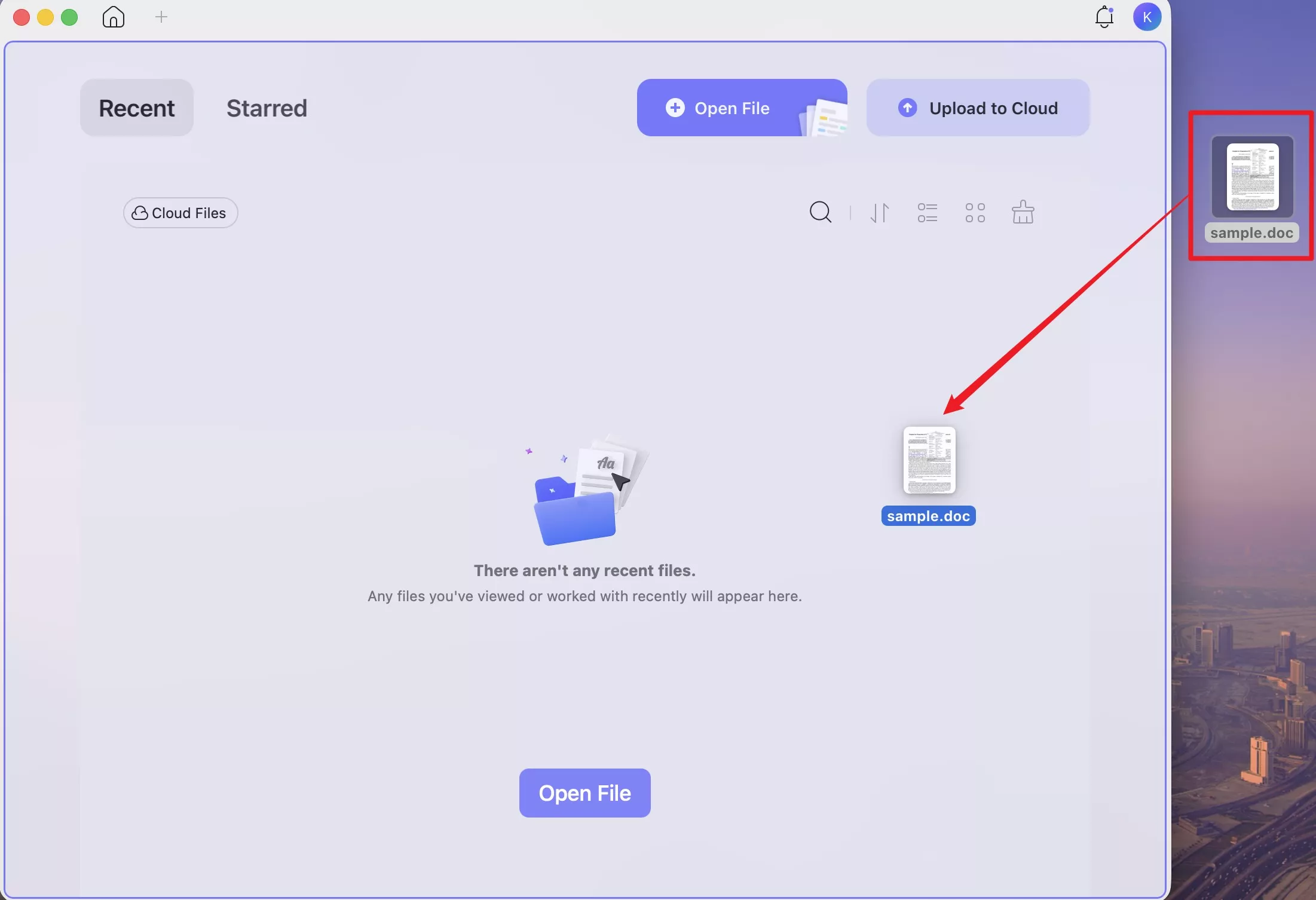
1. Reorder Pages (Drag & Drop)
You merged three files and the cover page landed in the middle. Reordering fixes sequence without touching content.
Step 1. Click Organize Pages to open the page thumbnail grid.
Step 2. Click and drag any page thumbnail to its new position; release to drop. Hold and select several to move them as a block.
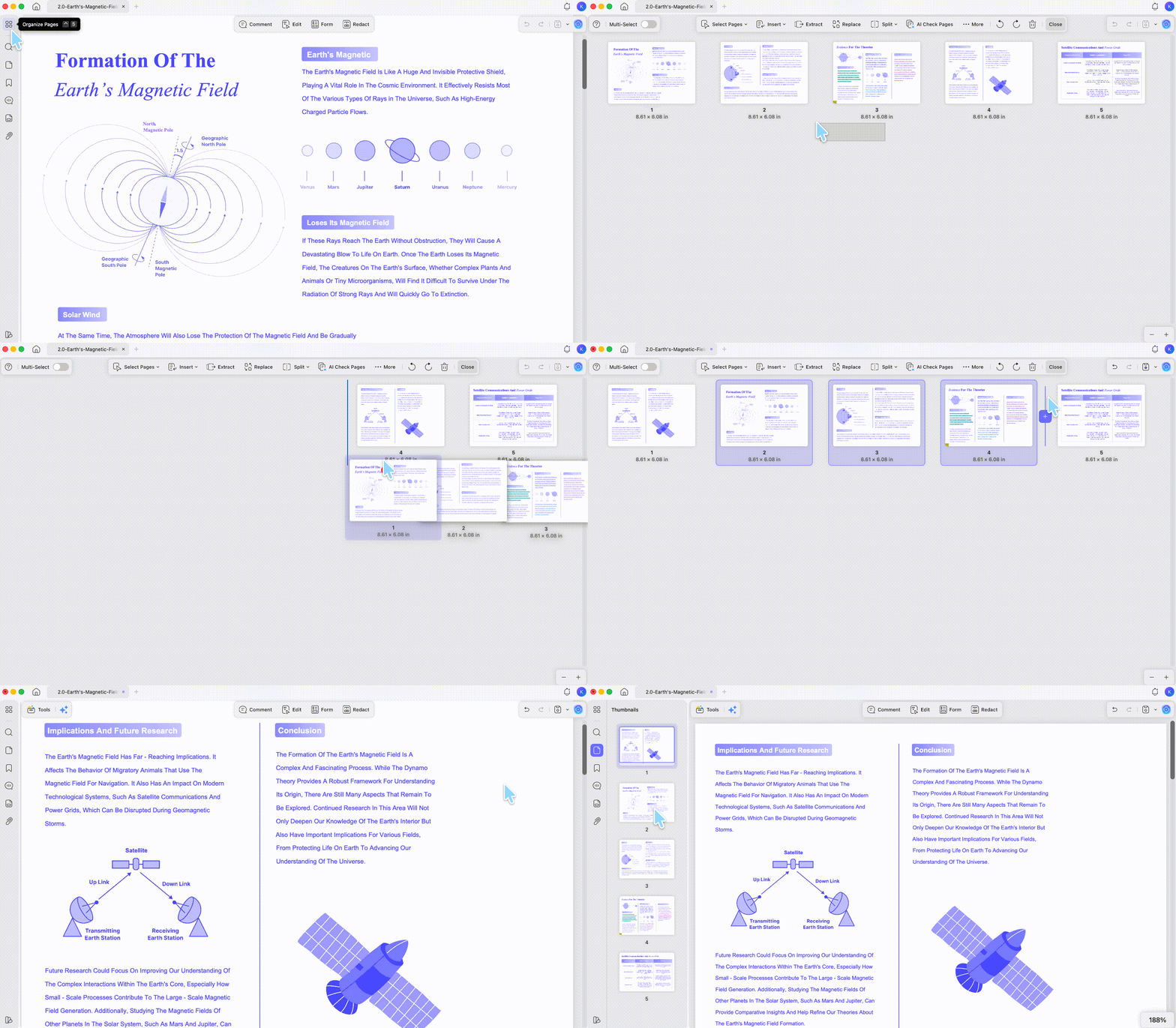
Step 3. Click Save (or Save As Other to keep the original).
Best for:
- Fixing sequence in reports, decks, merged files, or to reverse the order of PDF pages entirely.
Not for:
- Pulling pages out into a new document — use Extract for that.
2. Insert Pages
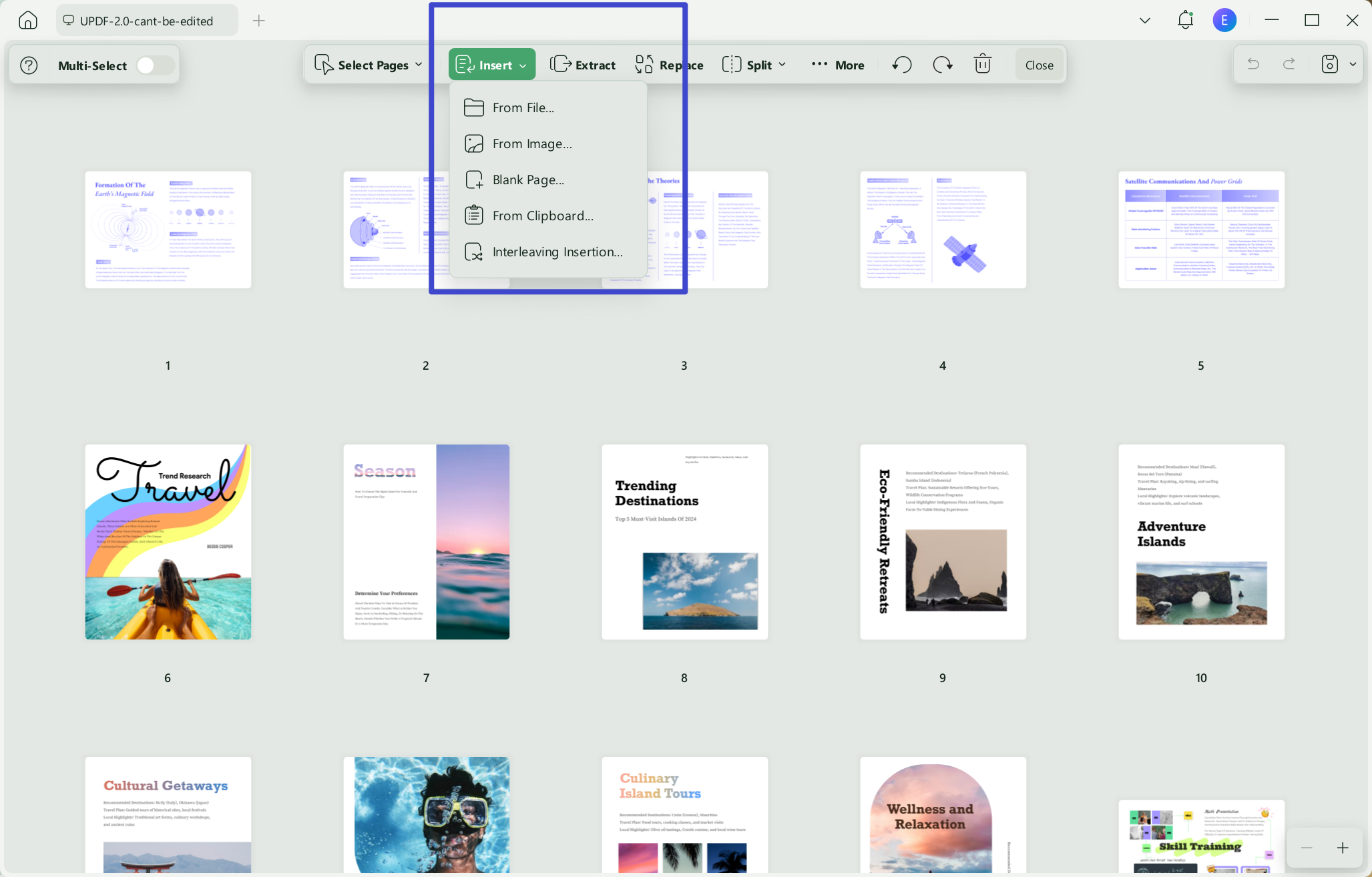
UPDF gives you five ways to insert, so you’re covered whether the new page lives in another file, on your clipboard, or doesn’t exist yet.
Step 1. In Organize Pages, click Insert.
Step 2. Choose the appropriate insertion source:
- From File: Insert all or selected pages from another PDF.
- From Image: Turn an image into a new PDF page.
- From Clipboard: Insert copied content as a page.
- Blank Page: Add one or more empty pages with a selected size, orientation, and position.
- Interleaving Insertion: Combine separately scanned odd and even pages in the correct order.
If you only need an empty page, follow this detailed guide to insert a blank page in a PDF on Windows, Mac, iPhone, iPad, Android, or in a browser. It also explains how to match the page size, insert several blank pages, and fix an incorrectly positioned page.
Step 3. Set the target position in the pop-up, confirm the insertion, and save the PDF.
Best for:
- Adding a blank divider, a signed cover page, a missing appendix, an image, or separately scanned duplex pages.
Not for:
- Overwriting an existing page — use Replace.
3. Replace a Page
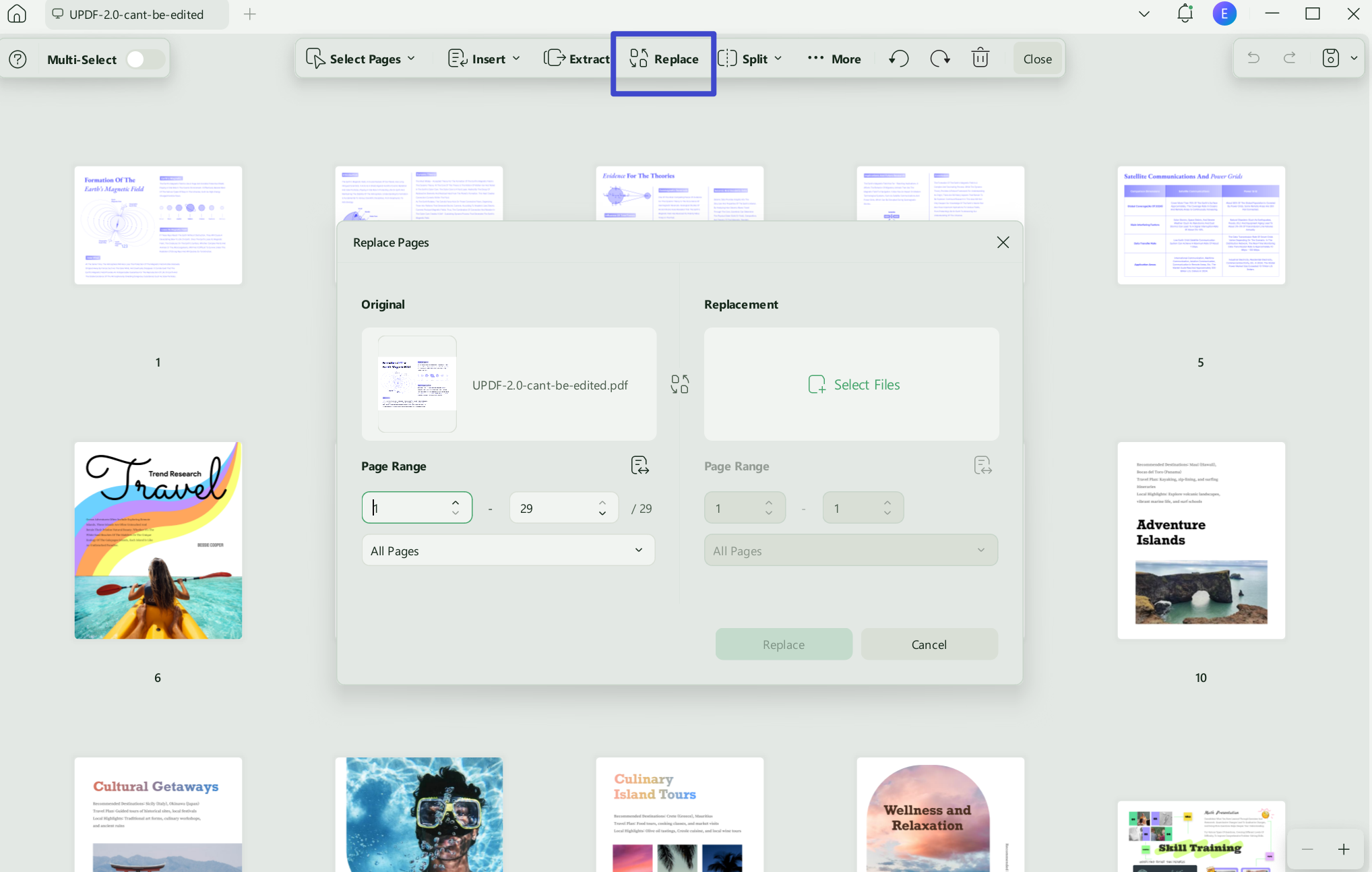
When page 3 has a typo and you’ve fixed it elsewhere, Replace swaps the old page for the new one while keeping the total page count stable.
Step 1. Click Replace.
Step 2. Select the source file containing the corrected page(s), then map which pages replace which.
Step 3. Confirm and save.
Best for:
- Corrections and version swaps — for the browser route, see replace PDF pages online.
Not for:
- Editing the text on a page itself — for that, open UPDF’s PDF editor
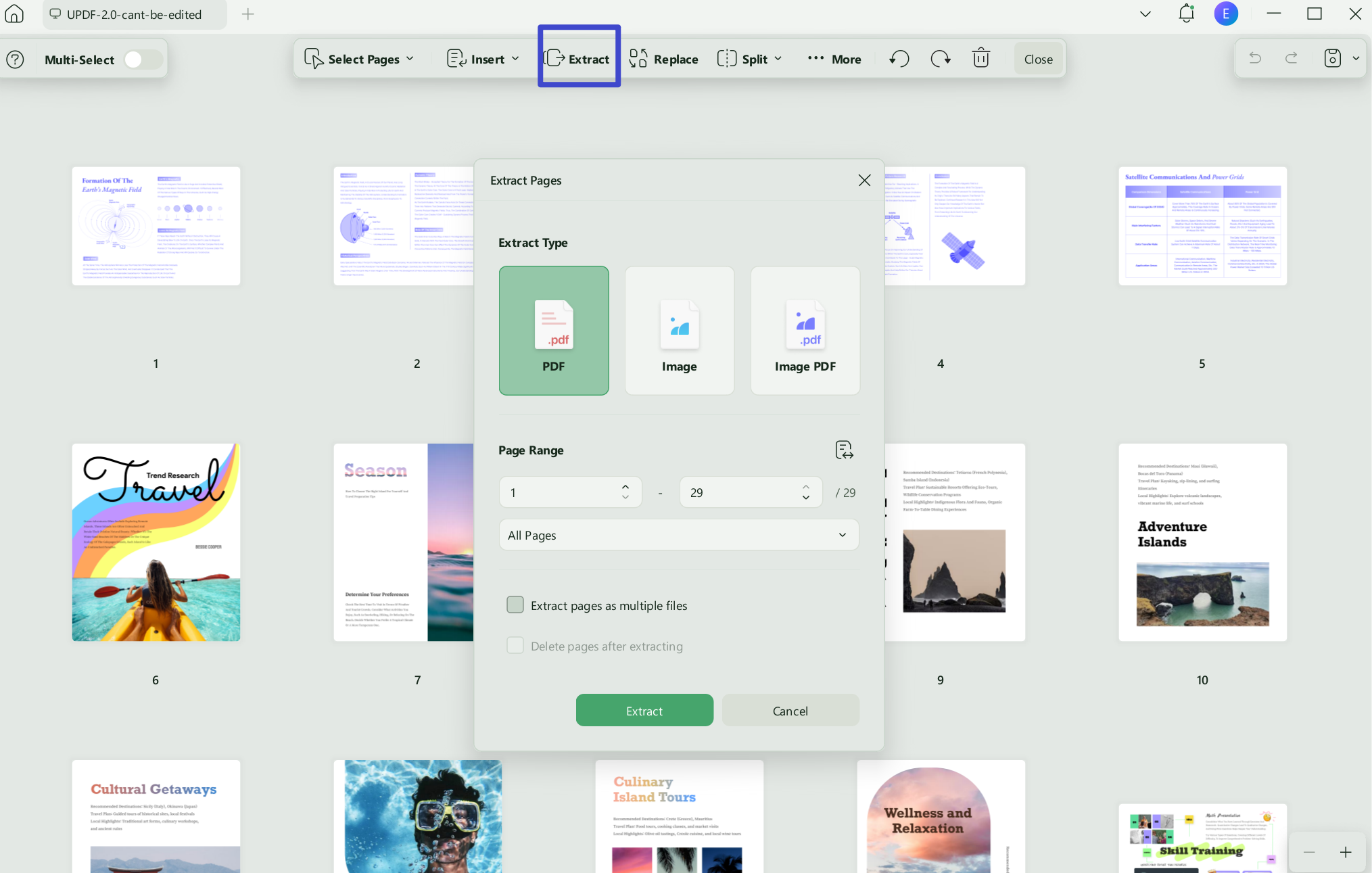
4. Extract Pages
Extract copies chosen pages into a brand-new PDF, leaving the original intact unless you tell it otherwise.
Step 1. Click Extract, then select the pages you want.
Step 2. Choose Extract pages as one file or as multiple files. Tick Delete pages after extracting if you also want them gone from the source.
Step 3. Click Extract to save the new file(s).
Best for:
- Sending only the invoice or only the signature pages.
Not for:
- Breaking a file into many evenly-sized parts — use Split.
5. Split a PDF
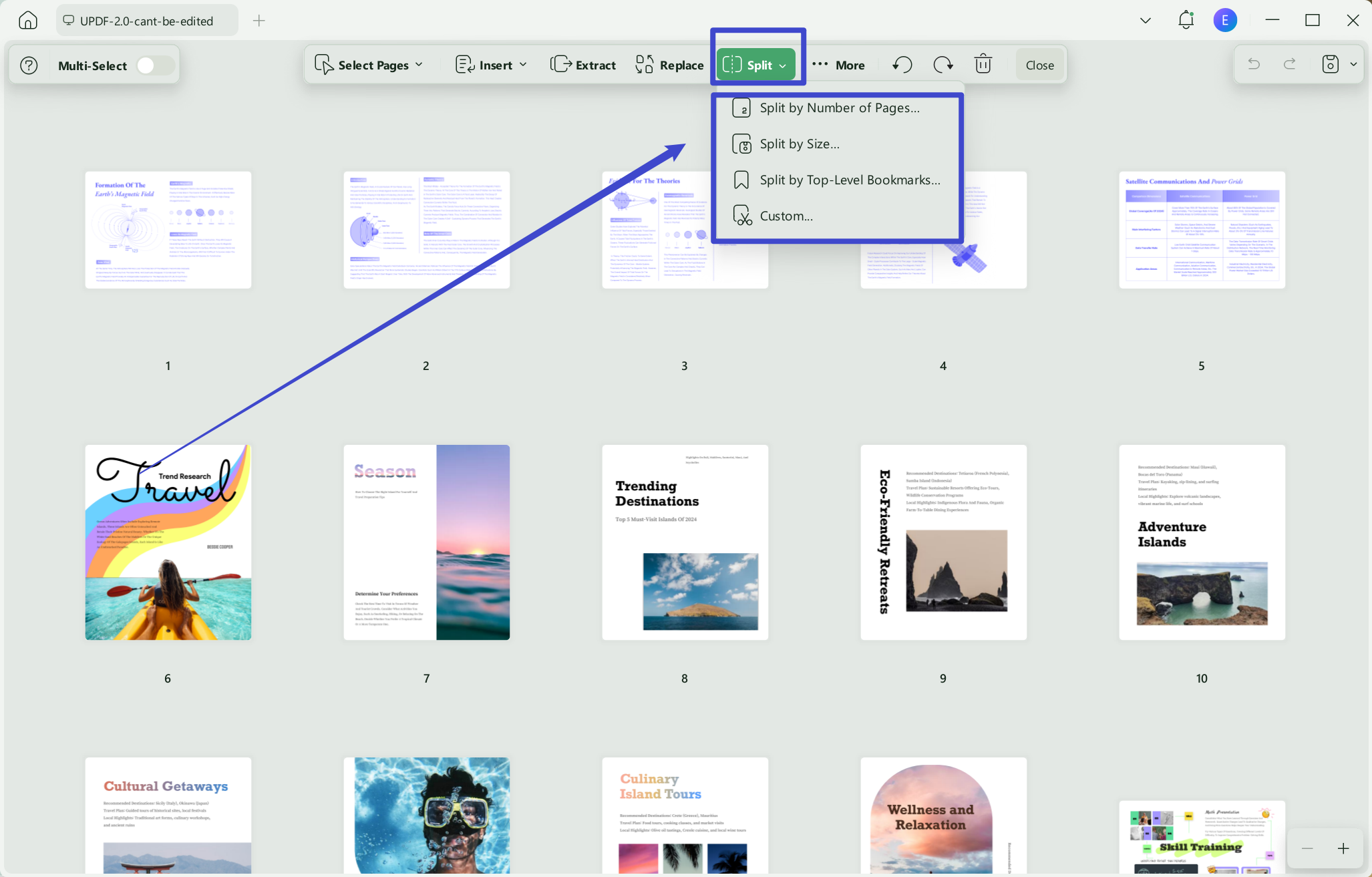
Split turns one large PDF into several smaller files using the rule that fits your document.
Step 1. Click Split.
Step 2. Pick a method: by number of pages, by file size, custom, or by top-level bookmarks (great for splitting a book into chapters).
Bonus Tip:
Step 3. Set the value and save the output files.
Best for:
- Chapter files, size-limited email attachments.
Not for:
- Grabbing a few specific pages — Extract is faster for that.
6. Rotate Pages
Scans often open sideways. Rotate fixes orientation permanently — unlike the temporary view rotation in most readers.
Step 1. In Organize Pages, select the sideways page(s).
Step 2. Click Rotate Counterclockwise or Rotate Clockwise until upright. Select multiple pages to rotate them together, or rotate only one page in the PDF. For the platform-specific steps, see rotate PDF on Windows.
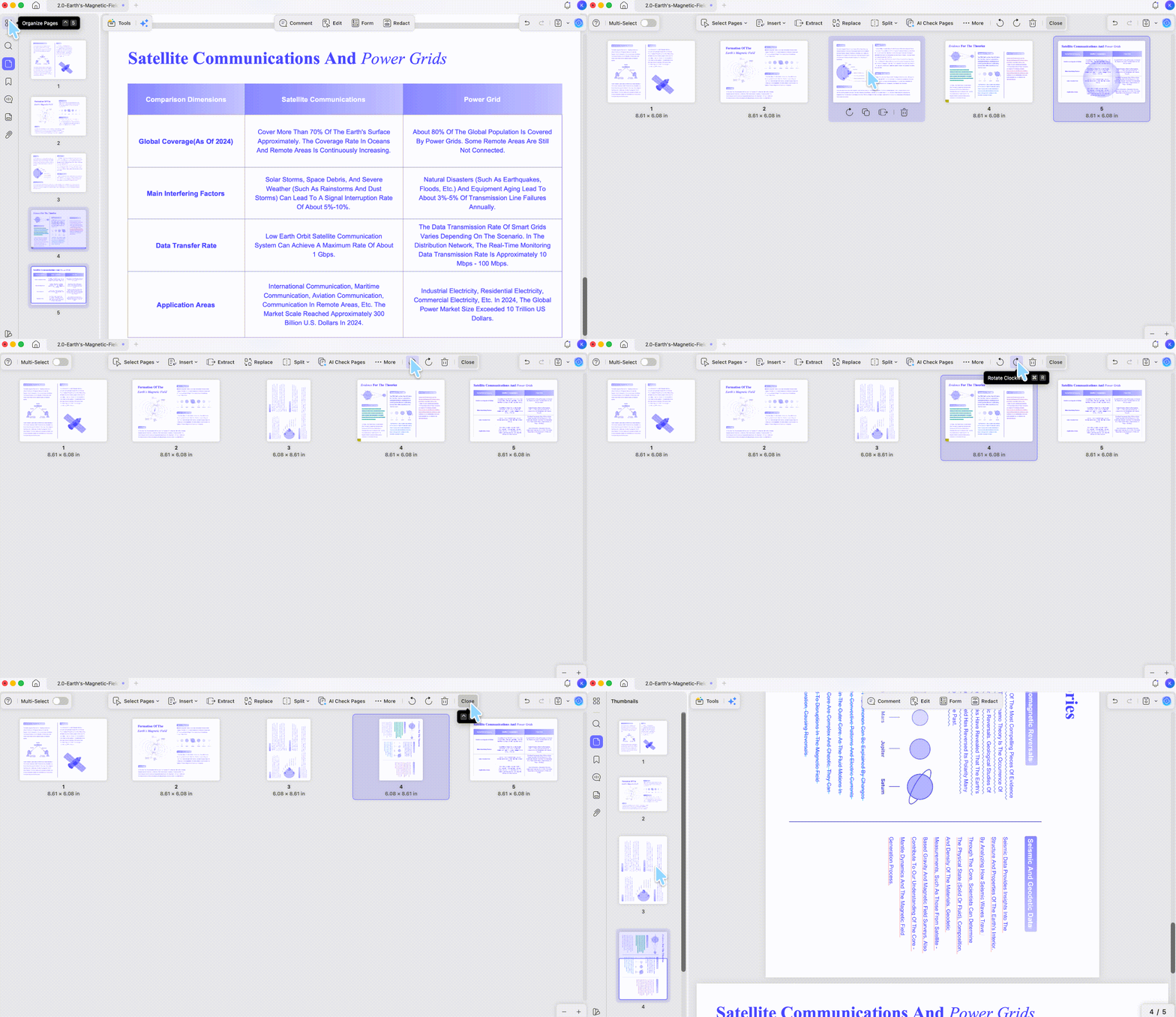
Step 3. Save so the orientation sticks for everyone who opens the file.
Best for:
- Landscape scans and phone-camera captures.
Not for:
- Changing page orientation for the whole document — see convert PDF from landscape to portrait; or cropping margins — see how to crop a PDF and crop a PDF page online.
7. Delete Pages
Remove blank pages from a PDF, duplicate scans, or pages you don't need before sharing.
Step 1. In Organize Pages, select the unwanted page(s).
Step 2. Click Delete (or press Delete).
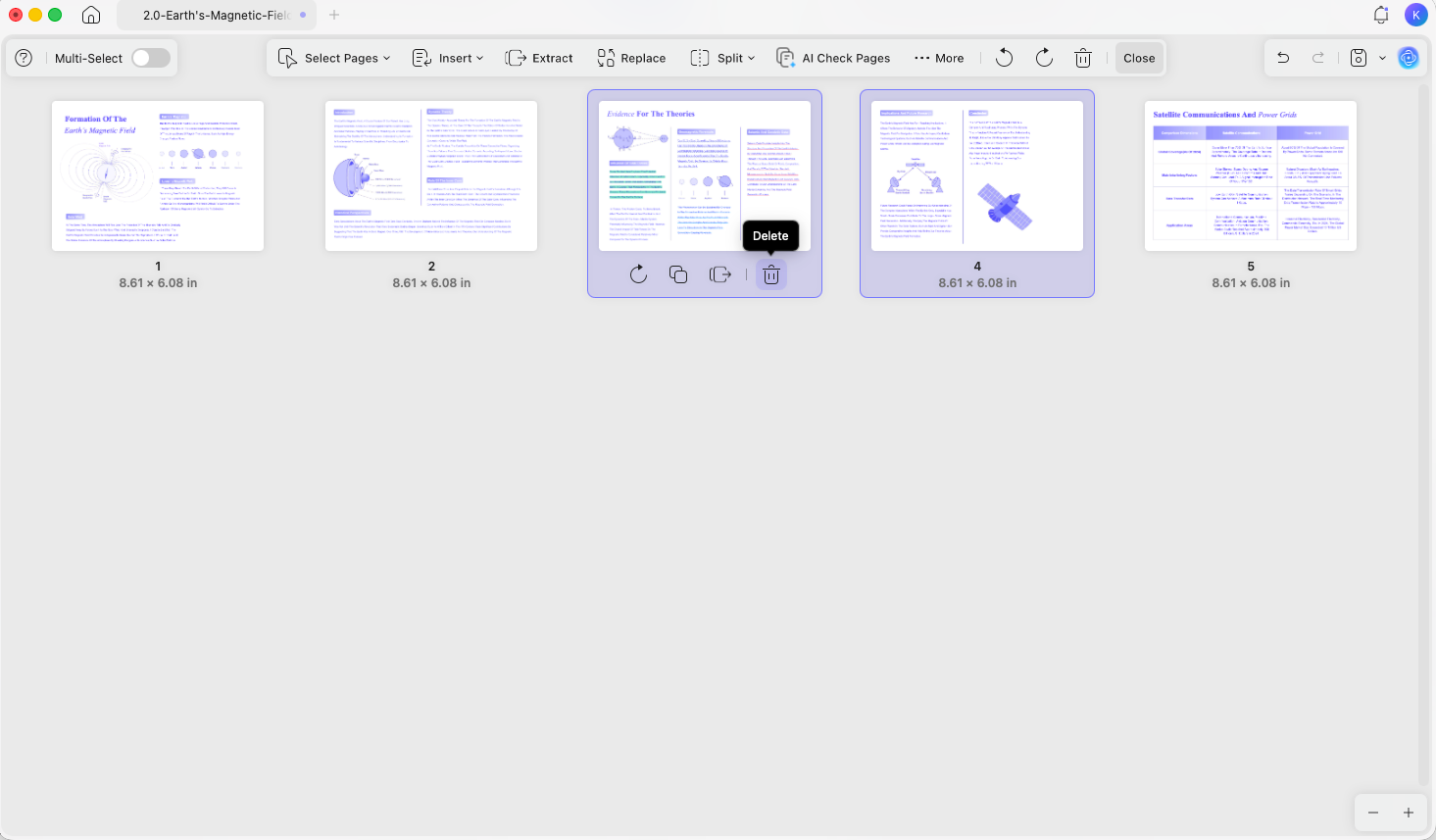
Step 3. Save the cleaned-up file.
Best for:
- Trimming merged files.
Not for:
- Redacting sensitive content — deleting a page doesn’t remove data elsewhere; see how to redact a PDF.
Download UPDF for free to try reordering, splitting, and extracting pages on your own file — installation is free, and Pro features are available when you need export without trial watermark or batch tools.
Windows • macOS • iOS • Android 100% secure
Part 2. Auto-Fix Page Problems with AI Check Pages
After combining files from different sources, you can end up with blank pages, an upside-down scan, or inconsistent page sizes — easy to miss in a 50-page document. AI Check Pages scans the whole PDF and lists every page that needs attention, so you don’t have to eyeball each one.
It flags blank pages, scanned pages, pages with shadows, inverted orientation, breaks in page numbering, pages containing annotations, and page-size inconsistencies.
Step 1. Open the PDF and click Organize Pages.
Step 2. Click AI Check Pages in the top toolbar. AI Check Pages scans the document and lists the issues in a panel on the right.
Step 3. Click any item to jump straight to that page, then click its Action button — for example, OCR a scanned page, or Delete to remove a blank page.
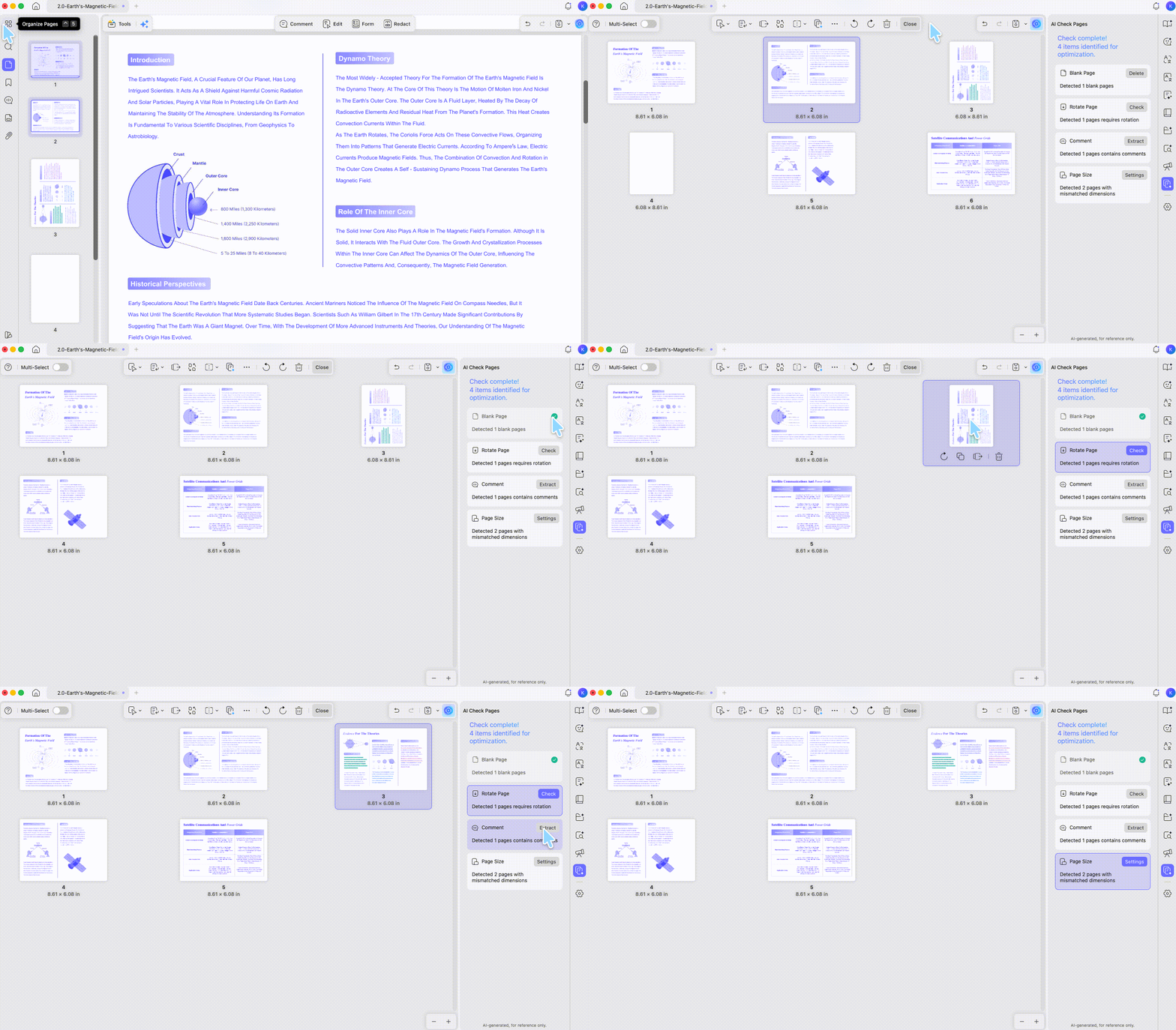
Step 4. Run AI Check Pages again to confirm; resolved items drop off the list.
Free vs. Pro:
Windows • macOS • iOS • Android 100% secure
Part 3. Organise Pages in PDF on iPhone, iPad & Android
UPDF carries one license across desktop and mobile, so the document you organize on your laptop is editable on your phone. On iPhone/iPad or Android, open the PDF and click Organize Pages, tap the page, and you can reorder, rotate, insert, extract, and delete pages with the same logic as desktop — you tap and drag instead of click and drag.
Step 1. Open the PDF in the UPDF mobile app and select "Organize Pages" from the toolbar icon in the upper right corner of the interface.
Step 2. Then tap-and-hold a page to drag it, or use the on-screen buttons to rotate, extract, split, duplicate a page, insert or delete.
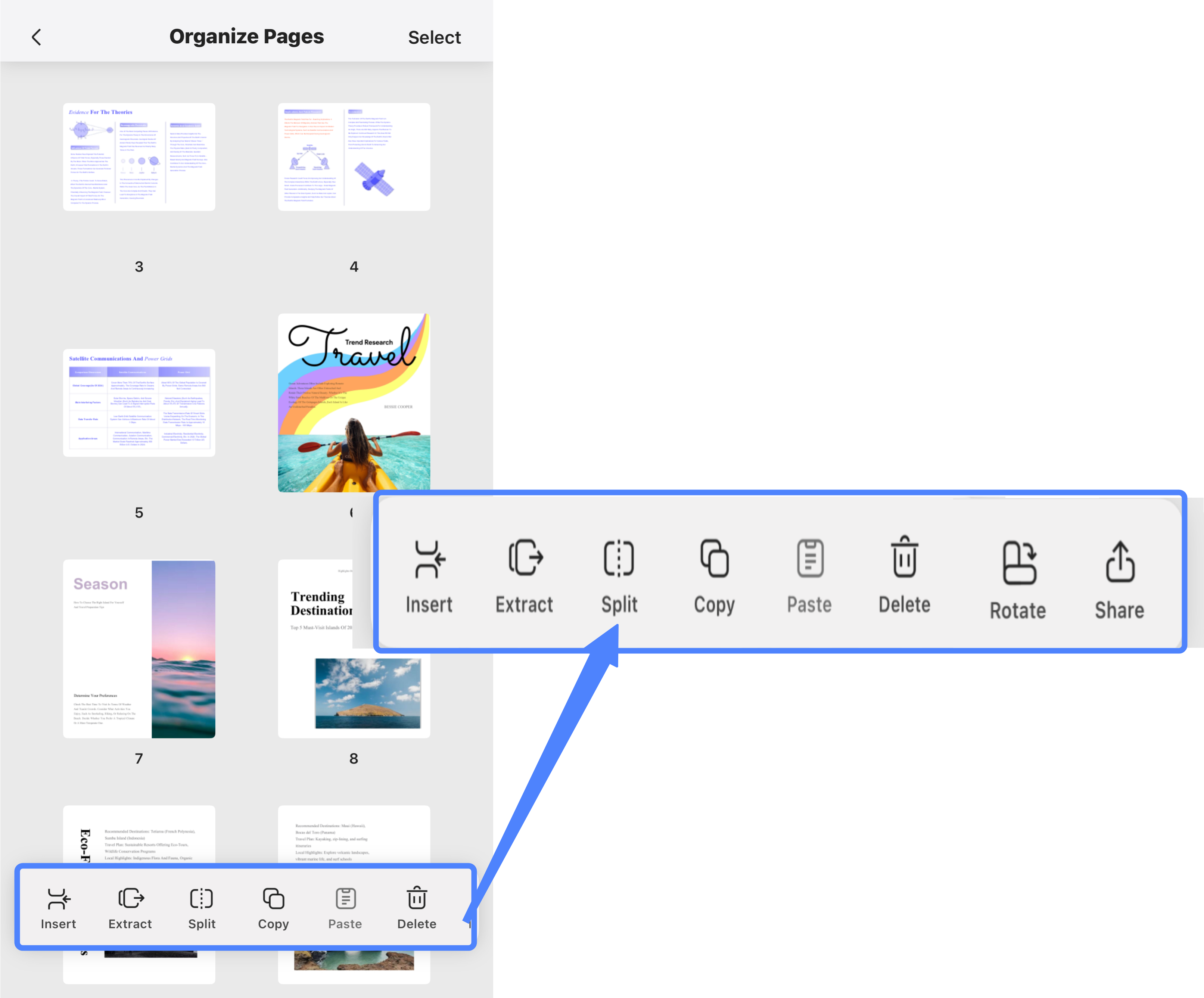
Step 3. Tap Save; you can sync the file through UPDF Cloud if you want to pick it back up on desktop.
Best for:
- Quick fixes on the move — rotating a photographed receipt, deleting a stray page before emailing.
Not for:
- Heavy split-by-bookmark or batch jobs, which are faster on desktop.
If you’d like to learn more about the many amazing features UPDF has to offer, you can read through this in-depth review. Or if you’d prefer— check out the video below for a full breakdown of organizing PDF documents using UPDF.
Part 4. UPDF vs. Adobe Acrobat for Organizing Pages
Both organize pages well. The real differences are price, where page tools sit behind a paywall, and platform coverage. Here are the hard constraints — including UPDF’s own limits.
| Capability | UPDF | Adobe Acrobat Pro |
| Reorder / split / extract / rotate | Yes; free to use | Yes; requires paid Acrobat Pro (no page editing in the free Reader) |
| AI page-issue detection | Yes — AI Check Pages flags blank, reversed, scanned, odd-sized pages | No equivalent one-click page-audit tool |
| Platforms | Windows, Mac, iOS, Android — one license | Windows, Mac, plus mobile via separate subscription tiers |
| Price | $49.99/yr or $79.99 one-time perpetual (current pricing) | ~$239.88/yr; no perpetual license since 2021 |
| Free tier limit | Page tools free; export adds a watermark until you upgrade; 100 free AI uses | Free Reader cannot reorganize pages at all |
| Works offline | Yes — files stay on your device | Yes for desktop; some features push to Adobe cloud |
Why people switch: if you only need to organize, sign, and lightly edit PDFs, paying ~$239.88 a year for Acrobat is hard to justify. UPDF does the same page work, adds AI Check Pages, and a one-time $79.99 license covers all four platforms. See the full UPDF vs. Adobe Acrobat comparison for editing, OCR, and conversion details.
Windows • macOS • iOS • Android 100% secure
Part 5. If the Standard Method Doesn’t Work (Edge Cases)
- "The page tools are greyed out.": The PDF is almost certainly password-protected or permission-restricted. You’ll need to enter the password or remove the restriction before organizing — only do this on files you own or are authorized to edit. See how to remove PDF security.
- "The pages are different sizes after merging.": Combining files from different sources can leave mismatched dimensions. Standardize them by changing the paper size in the PDF so every page matches.
- "Pages won’t reorder or the file won’t open.": The PDF may be corrupted, especially if it stopped downloading midway. Re-download it from the source, or try repairing the corrupted file.
- "A scanned page shows as one flat image and AI flags it.": It has no text layer. Run OCR (in UPDF: leftside Tools → OCR, or the OCR action inside AI Check Pages) to make it searchable and editable before you split or extract.
- "Rotation resets when someone else opens the file.": You likely rotated the view, not the page. Rotate inside Organize Pages and save — that change is permanent in the file itself.
- "The pages I want to organize aren’t PDFs.": Drag the Word, Excel, PowerPoint, or image files onto the UPDF desktop window to convert them to PDF first, then organize as usual.
Part 6. FAQ
1. Will organizing pages change the page content?
No. Reorder, split, extract, and rotate only move or copy whole pages — the text and images on each page stay exactly as they were.
2. Why won't my PDF pages drag and drop into a new order?
Usually one of three things. The file is permission-restricted (enter the password or remove the restriction first); you're zoomed in so the drop target is off-screen — zoom out until the whole thumbnail grid is visible; or you're in a reader-only tool. In UPDF, drag-and-drop lives inside Organize Pages, and works on the page thumbnail grid regardless of zoom.
3. How do I reorder a 100–200 page PDF without dragging one page at a time?
Dragging is painful at that length — the thumbnail pane barely auto-scrolls. Instead, select a block of pages and move them as a group, or split the document by bookmarks, fix the order, and merge it back. UPDF lets you multi-select pages in Organize Pages and drag the whole set at once.
4. My page order reverted after I saved (or printed). Why?
You likely changed the view, not the file, or exported through a "print to PDF" path that reverses order. Make the change inside Organize Pages and use Save / Save As Other — not a print-to-PDF export — so the new order is written into the document itself.
Conclusion
Organizing a PDF comes down to matching the right tool to the job — reorder for sequence, extract for pulling pages out, split for breaking a file up, rotate for orientation, delete for trimming. UPDF puts all of them in one Organize Pages panel and adds AI Check Pages to catch blank, reversed, and odd-sized pages automatically across Windows, and Mac.
Download UPDF for free to try organizing the pages in your own document — installation is free, and Pro features are available when you need watermark-free export or batch tools.
Windows • macOS • iOS • Android 100% secure





 Enya Moore
 Enola Miller
 Lizzy Lozano
 Enrica Taylor
 Enid Brown