 UPDF
 UPDF for Windows
 UPDF for Mac
 UPDF for iPhone/iPad
 UPDF for Android
 Nomostar
 UPDF AI Online
 UPDF Sign
 IvyCraft
 Edit PDF
 Annotate PDF
 Create PDF
 PDF Form
 Edit links
 Convert PDF
 OCR
 PDF to Word
 PDF to Image
 PDF to Excel
 Organize PDF
 Merge PDF
 Split PDF
 Crop PDF
 Rotate PDF
 Protect PDF
 Sign PDF
 Redact PDF
 Sanitize PDF
 Remove Security
 Read PDF
 UPDF Cloud
 Compress PDF
 Print PDF
 Batch Process

 About UPDF AI
 UPDF AI Solutions
 AI User Guide
 FAQ about UPDF AI
 Summarize PDF
 Translate PDF
 Chat with PDF
 Chat with AI
 Chat with image
 PDF to Mind Map
 Explain PDF
 PDF AI Tools
 Image AI Tools
 AI Chat Tools
 AI Writing Tools
 AI Study Tools
 AI Working Tools
 Other AI Tools
 AI Bookmark Generation
 AI Bookmark Summary
 AI Watermark Generation
 AI Background Generation
 AI Sticker Generation
 AI Stamp Generation
 AI Editing Suite
 UPDF Copilot
 AI Page Management
 AI Semantic Search
 PDF to Word
 PDF to Excel
 PDF to PowerPoint
 Enterprise Solution
 Enterprise Sign
 Enterprise AI
 Enterprise Plan
 Enterprise User Guide
 Enterprise Webinar
 IT
 Education
 Construction
 Financial Service
 Healthcare
 Insurance
 Legal
 Manufacturing
 Government
 Researchers & PhDs
 Solopreneurs & Freelancers
 Lawyers & Legal Professionals
 Real Estate Agents & Brokers
 Education Solution
 Customer Stories
 User Guide
 UPDF Tricks
 FAQs
 UPDF Reviews
 Download Center
 Blog
 Newsroom
 Tech Spec
 Updates
 UPDF vs. Adobe Acrobat
 UPDF vs. Foxit
 UPDF vs. PDF Expert


Quick answer: The best Hebrew OCR tool depends on the source. For scanned PDFs, prioritize Hebrew language support, right-to-left reading order, layout retention, and an editable or searchable PDF output. For a single image, a lightweight image-to-text tool may be enough.
Hebrew OCR has challenges that a generic accuracy claim cannot explain: letters must remain in right-to-left order, niqqud may be missed, and mixed Hebrew-English text, numbers, columns, or tables can change the reading sequence. This guide compares five practical options and shows what to verify before relying on the result. If you want to test a scanned Hebrew PDF first, UPDF supports Hebrew OCR on desktop and mobile and creates a new editable or searchable PDF. Download it below and check one representative page before processing the full document.
Windows • macOS • iOS • Android 100% secure
Part 1. Comparison of the 5 Best Hebrew OCR Software
Use this table as a decision guide rather than a fixed accuracy ranking. OCR results change with scan quality, font, page structure, and the amount of Hebrew mixed with English or numbers.
| Tool | Best for | Hebrew-specific check | Output and privacy | Current cost |
| UPDF | Scanned Hebrew PDFs on desktop or mobile | Hebrew is included among 38 OCR languages; verify RTL order, niqqud, names, and mixed numbers after conversion | Editable PDF, Text and Pictures Only, or Searchable PDF Only; processing is available in the app | Free trial; Pro Annual $49.99 or Lifetime $79.99 |
| Prizmo | Mac and iPhone users working with images and documents | Hebrew is available as an OCR language; manually review complex layouts and vocalized text | Editable recognition results with export and text-to-speech options | Check the current Mac App Store or Prizmo pricing page |
| Convertio | Occasional browser-based OCR | Lets you choose Hebrew and additional languages; RTL formatting should be checked after export | Exports to Word, Excel, PDF, and text; logged-in result files are stored for up to 14 days | OCR packages start at US$0.10 per page |
| Online OCR Converter | Extracting text from a small Hebrew image | Useful for plain text; not ideal when page structure must be retained | Copyable text output; review the site's current upload and privacy terms before using sensitive files | Free and paid limits vary by plan |
| Google Docs OCR | Simple, free extraction through Google Drive | Can recover basic Hebrew text, but tables, columns, footnotes, and reading order may not survive | Creates an editable Google Doc; the file is uploaded to Google Drive | Free with a Google account |
How We Evaluated Hebrew OCR Tools
For a fair comparison, use the same clear scan and a more difficult page containing Hebrew and English, numbers, niqqud, and a multi-column or table layout. Compare five points: character recognition, right-to-left reading order, preservation of page structure, ease of correcting errors, and the available export format. We do not assign a universal accuracy percentage because the result depends heavily on the source file; a one-page test is more useful than a vendor's broad accuracy claim.
Part 2. 5 Hebrew OCR Tools for PDFs and Images
All five options can help with Hebrew text, but they serve different workflows. Test the same representative page in any tool you are considering, then compare reading order, character recognition, layout, and the amount of manual correction required.
1. UPDF (PC&Mobile)
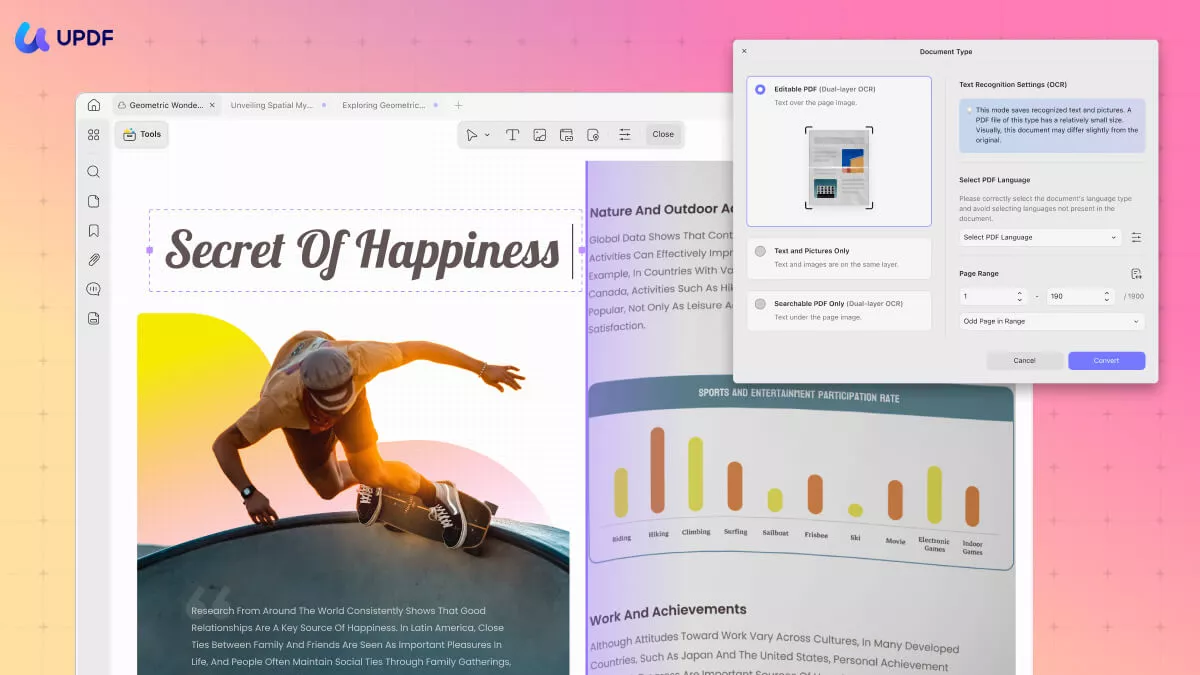
UPDF is a practical choice for scanned Hebrew PDFs because its OCR tool supports Hebrew among 38 languages on Windows, Mac, iOS, and Android. It can create a new Editable PDF, a Text and Pictures Only file, or a Searchable PDF Only version, so the output can match whether you need to correct text or simply search an archive. For Hebrew documents, always compare the result with the source—especially right-to-left order, niqqud, names, dates, and mixed English or numbers.
Windows • macOS • iOS • Android 100% secure
You can limit OCR to selected pages or process multiple scanned PDFs in a batch. After recognition, the same app can edit, annotate, convert, organize, and protect the new PDF, which is useful when OCR is only the first step in the workflow.
Pros:
- OCR images and scanned documents
- Hebrew recognition with editable or searchable PDF output
- Recognize text from 3 languages simultaneously
- Various output formats
- Selective page ranges and three OCR output modes
- Selective page OCR
- Available on Windows, Mac, iOS and Android
- Batch OCR
- Perform OCR during batch conversion.
Cons:
- Limited free access
User Ratings
- G2: 4.5/5
- Capterra: 4.5/5
User Steps (PC)
Step 1. Install and run UPDF on your computer (Windows or Mac). Drag and drop the PDF or image file you want to perform OCR.
Windows • macOS • iOS • Android 100% secure
Step 2. Click the "OCR" option in "Tools" from the left sidebar. Once open a new tab, select the mode you want in the left side of setting:

- Editable PDF: Turns scans into fully editable PDFs where both text and images can be selected, modified, and moved with preserved original layout. You can even replace images while keeping the page layout intact.
- Text and Pictures Only: Extracts just the words and images from the scan without preserving the page formatting. It is useful when you want a simple file to copy or edit text/images.
- Searchable PDF Only: Keeps the images in the scanned pages as it is, but adds an invisible text layer. It makes the file searchable without allowing text edits.
Customize the OCR settings, like a language that matches the source document, page range, etc. Once done, click "Convert".
Step 3. UPDF will perform the thorough OCR and create a new file that is editable and searchable.
If you have multiple scanned documents, UPDF also supports batch OCR.
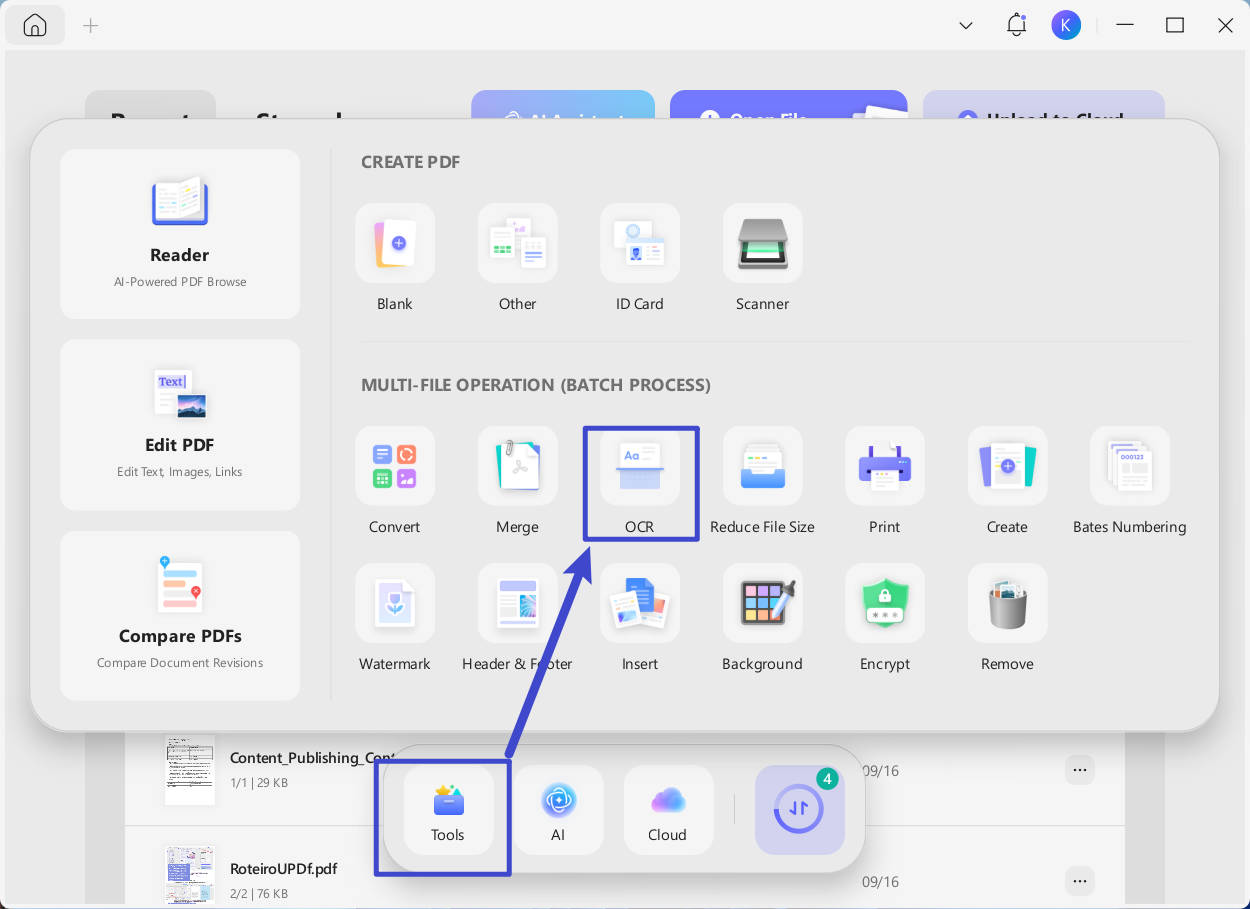
Step 1. Launch the UPDF software. In the main interface, locate the "Multi-File Operation (Batch Process)" section. Find and select the "OCR" icon.
Windows • macOS • iOS • Android 100% secure
Step 2. In the left-hand area of the Batch Process window, you can add your PDF files by either: dragging and dropping them into the designated area, or clicking the "+ Add Files" button and selecting the files from your computer.
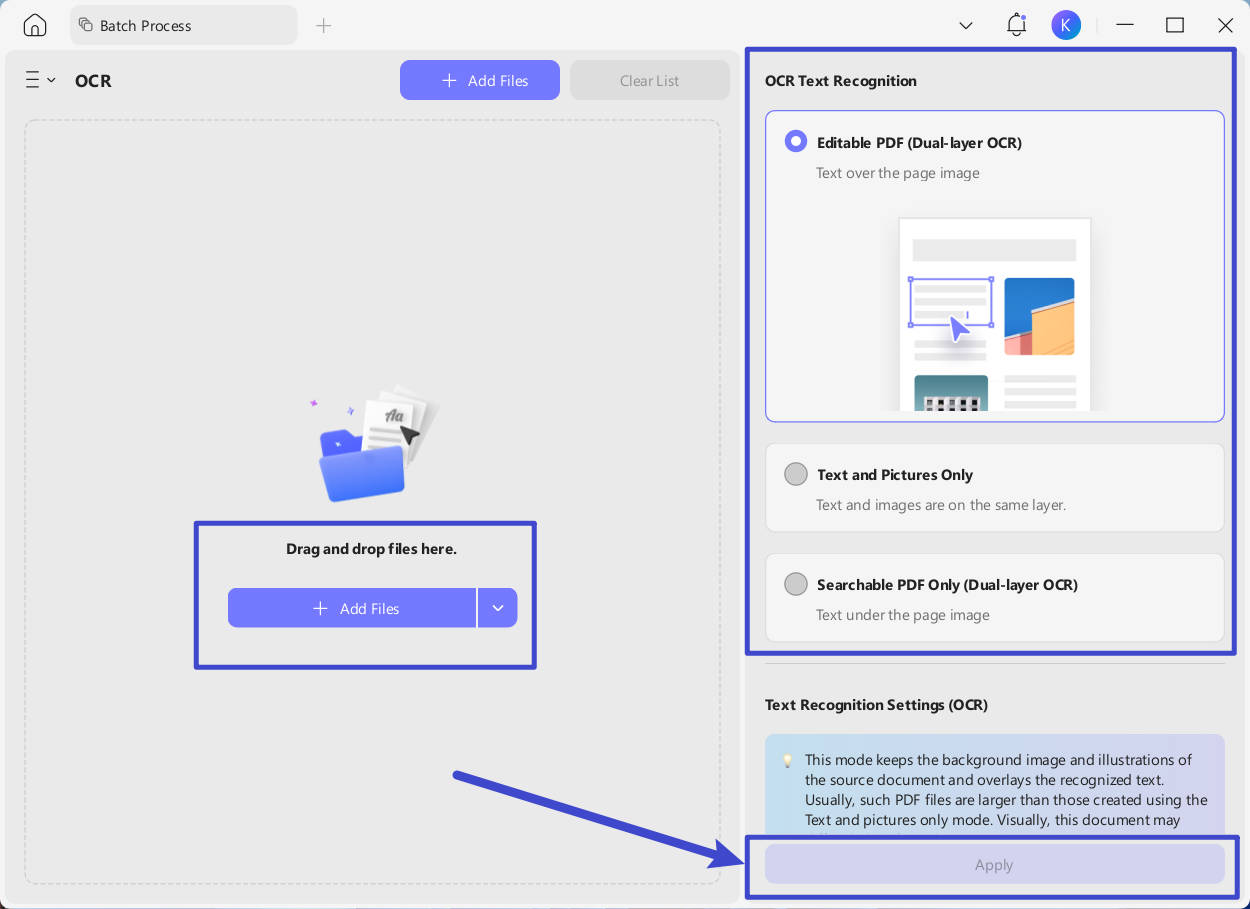
Step 3. On the right side, select the mode you want and language that matches the source document.
Step 4. Once done, click the "Apply" button to start the batch OCR process.
User Steps (Mobile)
Step 1. Launch UPDF and Open the File
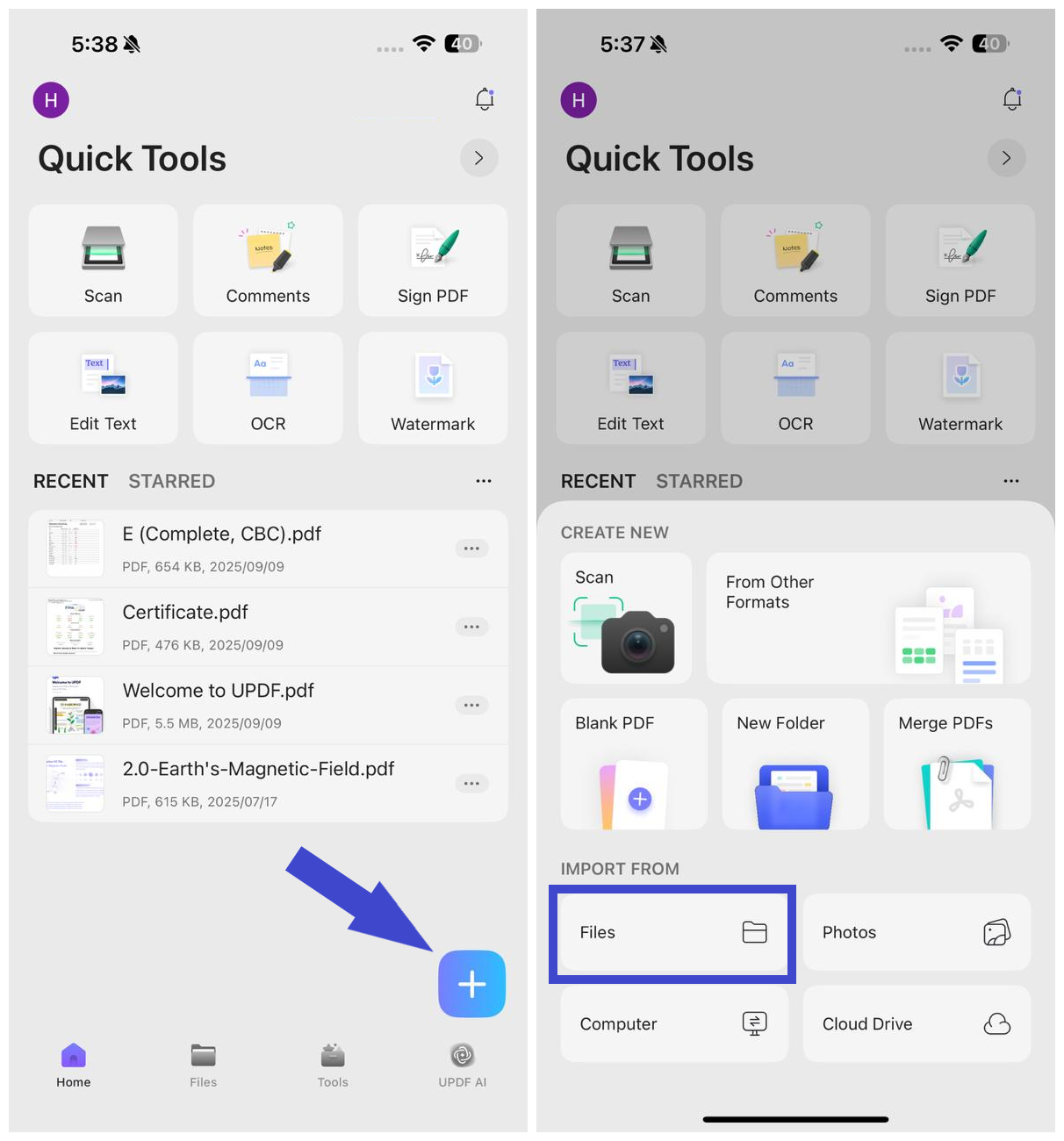
Way 1: Open the UPDF app on your phone (Android/iOS). You can download UPDF Mobile from App Store and Google Play. Click the "+" icon from the bottom right corner and tap "Files" to open the scanned PDF.
From the pop-up window, click the OCR button at the bottom of the page.

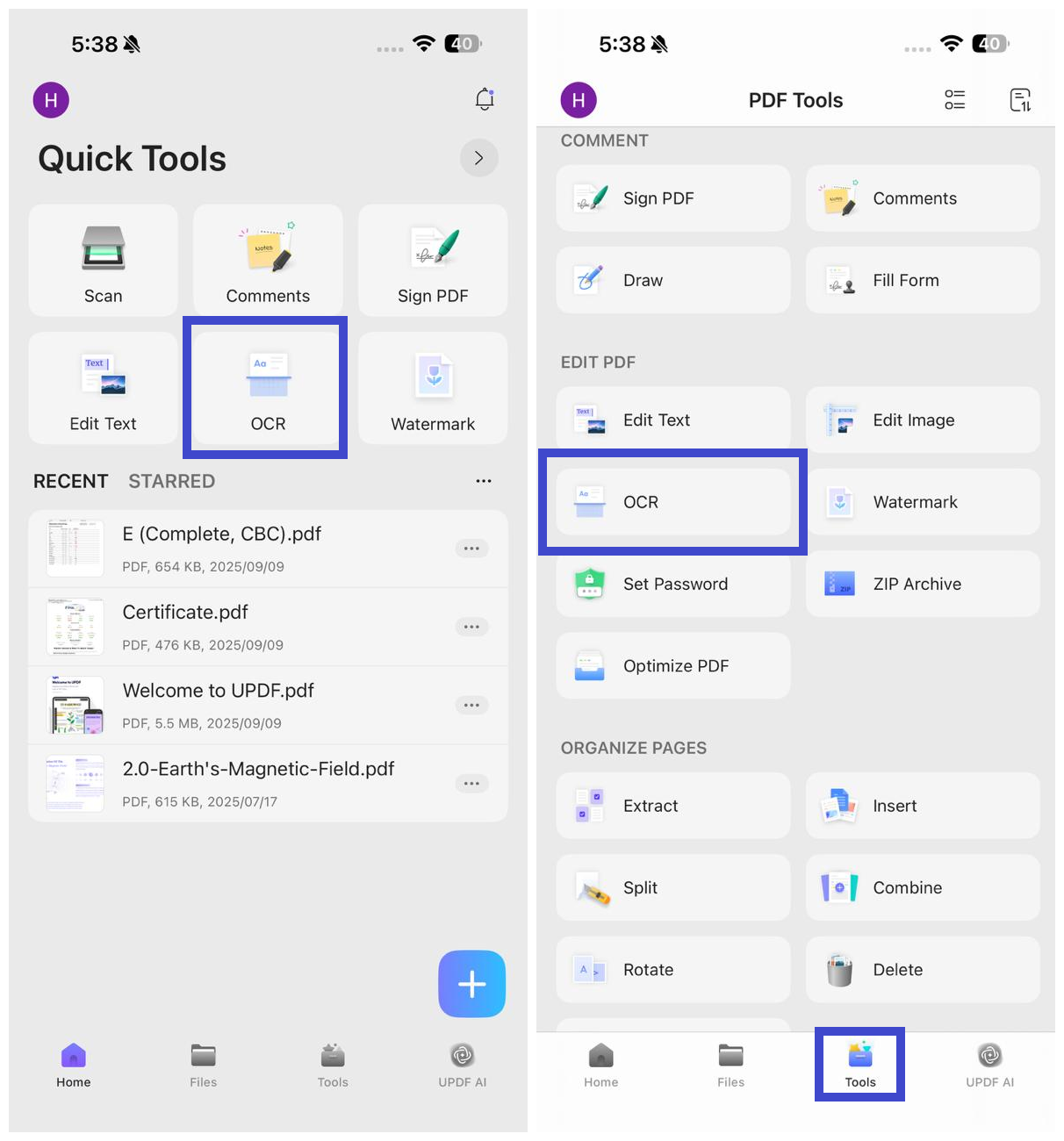
Way 2: Alternatively, if you have ever imported scanned PDF before, you can click "OCR" from "Quick Tools" or tap "Tools > OCR" and select the scanned PDF file in UPDF
Step 2. Under "OCR Recognition Type", choose one of the following options:
- Editable PDF
- Text and Pictures Only.
- Searchable PDF Only
Step 3. Click "Select PDF Language" and choose the document language. Select multiple languages if the document contains text in more than one language.
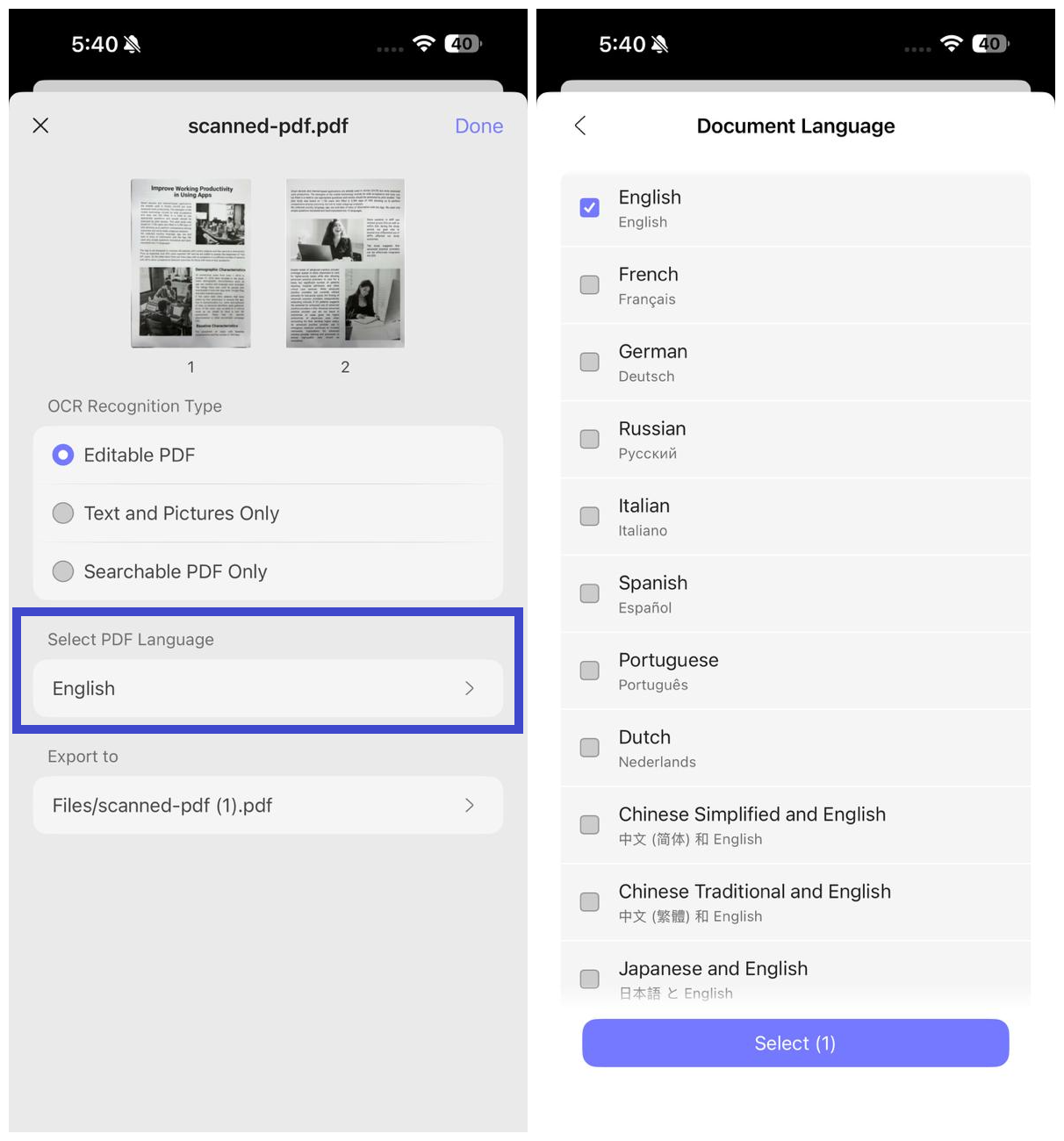
Step 4. Configure the "Export to" location to specify where you want to save the OCRed PDF and hit the "Done" button to begin OCR.

Step 5. Wait for the OCR to finish. Once the OCR is completed, go to the "Files" tab and open the newly-generated OCRed PDF. Copy the text or use UPDF's edit feature to edit text and images.
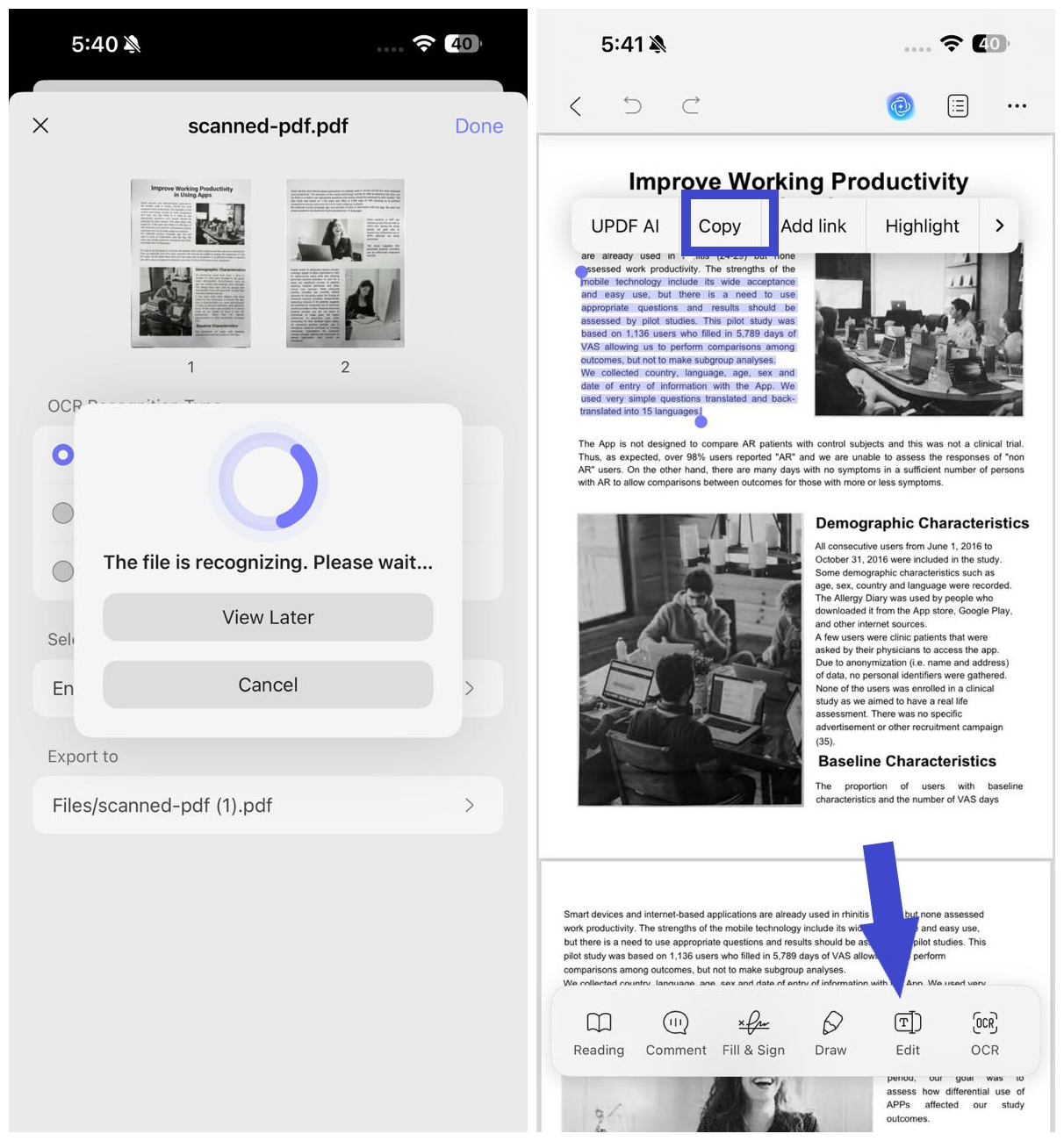
That's it! This way, you can quickly perform Hebrew OCR with the intuitive approach of UPDF.
User Reviews
- UPDF is an excellent solution for anyone looking for an easy-to-use, feature-rich PDF software.
- I really appreciate the UI of the application. The functionality/usability is great. Most PDF editors have a fairly standard feature set and I find UPDF not to be lacking at all. The application runs smoothly and does not bog down my system's available resources. I find it to be a perfect replacement for Adobe and I don't plan on going back!
- I like it because UPDF is easy to use and has all the tools I need to create, edit, and convert PDFs. I was able to purchase as a one off, so I'm not on the hook for an additional monthly subscription cost. It works with large files and has great editing options. The OCR feature is also handy, making scanned documents editable.
To learn more about UPDF's OCR feature, watch this video.
Bonus Tip
UPDF also offers an AI assistant that can also be used as an OCR tool. It is powered through OpenAI's GPT, which can extract text from the provided file. The steps are as follows:
Step 1. Go to the UPDF's online AI assistant, sign in, and click the attachment button to upload the image. Alternatively, you can also open the image in UPDF's desktop app and access the UPDF AI.
Windows • macOS • iOS • Android 100% secure
Step 2. In the chat box, type the prompt "Extract text from the image" and click Enter. Once done, UPDF AI will extract the text, which you can now copy and use wherever required.

This gives you two practical workflows: traditional OCR for complete scanned PDFs and AI-assisted extraction for a specific image or passage. Always review Hebrew reading order and small marks before reusing the text.
2. Prizmo
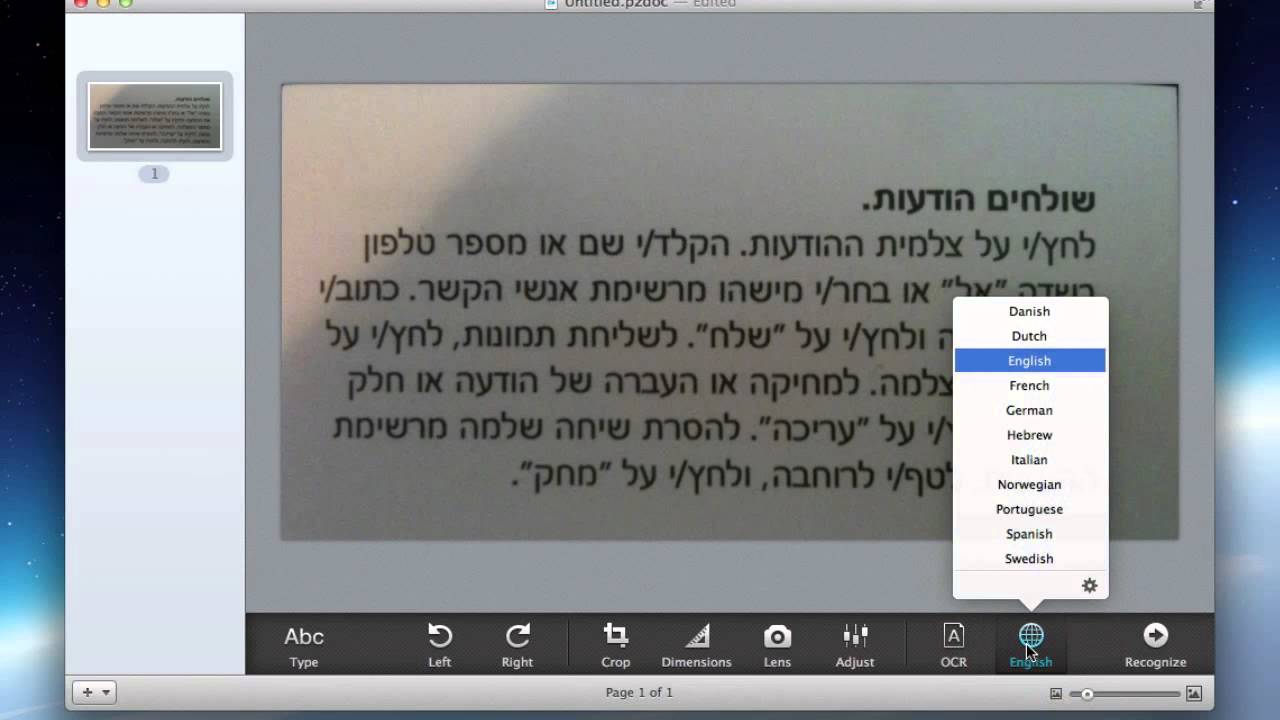
Prizmo is an OCR software for Mac that provides a user-friendly solution for Mac users to perform OCR on pictures or documents. It supports OCR in 30 languages, including Hebrew. Once recognized, it allows editing the text or translating into 59 languages.
Pros:
- Powerful Mac OCR app
- 30 languages supported
- Perform OCR on pictures and documents
- OCR editing and correction (add/delete/merge/reorder regions)
Cons:
- Limited only to Mac
- Available only on Apple platforms
- Complex page layouts and niqqud still require manual review
- More features than a user needing only one quick extraction may require
User Ratings
- Mac App Store: 2.8/5
User Steps
Step 1. Install and launch Prizmo on your Mac system. Drag and drop the image or document.
Step 2. Select Hebrew language and click "OCR" to perform OCR.
Step 3. After the OCR process is completed, you will be able to access the text.
3. Convertio
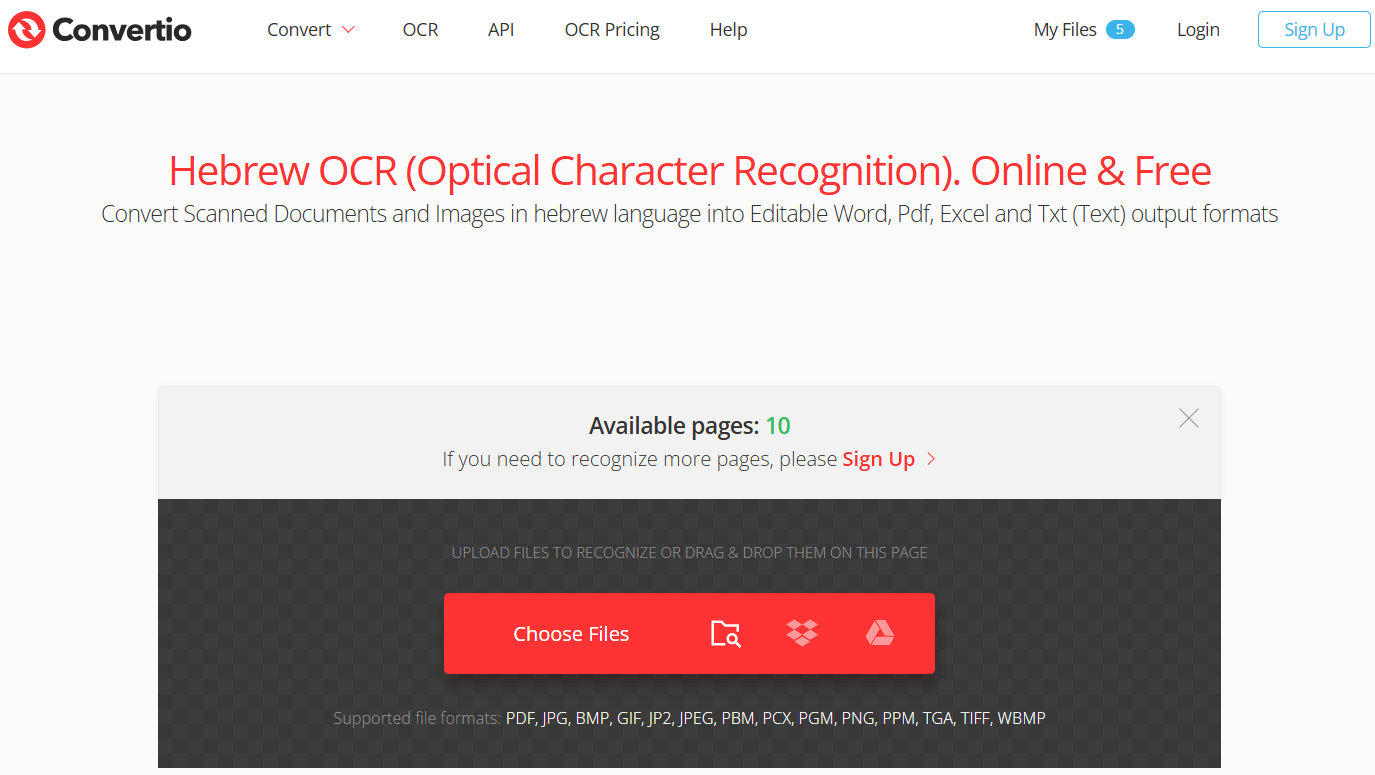
Convertio is a web-based OCR Hebrew tool. It allows you to upload images and documents in the Hebrew language, perform OCR, and convert them into editable Word, Excel, PDF, or text formats. If the document includes multiple languages besides Hebrew, it can also detect them.
Pros:
- Web-based Hebrew OCR tool
- Intuitive interface
- Perform OCR on images and PDFs
- Multi language detection
- Diverse output formats
Cons:
- 10 pages OCR without sign up
- Limited file size in the free plan
- Slow performance
User Ratings
- TrustPilot: 4.9/5
- G2: 4.8/5
User Steps
Step 1. Go to the Convertio website and click "Choose Files" to upload the image or PDF.
Step 2. Specify the output format and click "Recognize".
Step 3. Download the output file.
Need more than browser-based OCR?
Convertio is convenient for occasional files, but UPDF is better suited to recurring or sensitive PDF work because you can recognize Hebrew, check the result, and continue editing or converting in the same app. Download UPDF to test your own scan, or review the current UPDF plans if you need unrestricted use.
Windows • macOS • iOS • Android 100% secure
4. Online OCR Converter
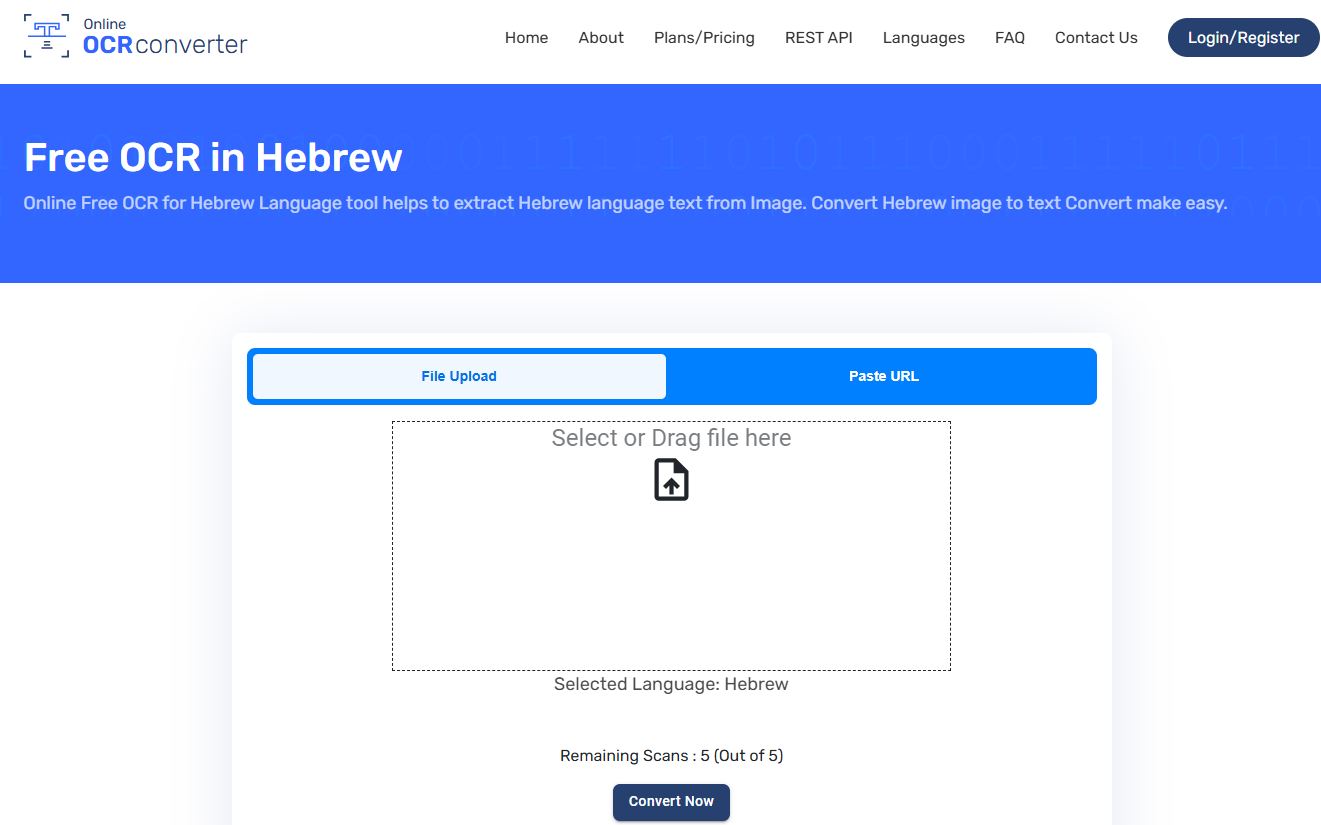
Online OCR Converter is another of the best Hebrew OCR software if you want to perform OCR on image files online without installing any software. It can take an image file from your desktop or URL and extract text from it. Afterward, you can copy and use the text where required.
Pros:
- Web-based OCR Hebrew
- Support diverse image formats
- URL-based image upload
- Click-based interface
Cons:
- Designed mainly for image-based extraction rather than layout-preserving PDF workflows
- Review current upload limits and privacy terms before processing sensitive files
- Extracted text is only copyable
User Ratings
- N/A
User Steps
Step 1. Go to the Online OCR Converter website and drag and drop the Hebrew image.
Step 2. Click "Convert Now" to perform OCR.
Step 3. Once the OCR is completed, copy the extracted text.
5. Google Docs OCR
Google Docs has a built-in OCR functionality that can extract text from PDFs or photo files. In this approach, you have to first upload the file to Google Drive and then open it with Google Docs. During this process, Google Docs will extract the text.
Pros:
- Google-powered OCR
- Extract text from PDFs or photo files
- Free OCR solution
Cons:
- Multi-step process
- Best results for file size of 2 MB or smaller
- May not detect tables, lists, endnotes/footnotes, etc.
User Ratings
- GetApp: 4.7/5
User Steps
Step 1. Go to Google Drive and upload the file.
Step 2. Right-click the file and tap Open with > Google Docs.
Step 3. Utilize the extracted text.
Part 3. What can We Do After OCR?
UPDF is not only an OCR tool but also an all‑in‑one PDF editor compatible with Windows, Mac, iOS, and Android. It offers outstanding advantages in managing and editing PDF documents. Next, I will introduce UPDF’s key features.
Click to download UPDF and try it out as you read.
Windows • macOS • iOS • Android 100% secure
Key Features:
- View PDFs: Open the OCR file and read through it without any trouble or delay. You can also change PDF background color as you like.
- Annotate PDFs: You can highlight content, drop a comment, draw a shape, and mark up your PDF as you like when you read the Hebrew file.
- Batch Process: You can batch convert, compress PDF files, OCR and so on to save your time.
- UPDF AI: It comes with a ChatGPT-powered AI assistant that can assist in reading and consuming PDF content by providing summaries about your file. It can even search academic papers about Hebrew for you.
- Cloud Storage: You can easily export all your annotations to a separate PDF and upload it to UPDF Cloud.
If you want to learn more about UPDF, you can watch the video below or read this review article.
Hebrew OCR FAQs
Can OCR preserve right-to-left Hebrew text order?
A Hebrew-capable OCR engine can recognize the characters, but right-to-left order may still break in columns, tables, or text mixed with English and numbers. Compare the output with the source before using it.
Can Hebrew OCR recognize niqqud?
Some tools may detect clear niqqud, but these small marks are easier to lose or misplace than letters. Use a high-resolution scan and verify every vocalized word manually.
How do I convert a scanned Hebrew PDF to editable text?
Open the scan in UPDF, choose Tools > OCR, select Hebrew, choose Editable PDF, set the page range, and click Convert. UPDF creates a new PDF in which you can review and edit the recognized text.
How can I copy Hebrew text from an image without breaking RTL order?
Run the image through a Hebrew OCR tool, paste the result into an editor that supports right-to-left text, and check punctuation, numbers, and mixed English phrases before reusing it.
Conclusion
Choose a Hebrew OCR tool by the file you actually have. UPDF is the strongest fit here for multi-page scanned PDFs that must remain editable or searchable across desktop and mobile; Convertio is convenient for occasional online conversion; Prizmo suits an Apple-only workflow; Google Docs can handle basic free extraction; and a simple online converter may be enough for one image. Whichever tool you choose, verify RTL order, niqqud, names, dates, and mixed-language text before relying on the output. For a wider comparison of OCR features and platforms, see our OCR software guide.
Windows • macOS • iOS • Android 100% secure






 Enid Brown
 Enya Moore
 Lizzy Lozano
 Enrica Taylor