 UPDF
UPDF
 UPDF for Windows
 UPDF for Mac
 UPDF for iPhone/iPad
 UPDF for Android
 Nomostar
 UPDF AI Online
 UPDF Sign
 IvyCraft
 Edit PDF
 Annotate PDF
 Create PDF
 PDF Form
 Edit links
 Convert PDF
 OCR
OCR PDF to Word
 PDF to Image
 PDF to Excel
 Organize PDF
 Merge PDF
 Split PDF
 Crop PDF
 Rotate PDF
 Protect PDF
 Sign PDF
 Redact PDF
 Sanitize PDF
 Remove Security
 Read PDF
 UPDF Cloud
 Compress PDF
 Print PDF
 Batch Process
 About UPDF AI
 UPDF AI Solutions
 AI User Guide
 FAQ about UPDF AI
 Summarize PDF
 Translate PDF
 Chat with PDF
 Chat with AI
 Chat with image
 PDF to Mind Map
 Explain PDF
 PDF AI Tools
 Image AI Tools
 AI Chat Tools
 AI Writing Tools
 AI Study Tools
 AI Working Tools
 Other AI Tools
 AI Bookmark Generation
 AI Bookmark Summary
 AI Watermark Generation
 AI Background Generation
 AI Sticker Generation
 AI Stamp Generation
 AI Editing Suite
 UPDF Copilot
 AI Page Management
 AI Semantic Search
 PDF to Word
 PDF to Excel
 PDF to PowerPoint
 Enterprise Solution
 Enterprise Sign
 Enterprise AI
 Enterprise Plan
 Enterprise User Guide
 Enterprise Webinar
 IT
IT Education
 Construction
 Financial Service
 Healthcare
 Insurance
 Legal
Legal Manufacturing
 Government
 Researchers & PhDs
 Solopreneurs & Freelancers
 Lawyers & Legal Professionals
 Real Estate Agents & Brokers
 Education Solution
 Customer Stories
 User Guide
 UPDF Tricks
 FAQs
FAQs UPDF Reviews
 Download Center
 Blog
Blog Newsroom
 Tech Spec
 Updates
 UPDF vs. Adobe Acrobat
 UPDF vs. Foxit
 UPDF vs. PDF Expert

“My current PDF AI reader lets me upload an entire 200-page market report, but it just sits there waiting for me to ask questions. I don't even know what critical blind spots to ask about. When I finally prompt it to summarize a section, it hallucinates data points that don't exist in the source text, forcing me to manually scroll and cross-verify everything anyway.”
— Dr. Aris Thorne, Research Coordinator
This systemic passivity is the hidden efficiency tax of modern document workflows. While the 2026 market is flooded with pdf ai chat utilities that promise to chat with your documents, most operate as generic, reactive search boxes. They heavily rely on the user knowing exactly what to look for, and their lack of structured indexing often leads to severe contextual hallucinations when parsing dense enterprise data.
True analytical leverage isn't just about having an isolated chat prompt; it's about proactive semantic analysis. In this 2026 review, we hands-on test the leading ai for pdf tools to see which platforms bridge this gap. You will discover exactly how modern engines map out complex document hierarchies, extract verifiable citations, and transform massive, unreadable files into interactive knowledge bases.
Quick Decision Matrix: Which PDF AI Tool Fits Your Workflow?
Choosing the right AI for PDF depends on how you work, rather than which tool looks cool. Look at the table below to match your workflow with a focused recommendation:
| Target Audience/Use Case | Recommended PDF AI Tool | Core Advantage |
| Modern SMBs, Researchers, and Teams | UPDF AI PDF Editor | Typographic Integration: Inline text reflow, 1-click multi-box alignment, and context-aware ai pdf reader tools without tab-switching. |
| Agile, On-the-Go Professionals & Students | UPDF AI Online Interface | Cloud-Native Speed: Instant, browser-based chat, deep document summarization, bilingual layouts, and visual mind-mapping across devices with zero software installation. |
| Enterprise & Legal Compliance | Adobe Acrobat + AI Assistant | Legacy legal form-filling and compliance-grade data auditing (Requires premium add-on subscription). |
| Casual Cross-Format Analysis | ChatGPT / Google Gemini | Fast cross-document querying, but completely lacks native PDF layout or text-editing capabilities. |
| Casual, Lightweight Web Ingestion | ChatPDF | Zero-Friction Utility: Simple, lightweight cloud interface for casual fact-extraction on Chromebooks/tablets, but restricted by strict file sizes and zero edit tools. |
Top 5 PDF AI Tools Reviewed (2026 List)
Users need reliable AI tools because guessing with random apps easily breaks trust, workflow, and important documents. When a tool is unstable, you waste time fixing errors instead of understanding content or finishing real work. Now, let's see how the right PDF AI tools can support you every single day.
1. UPDF — The Ultimate All-in-One AI PDF Editor & Reader
Best For: Academic researchers, students, financial analysts, and corporate managers who need to rapidly ingest, translate, and synthesize massive, complex documents within a multi-scenario workflow.
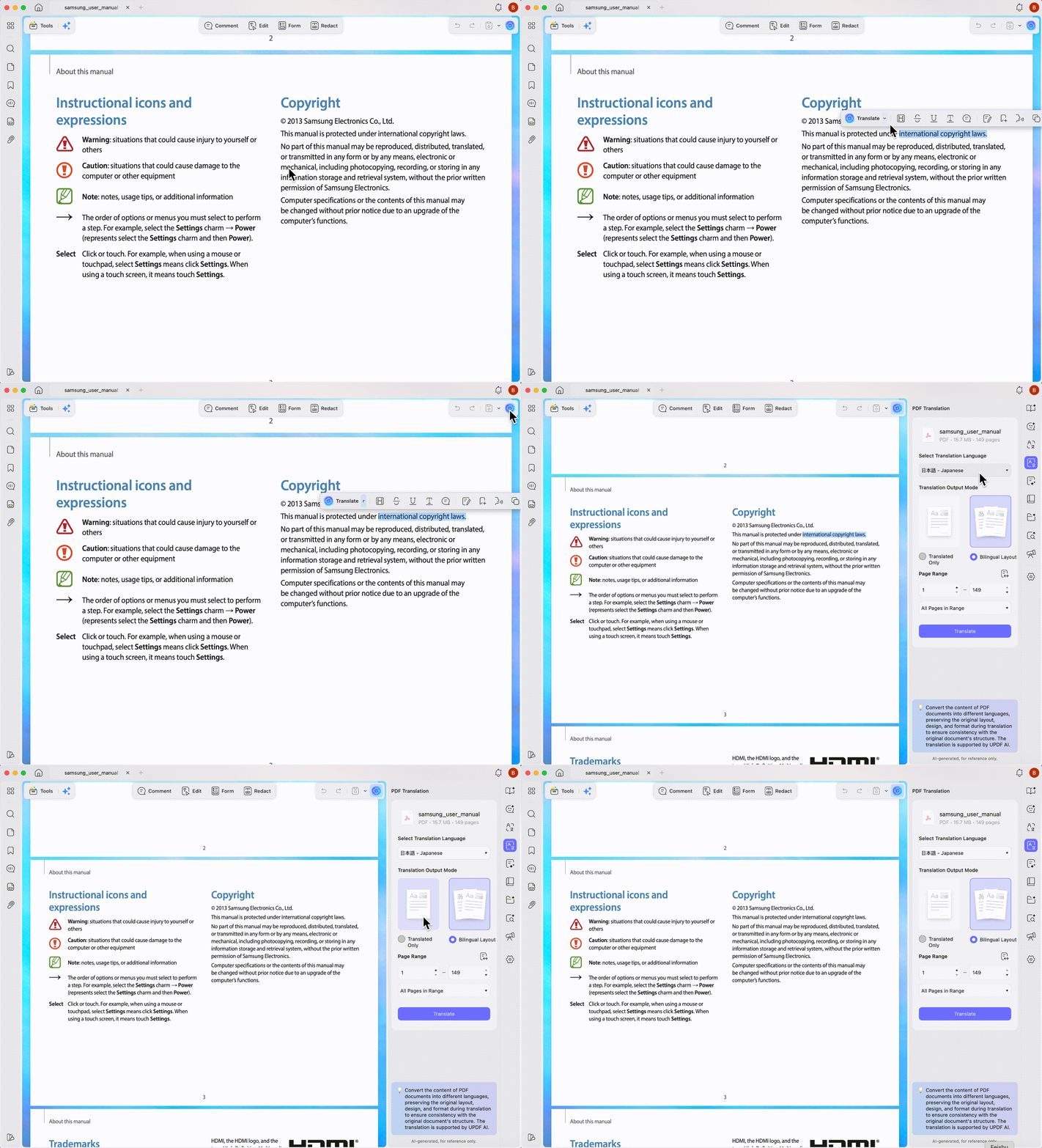
UPDF completely eliminates this tab-shuffling by serving as an AI PDF reader that integrates its intelligence directly into the document layer. When reading multi-column research papers or foreign supplier manuals across 26 languages, you no longer have to copy and paste text into a side chatbot. You can just highlight an elusive term or clause on the canvas to invoke an immediate Translate or Summarize command via the overlay pop-up menu. For deep study, you can output a clean Translated Only file or utilize the translate pdf to english workflow to view sentences side-by-side in a Bilingual Layout without losing original fonts or breaking pricing tables.
Windows • macOS • iOS • Android 100% secure
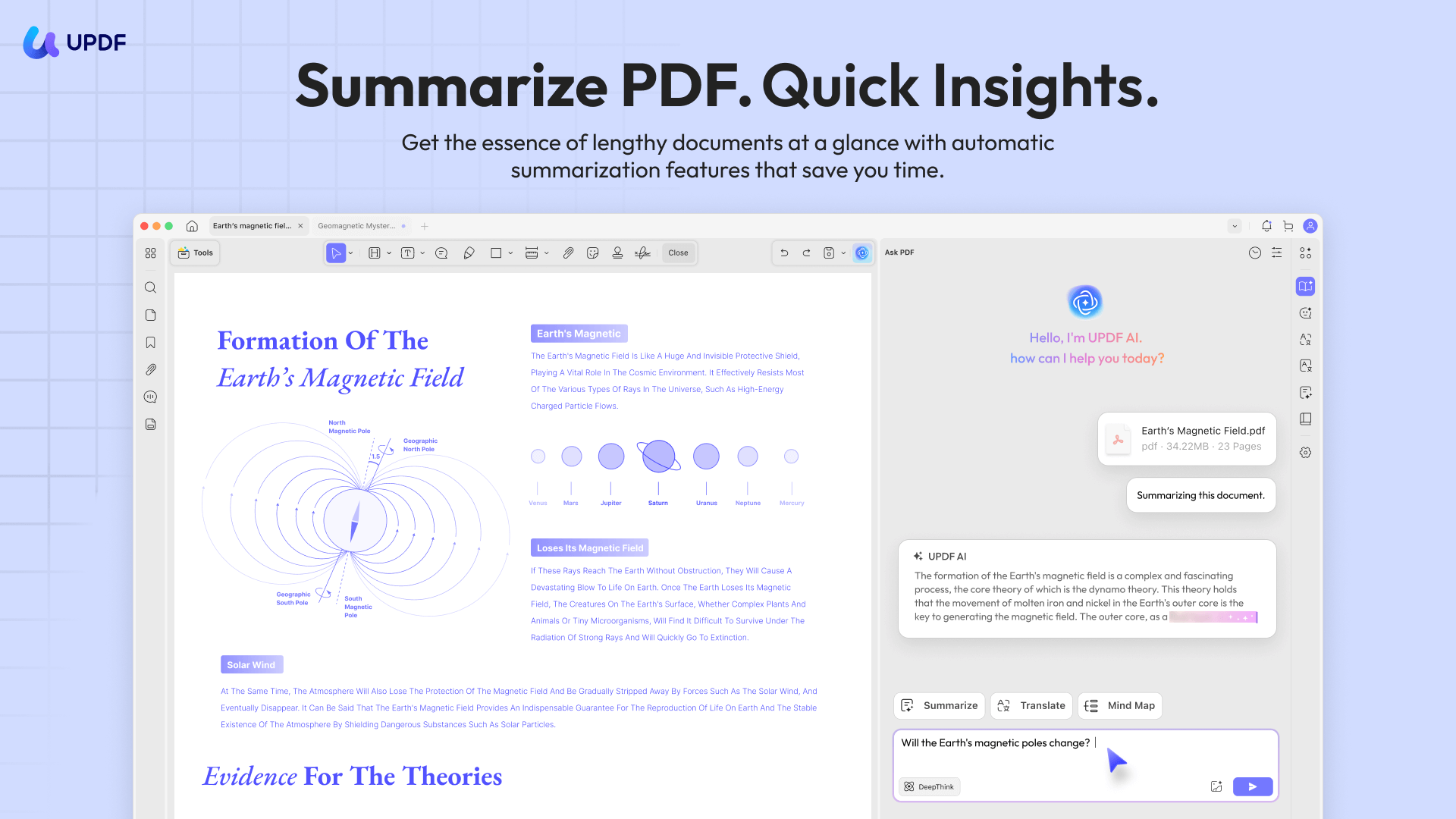
To conquer reading fatigue under tight deadlines, the platform allows you to effortlessly summarize pdf files with a Global Summary generated automatically upon file upload. You can safely cross-examine dense financial grids within a secure workspace, where the AI engine operates on a strict localized context retrieval mechanism—ensuring every response is deeply anchored to your document's verifiable datasets to eliminate hallucination risks.
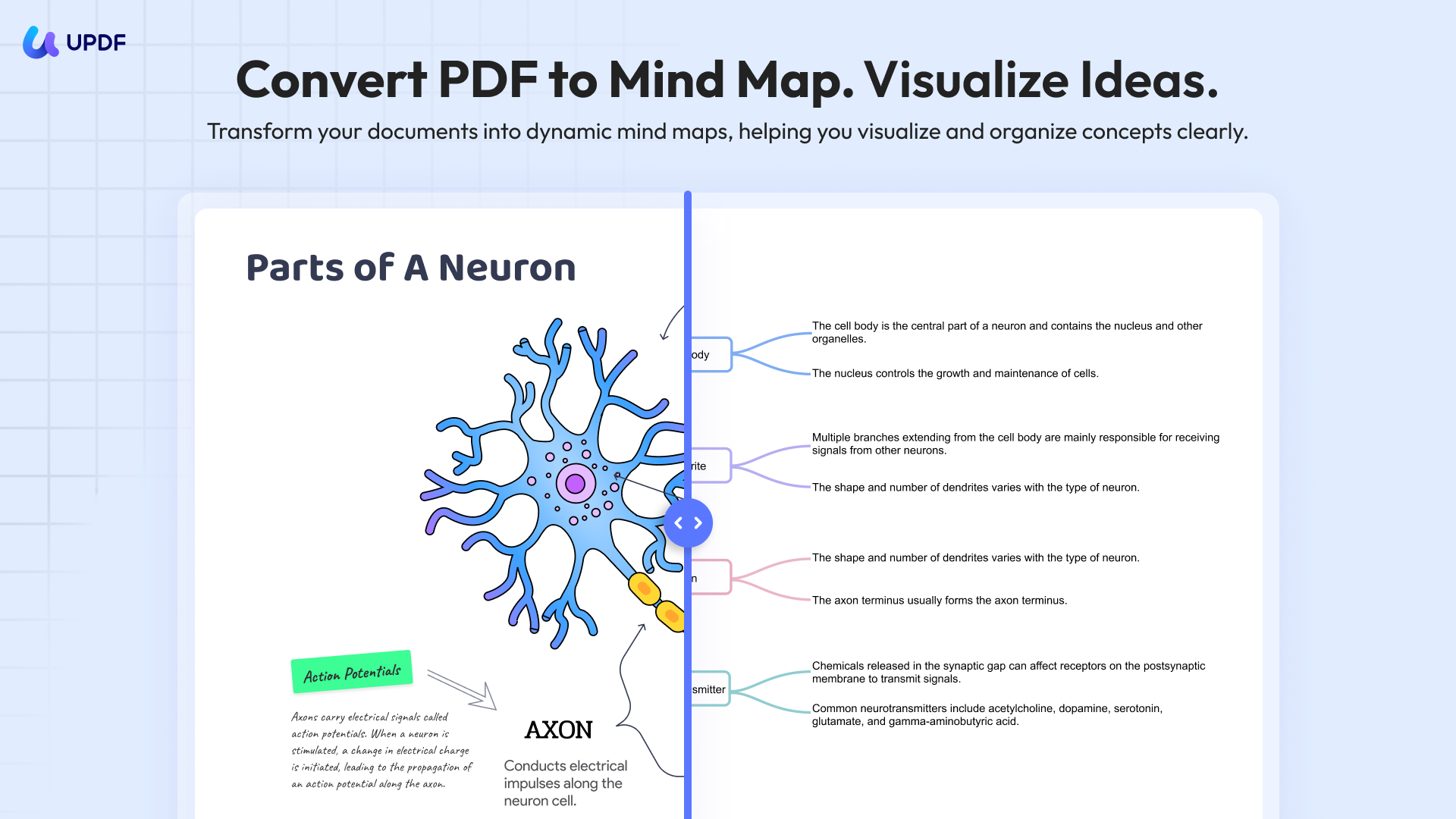
Finally, to help you present or internalize unstructured data, a single click invokes the pdf to mind map tool, instantly converting the document's semantic relationships into an organized, expandable visual schema that makes it a highly fluid environment for end-to-end research.
Dual-Engine Ecosystem: Desktop Power Meets Browser Flexibility
Unlike single-tab web utilities, UPDF delivers its AI intelligence across two interconnected workflows:
- The App Workspace (Desktop & Mobile): Built for deep research. It weaves advanced AI features directly into a complete PDF editor, letting you jump from an AI translation straight into real-time text editing, organizing, or annotating without switching software.
- The UPDF AI Online Interface: Built for zero-friction, browser-based speed. Requiring zero installation, this cloud engine focuses purely on smart understanding. You can upload multiple PDF files to instantly execute conversational chat, summarize pdf runs, bilingual translations, or visual mind-mapping. For users who does not want install software, try the Online version of UPDF AI.
Testing UPDF AI: Free Trial & Scalable Pricing
For professionals looking to audit these features against real-world work files, UPDF offers an entry tier that serves as a highly practical chatpdf alternative.
If you want to observe how this dual-engine interface behaves under heavy analysis before setting up an account, explore the strategic workflow video below to watch UPDF parse and translate multi-layered study files in real-time.
2. ChatPDF — The Best for Quick, Casual Browser-Based Ingestion
Best For: Students and casual web users who need to quickly extract basic facts from a light textbook chapter or non-confidential PDF link without installing apps.
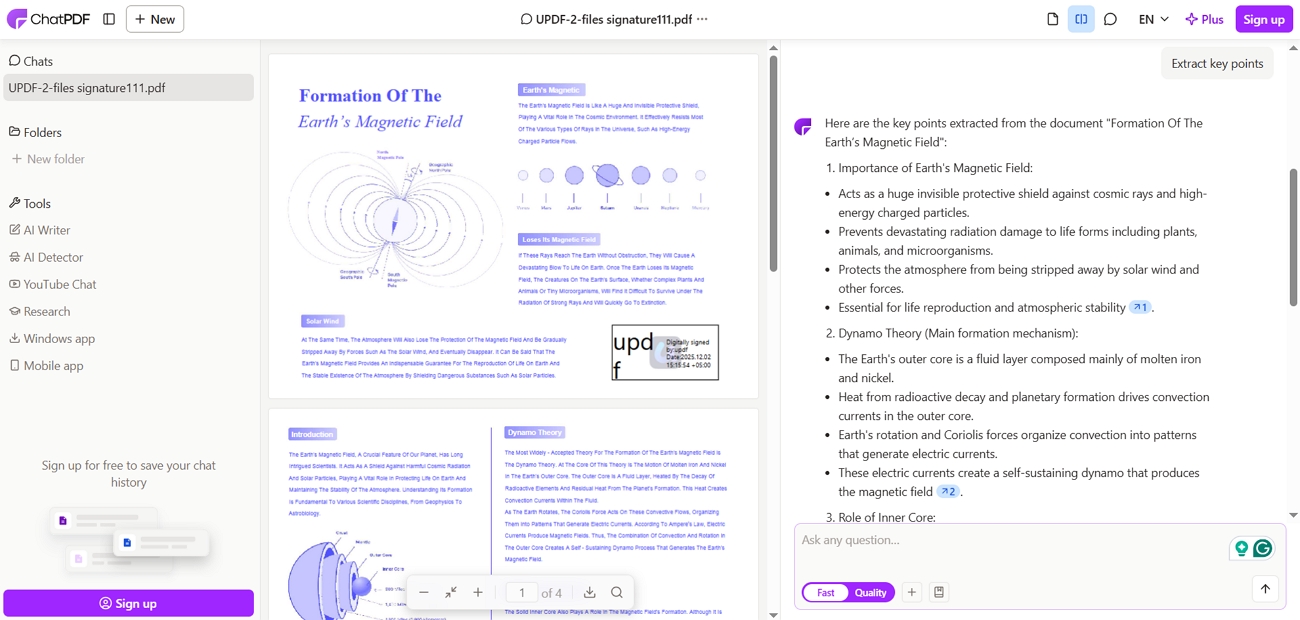
As an early pioneer and highly popular chatpdf alternative workflow, ChatPDF offers the ultimate lightweight convenience. The interface is completely stripped down: you drag a file into your web browser, and a simple chat interface appears instantly. It uses clean memory-caching to let users ask basic questions about data tables, making it perfect for lightweight Chromebooks or tablets where local software installation is blocked or unnecessary.
The Operational Trade-Off: ChatPDF functions strictly as a basic cloud utility. It has zero capability to modify original PDF text, cannot translate documents while matching font typography, and lacks advanced visual tools like automatic mind-mapping. Additionally, because it requires uploading your entire file to remote, third-party cloud servers, it poses real corporate compliance and GDPR data-leak risks, making it entirely unsuited for sensitive financial reports or private contracts.
Pricing Plans
| Plan | Pricing | Questions |
| Basic | $0 | 50 |
| Plus | $5.99/month | 100 |
3. Adobe Acrobat AI Assistant — The Best for Legacy Corporate Compliance
Best For: Enterprise legal departments and massive law firms already locked into the Adobe ecosystem who require compliance-grade document auditing.
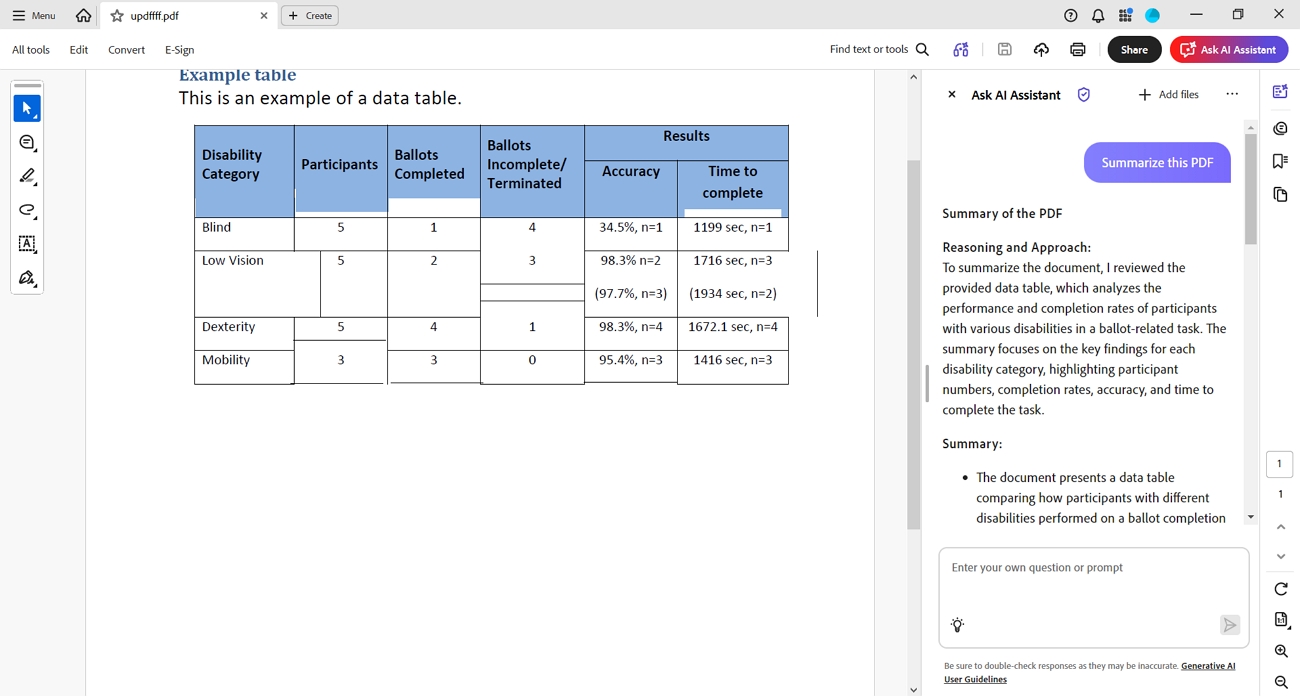
Adobe Acrobat remains the enterprise benchmark for formal documentation, and its newly integrated AI Assistant leverages that legacy architecture perfectly. It excels at scanning heavily encrypted legal forms, generating high-level summaries across massive corporate archives, and verifying standard electronic signatures.
The Operational Trade-Off: While Adobe's semantic data parsing is incredibly secure, its AI interface functions as a completely detached right-hand side-panel. It is a strictly "read-only" commentator. If you ask it to rephrase an enterprise clause, you cannot execute that change inline fluidly; you must copy the response, manually switch into Acrobat's heavy editing mode, and double-click the rigid frame. Furthermore, the AI features require a premium subscription ($9.99/month billed annually) on top of your already expensive standard Acrobat Pro license, making it a high-cost barrier for mid-market users.
Pricing Plans
In most cases, Acrobat AI Assistant is not bundled and appears as a separate, billable add-on. Acrobat Studio is the only individual plan in this lineup that broadly includes AI features for $24.99/month. If your existing Acrobat subscription does not bundle AI, Adobe offers a separate Acrobat AI Assistant add-on starting at $4.99/month, depending on region and current promos.
4. ChatGPT — The Best for Multi-Format Data Synthesis
Best For: Creative professionals and marketing managers who need to cross-reference data across PDFs, Excel spreadsheets, and raw web URLs simultaneously.
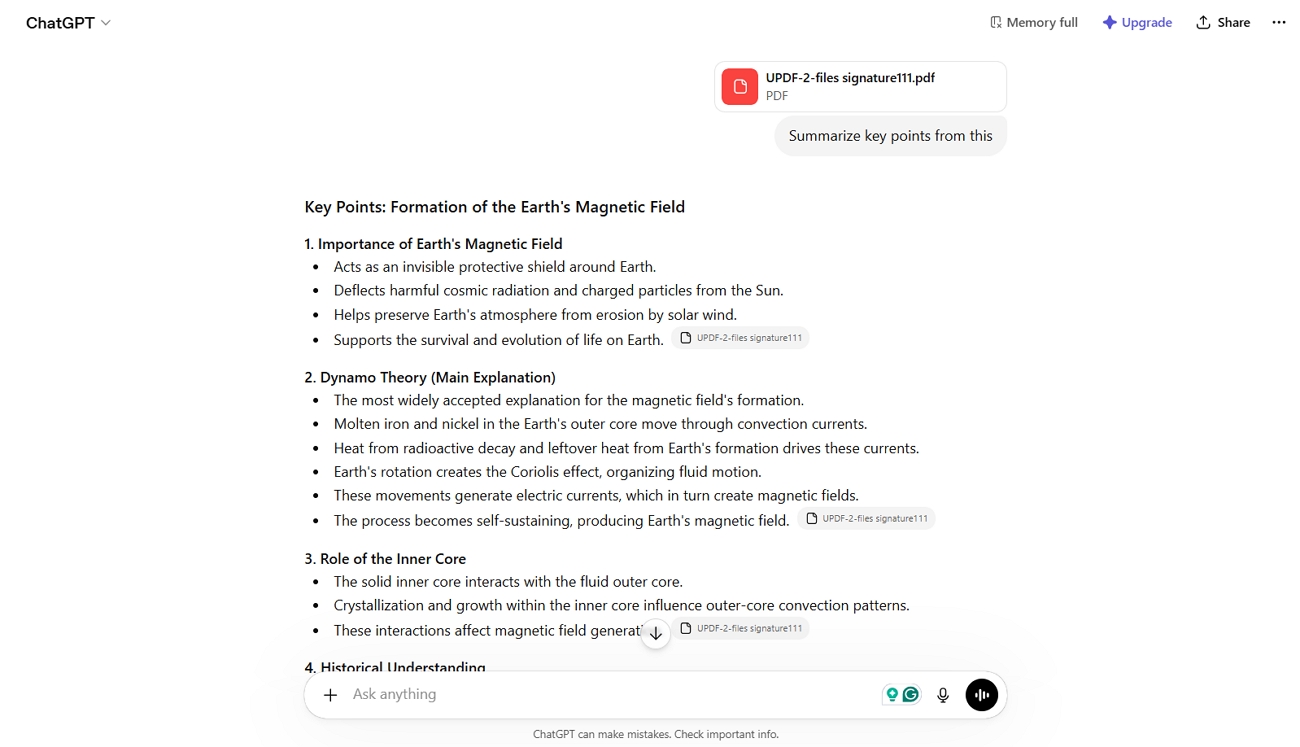
As a pioneer in generative intelligence, ChatGPT (powered by GPT-4o) offers immense computational reasoning scale. When you upload a document into its interface, its neural network parses data with extreme speed. It excels at complex, cross-format synthesis—allowing you to execute comparative prompts like, "Analyze this PDF marketing plan, cross-reference it with this uploaded competitor pricing sheet, and draft a tailored promotional email." For non-linear brainstorming and synthesizing unstructured text from disparate file types, its logic remains a benchmark.
The Operational Trade-Off: ChatGPT is a native web chatbot, meaning it completely lacks a native document layout layer. It treats your PDF as a flat, extracted text string. You cannot view the original page margins, fix a typo on the page, or handle basic page management like reordering or deleting sheets. If your day-to-day workflow requires acting directly on the document canvas rather than just mining text out of it, the constant downloading, uploading, and tab-switching between your web browser and a local desktop reader becomes a severe operational bottleneck.
Pricing Plans
| Plan | Price |
| Free | $0 |
| Plus | $20/month |
| Pro | $200/month |
| Team/Business | Custom pricing |
5. Google Gemini — The Best for Ecosystem Integration & Real-Time Data Grids
Best For: Enterprise operations and professionals heavily anchored to Google Workspace (Docs, Sheets, Drive) who require expansive contextual memory.
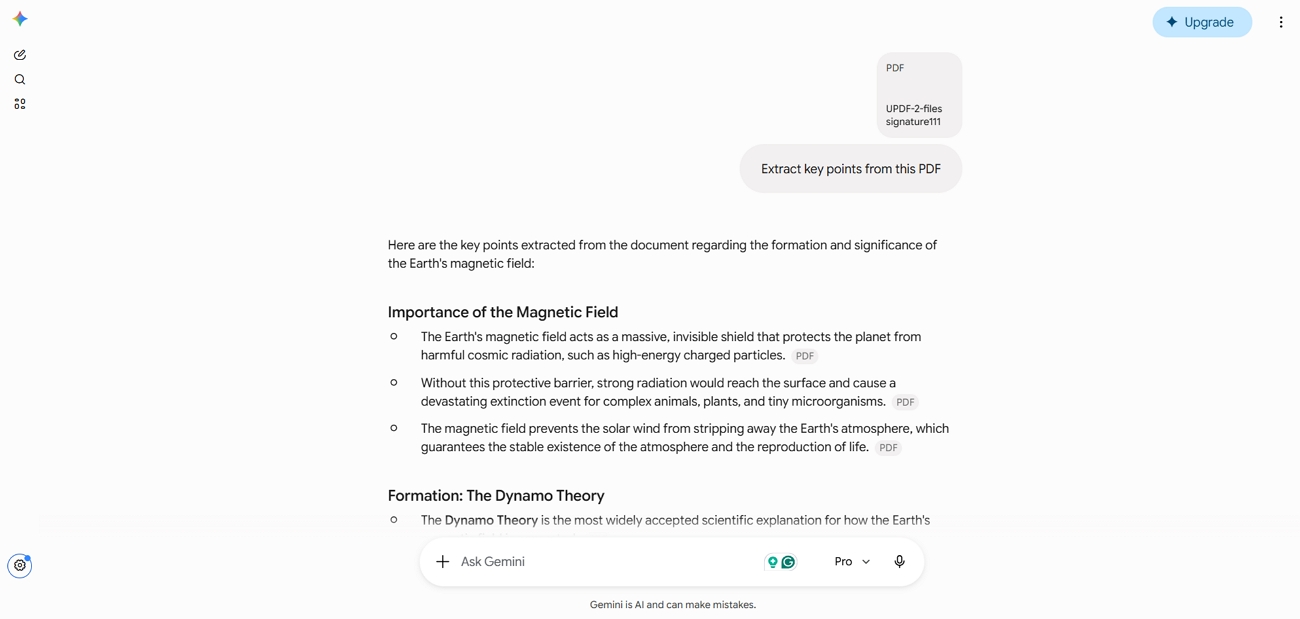
Google Gemini shines through its massive context window and deep, native integration with the cloud ecosystem. When processing massive, data-heavy PDFs, Gemini excels at parsing intricate data grids and mapping out sprawling research reports. Its defining edge is its real-time connection to the web and your private cloud: you can pull a PDF directly from Google Drive, ask Gemini to analyze it, and immediately export the extracted insights into a live Google Doc or Sheet with a single click, creating a highly collaborative pipeline.
The Operational Trade-Off: Similar to ChatGPT, Gemini functions strictly as a reactive chat interface and completely lacks document-level editing capabilities. It cannot modify original PDF typography, line weights, or bounding box structures. Furthermore, users frequently note that when dealing with strictly offline PDF workflows or highly sensitive financial reports that cannot legally be indexed by external cloud models, a cloud-dependent chatbot poses significant compliance and corporate privacy risks compared to a localized desktop solution.
Pricing Plans
| Plan | Price |
| Gemini Basic | $0 |
| Plus | $7.99/month |
| Pro | $19.99/month |
| Ultra | $99.99/month |
Technical Basics: How AI Parses PDF Semantics?
When you open a PDF in AI for PDF tools, they first convert messy pages into clean text. OCR (Optical Character Recognition) reads characters from scanned pages or images and turns them into editable words. This step makes old books, printed contracts, or photographed notes searchable and easy to copy or highlight.
Then. NLP (Natural Language Processing) looks at sentences, headings, and paragraphs to understand how everything connects logically. It helps the tool spot sections, questions, definitions, and key points instead of seeing only raw text. Together, OCR and NLP let AI understand both what your PDF says and how the document is structured.
People Also Ask
1. Which AI tool is best for long PDFs?
For very long academic PDFs, ChatPDF keeps context across questions so follow-ups stay focused. When you also need editing and comments, UPDF and Acrobat add control alongside smart reading.
2. How do AI PDF tools help students study?
Students turn dense chapters into short summaries and simple explanations that feel easier to review. UPDF adds page summaries, OCR, and tidy reading tools so notes and pages stay organized.
3. Can AI replace traditional PDF editors completely?
No, AI tools currently understand document text but cannot manage complex layout typography or compliant desktop document editing. Most professional workflows utilize AI for fast content comprehension while relying on comprehensive editors like UPDF to execute precise formatting, 1-click text alignment, and official document exporting.
4. Which PDF AI option feels most all-in-one?
UPDF delivers the most unified experience by combining an inline ai pdf editor with a deep bookmark summary agent inside a single workspace. Unlike standard web tools like ChatGPT or ChatPDF which only offer Q&A chats, UPDF allows you to modify text, align misaligned frames, and invoke AI rewriting directly on the document canvas without switching browser tabs.
Conclusion: The New Era of Seamless Documentation
To conclude, this guide showed how different people need different workflows from modern PDF tools. We explored how tools can reduce clicks and confusion, so PDF AI feels like quiet background support. If you want one calm workspace instead of tab chaos, downloading a modern AI PDF reader and editor like UPDF keeps everything simple and secure.
Windows • macOS • iOS • Android 100% secure





 Engelbert White

 Grace Curry
 Enya Moore
 Enola Miller
— Dr. Aris Thorne, Research Coordinator