 UPDF
UPDF
 UPDF for Windows
 UPDF for Mac
 UPDF for iPhone/iPad
 UPDF for Android
 Nomostar
 UPDF AI Online
 UPDF Sign
 IvyCraft
 Edit PDF
 Annotate PDF
 Create PDF
 PDF Form
 Edit links
 Convert PDF
 OCR
OCR PDF to Word
 PDF to Image
 PDF to Excel
 Organize PDF
 Merge PDF
 Split PDF
 Crop PDF
 Rotate PDF
 Protect PDF
 Sign PDF
 Redact PDF
 Sanitize PDF
 Remove Security
 Read PDF
 UPDF Cloud
 Compress PDF
 Print PDF
 Batch Process
 About UPDF AI
 UPDF AI Solutions
 AI User Guide
 FAQ about UPDF AI
 Summarize PDF
 Translate PDF
 Chat with PDF
 Chat with AI
 Chat with image
 PDF to Mind Map
 Explain PDF
 PDF AI Tools
 Image AI Tools
 AI Chat Tools
 AI Writing Tools
 AI Study Tools
 AI Working Tools
 Other AI Tools
 AI Bookmark Generation
 AI Bookmark Summary
 AI Watermark Generation
 AI Background Generation
 AI Sticker Generation
 AI Stamp Generation
 AI Editing Suite
 UPDF Copilot
 AI Page Management
 AI Semantic Search
 PDF to Word
 PDF to Excel
 PDF to PowerPoint
 Enterprise Solution
 Enterprise Sign
 Enterprise AI
 Enterprise Plan
 Enterprise User Guide
 Enterprise Webinar
 IT
IT Education
 Construction
 Financial Service
 Healthcare
 Insurance
 Legal
Legal Manufacturing
 Government
 Researchers & PhDs
 Solopreneurs & Freelancers
 Lawyers & Legal Professionals
 Real Estate Agents & Brokers
 Education Solution
 Customer Stories
 User Guide
 UPDF Tricks
 FAQs
FAQs UPDF Reviews
 Download Center
 Blog
Blog Newsroom
 Tech Spec
 Updates
 UPDF vs. Adobe Acrobat
 UPDF vs. Foxit
 UPDF vs. PDF Expert

Writing an argumentative essay can feel overwhelming, especially with a controversial topic and a deadline closing in. The good news is that a great argument is not about being the loudest voice in the room. It is about building a logical and evidence-backed case that is hard to ignore.
But, how do you even start an argumentative essay? For starters, you will need a compelling hook, background information, and a sharp thesis statement. This guide covers all these elements in detail, along with proper structure and outline format. So, you can learn how to write an argumentative essay without confusion.
Throughout this process, you will need to do solid research to support your argument. UPDF makes this process easier with its AI-driven deep research tools. Download and try it for free now.
Windows • macOS • iOS • Android 100% secure
Part 1. The 5 Pillars: Understanding the Argumentative Essay Format
An effective argumentative essay depends on the following five core elements.
- Claim: Your main argument.
- Evidence: Data to support your claim.
- Warrant: Logical connection between evidence and claim.
- Backing: Extra support for your argument.
- Counter-claim: The strongest opposing view addressed with a rebuttal.
The Standard Argumentative Essay Format:
Once you understand the five pillars, you can apply them in an organized argumentative essay format, as explained below.
Introduction:
Begin with a hook that shows why the topic matters. Then, provide brief background information so readers understand the issue. When ending the introduction, use a precise thesis statement that states your claim clearly.
Body Paragraph 1. Strongest Argument:
Start with your strongest point and present relevant evidence to support it. Then explain how that evidence supports your thesis through clear reasoning. Do not assume readers will make the connection on their own.
Body Paragraph 2. Supporting Evidence:
The first body paragraph will introduce a second argument that supports your thesis from a different angle. To make your essay more persuasive, you will also provide a varied type of evidence, such as statistics, expert testimony, or case examples.
Body Paragraph 3. The Counter-Argument:
In this paragraph, you will address the most serious objection to your position. As you do so, present the objection fairly and accurately. After that, you can refute it with evidence and supporting context. Here, you will also need to use advanced academic writing to build a strong rebuttal.
Conclusion:
Restate your thesis using new wording. Then summarize your strongest supporting points. Finally, end with a broader implication, recommendation, or question for reflection. However, do not introduce new evidence in the conclusion.
Note: Be aware that AI tools are most useful for brainstorming ideas and summarizing complex sources. However, your claim and reasoning should come from your own critical analysis. Otherwise, it will defeat the entire purpose of academic writing.
Now, let's see how to write an argumentative essay step by step.
Part 2. Step-by-Step: The 5-Step Writing Process
Writing an effective argumentative essay involves the following five steps:
- Researching the topic
- Creating an outline
- Drafting the argument
- Addressing counterarguments
- Polishing the final draft.
While each step of this process requires plenty of time commitment, you can simplify it with the help of specialized tools such as UPDF and its AI assistant.
Researching Smarter with UPDF AI Online
In the research phase, you'll need to find and review credible sources across multiple academic databases. UPDF AI Online helps you simplify this process with its smart Scholar Research feature. Here's how to use it.
Step 1. Open the official webpage of UPDF AI Online. Select the "Scholar Research" option from the left panel and enter your research topic in the text field.
Step 2. Select "Standard" or "High Quality" research mode based on how deeply you want AI to research. Finally, click "Send" to proceed.
Step 3. To narrow the review, UPDF AI will ask for more specific information. Based on the questions, type additional details in the prompt box and hit "Send."
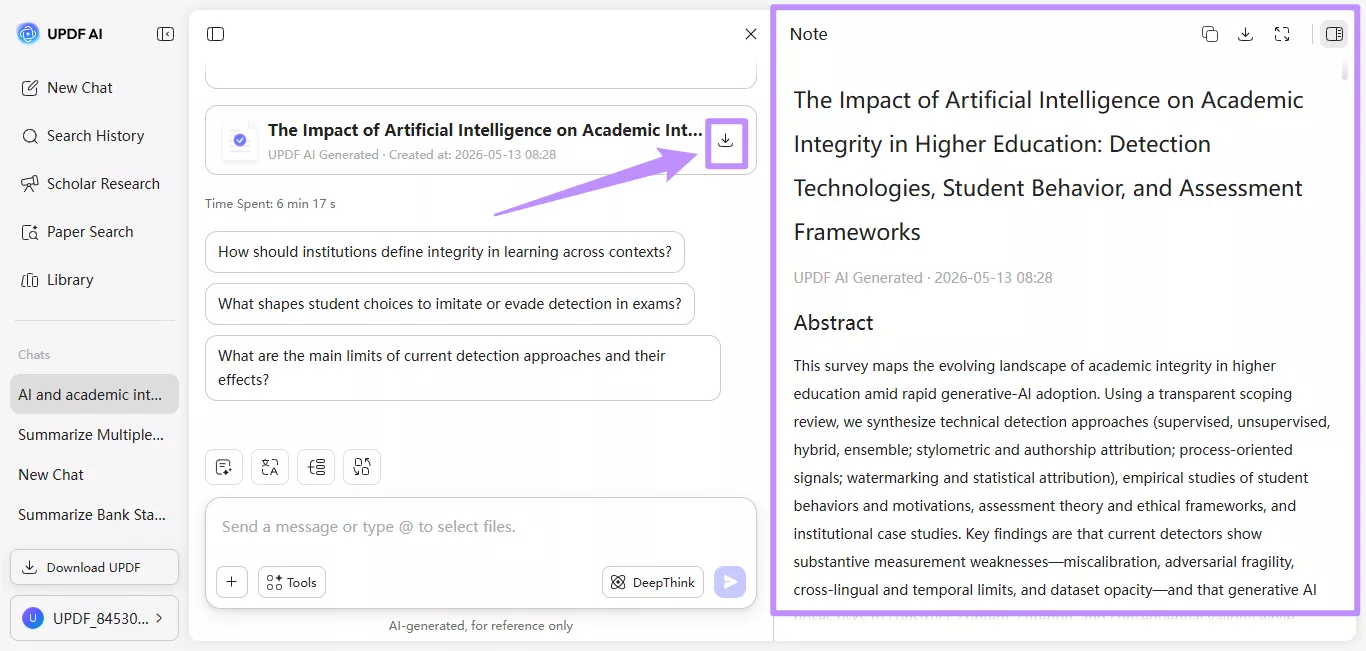
Step 4. UPDF AI will start a comprehensive paper research based on specific keywords related to your research topic. Then, it will provide a comprehensive literature review report in PDF format.
Step 5. You can click the PDF file to open and view it directly in chat. Or, click the "Download" button to save it on your device.
In addition to Scholar Research, you can use the "Paper Search" feature to find argumentative essay examples relevant to your topic. Simply select the "Keyword" mode when searching and the AI will index all relevant papers.
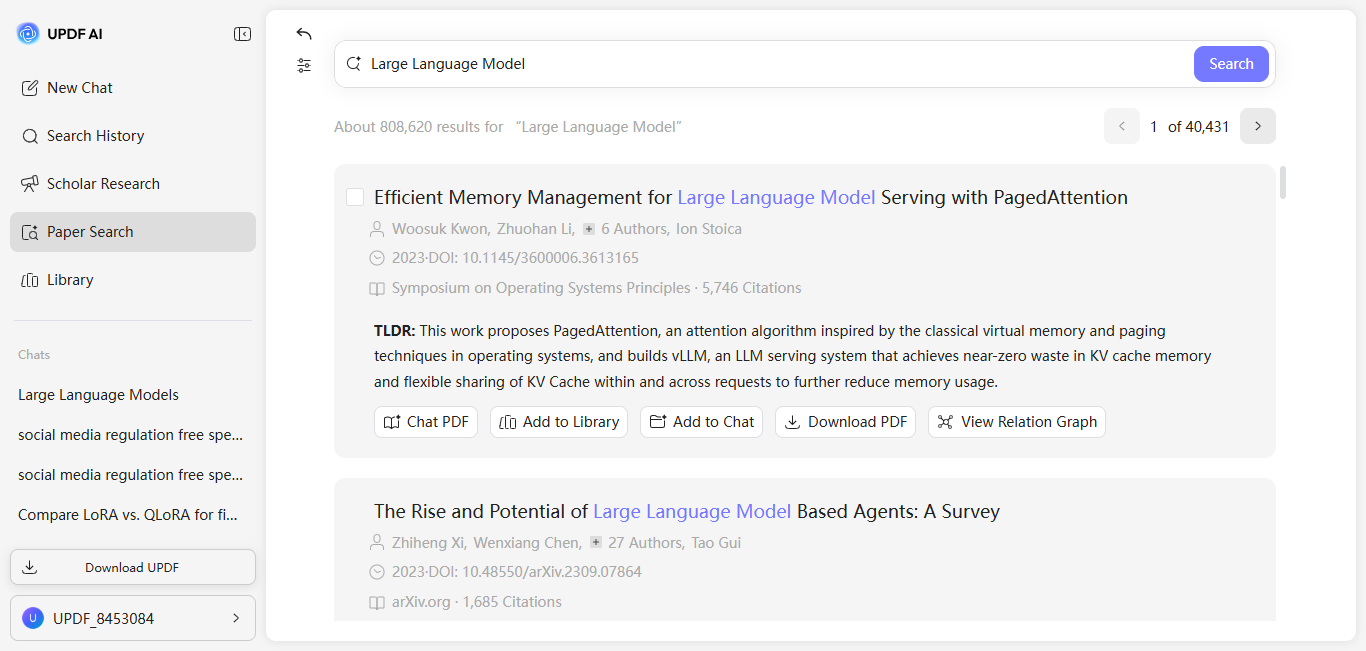
If you want a detailed explanation of how UPDF's Paper Search works, you can watch our video on How to Streamline Your Research with UPDF AI Online.
Part 3. Blueprint for Success: The Format of an Argumentative Essay Outline
A successful argument is divided into four sections, including claim, evidence, explanation, and rebuttal. A solid outline ensures all four appear in the right place before writing your essay.
Now, let's look at the format of an argumentative essay outline you can use.
1. Introduction
- Hook: An attention-grabbing opening statement
- Background: Brief context for the debate
- Thesis Statement: Your central claim, stated directly
2. Paragraph I: Strongest Supporting Argument
- Claim: The point this paragraph defends
- Evidence: Specific data, study, or expert source
- Explanation: Why does evidence support your thesis?
3. Paragraph II: Secondary Supporting Argument
- Claim: A distinct second line of support
- Evidence: A different type of source from Paragraph 1
- Explanation: The logical connection back to your thesis
4. Paragraph III: Counter-Argument and Rebuttal
- Counter-claim: State the strongest opposing view fairly
- Evidence: What the other side cites in their support
- Rebuttal: Why your position still holds, and with evidence
5. Conclusion
- Restate thesis in fresh language
- Summarize your three core points
- End with a closing thought or broader implication
Building a Stronger Rebuttal with UPDF AI Online
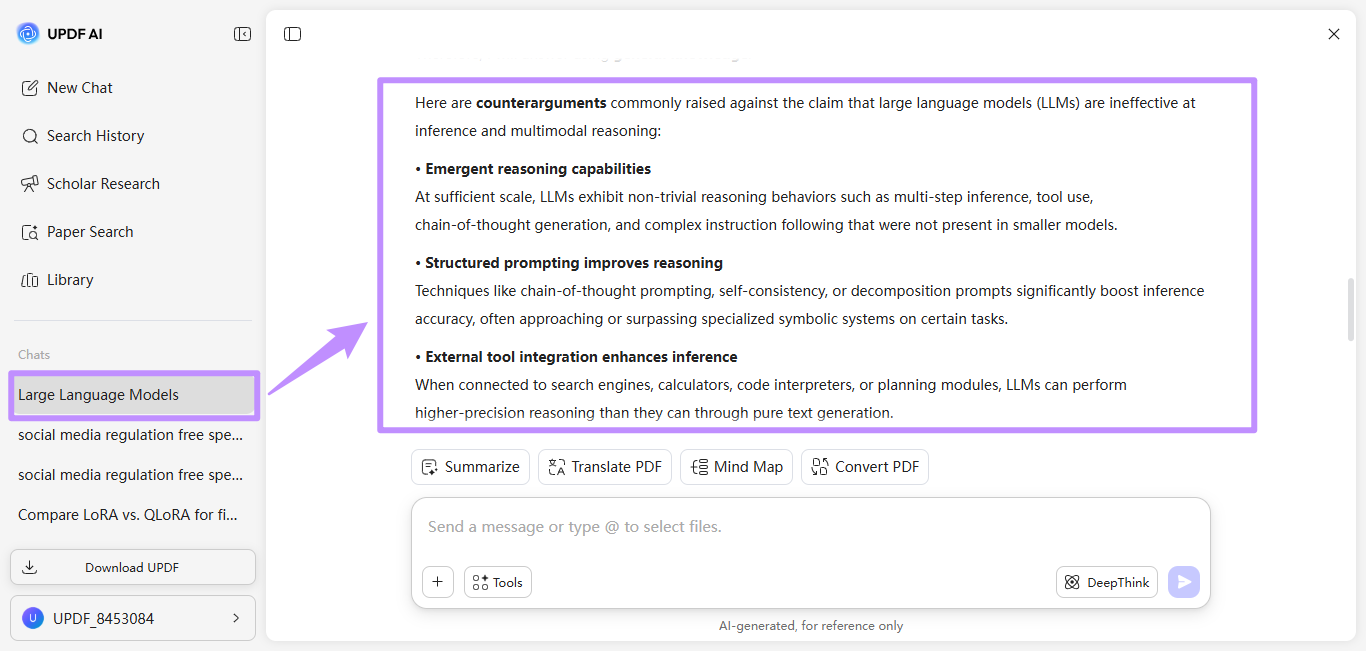
A convincing counter-argument requires you to think like your opponent, which is not always easy when you are committed to your own position. This is where UPDF AI Online gives you a real advantage with its Chat Project feature. It allows you to add multiple research PDFs with opposing arguments to a single chat and brainstorm rebuttals with AI.
Simply ask AI something like this: "What are the common counter-arguments to [Your Thesis]?" The AI will instantly extract all counterarguments that you can address in your essay.
Part 4. Final Polishing & Academic Efficiency
By this stage, you likely have several PDFs open alongside your first draft. However, switching between documents manually can waste time and disrupt your workflow.
UPDF can help you work faster and stay organized during the final review process. It allows you to cross-reference faster with its advanced annotation and AI-driven search tools.
Here's how it can help.
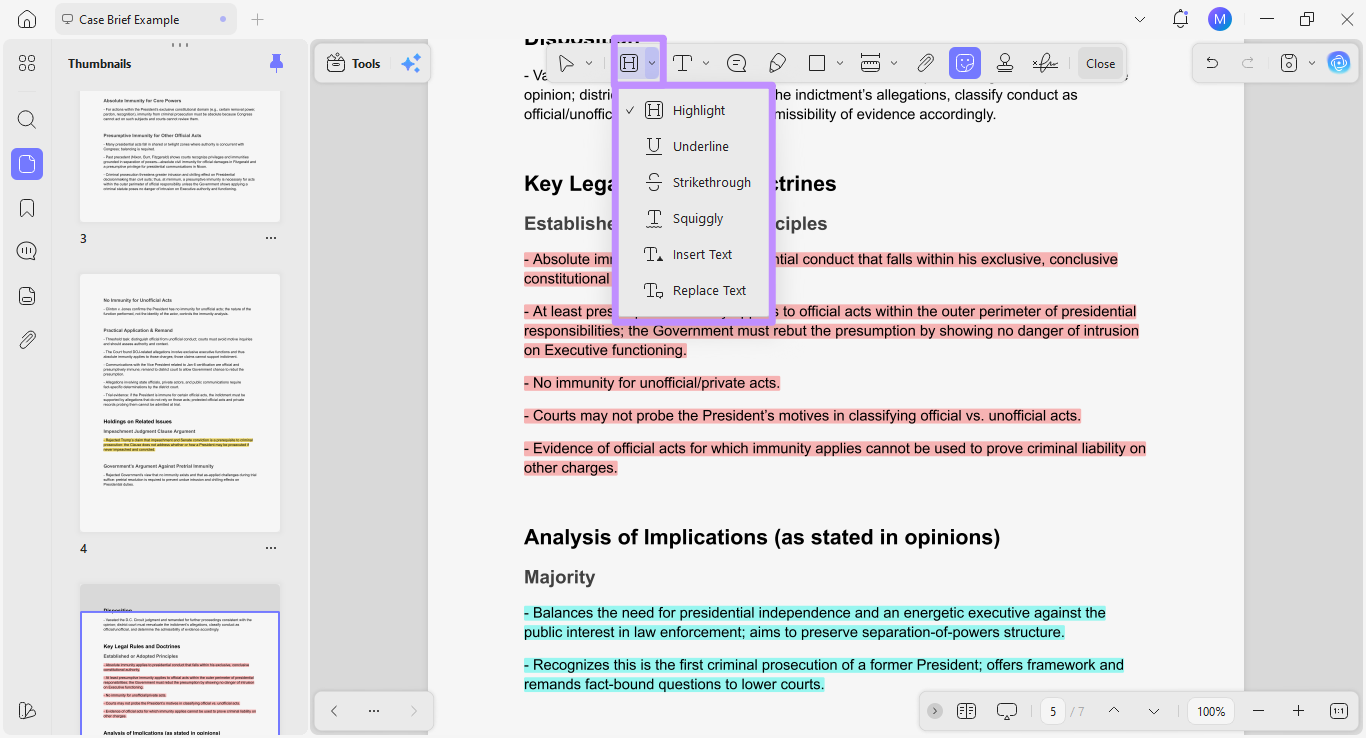
- Markup and Annotate: These tools let you highlight, underline, and strike through text. In addition, you can add squiggly lines, stamps, stickers, and text callouts. As a result, important edits and comments remain clear and easy to track.
- Semantic Search: If you need to cross-check specific terms or phrases in your draft, the AI Search tool allows you to find all instances of a word by its context and meaning. So, you can find a relevant passage even if it uses different terminology.
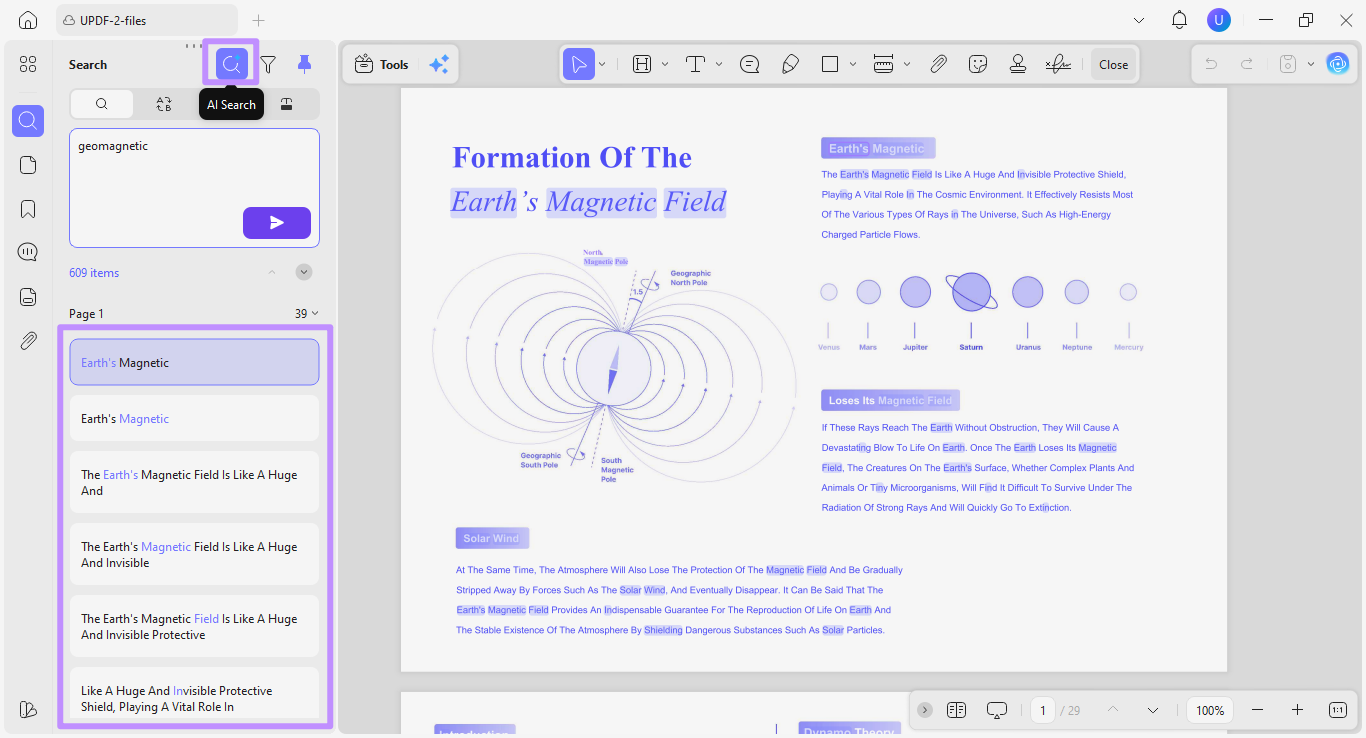
- Export Your Final Draft: Once you're done with your edits, you can export your draft in a PDF/A format. This format is commonly required by universities and institutions for official submissions.
You can try these features for free. If you need full editing access, you can upgrade to the premium version at a reasonable price. UPDF also offers an exclusive discount of up to 50% off for students. Compared with alternatives such as Adobe Acrobat, it provides stronger value for students managing a limited budget.
So, don't miss out. View UPDF Education pricing today or learn more about the key education benefits it offers.
FAQ: Common Student Queries
Q1: Can I use "I" in an argumentative essay?
No, it is best to avoid it in most academic contexts. This is because the first-person language shifts the focus from the argument to the writer, which weakens your authority.
Q2: How do I find credible argumentative essay examples?
You can use the Paper Search feature in UPDF AI Online to find credible argumentative essay examples. It allows you to search your topic by keywords to pull peer-reviewed papers from a database of over 220 million academic sources.
Q3: Is UPDF AI Online better for research than ChatGPT?
Yes. Unlike ChatGPT, UPDF AI Online offers more dedicated research tools, such as Scholar Research and Paper Search. These tools identify the latest peer-reviewed literature directly. Meanwhile, ChatGPT generates responses from training data, which can result in inaccurate citations.
Conclusion
Learning how to write an argumentative essay comes down to proper structure, credible evidence, and a rebuttal you can defend under scrutiny. If you get these right, you can give your argument more weight and grit. UPDF can simplify this entire process by helping you find peer-reviewed sources and organizing your final draft for submission. So, if you're ready to ace your essay assignment, try UPDF AI Online for free or download UPDF on your desktop.
Windows • macOS • iOS • Android 100% secure







 Enid Brown


 Lizzy Lozano