 UPDF
UPDF
 UPDF for Windows
 UPDF for Mac
 UPDF for iPhone/iPad
 UPDF for Android
 UPDF AI Online
 UPDF Sign
 IvyCraft
 Edit PDF
 Annotate PDF
 Create PDF
 PDF Form
 Edit links
 Convert PDF
 OCR
OCR PDF to Word
 PDF to Image
 PDF to Excel
 Organize PDF
 Merge PDF
 Split PDF
 Crop PDF
 Rotate PDF
 Protect PDF
 Sign PDF
 Redact PDF
 Sanitize PDF
 Remove Security
 Read PDF
 UPDF Cloud
 Compress PDF
 Print PDF
 Batch Process
 About UPDF AI
 UPDF AI Solutions
 AI User Guide
 FAQ about UPDF AI
 Summarize PDF
 Translate PDF
 Chat with PDF
 Chat with AI
 Chat with image
 PDF to Mind Map
 Explain PDF
 PDF AI Tools
 Image AI Tools
 AI Chat Tools
 AI Writing Tools
 AI Study Tools
 AI Working Tools
 Other AI Tools
 AI Bookmark Generation
 AI Bookmark Summary
 AI Watermark Generation
 AI Background Generation
 AI Sticker Generation
 AI Stamp Generation
 AI Editing Suite
 UPDF Copilot
 AI Page Management
 AI Semantic Search
 PDF to Word
 PDF to Excel
 PDF to PowerPoint
 Enterprise Solution
 Enterprise Sign
 Enterprise AI
 Enterprise Plan
 Enterprise User Guide
 Enterprise Webinar
 Banking
 Healthcare
 Insurance
 Legal
Legal Manufacturing
 Government
 Education Solution
 Customer Stories
 User Guide
 UPDF Tricks
 FAQs
FAQs UPDF Reviews
 Download Center
 Blog
Blog Newsroom
 Tech Spec
 Updates
 UPDF vs. Adobe Acrobat
 UPDF vs. Foxit
 UPDF vs. PDF Expert

A strong book review does three things well: it accurately summarizes the book, it analyzes the author's arguments or storytelling choices, and it gives the reader a clear sense of whether the book is worth their time. Getting all three right — especially under the pressure of an academic deadline — is harder than it looks.
This guide gives 10 best book review examples for college students across classic literature and modern non-fiction, breaks down exactly what every book review should include, and — in Part 4 — walks you through a step-by-step process for writing your own review. That process includes using UPDF's AI tools to analyze the book, generate summaries of complex chapters, build a mind map of the book's key arguments, and draft your review faster than starting from a blank page.
Windows • macOS • iOS • Android 100% secure

Part 1. What is A Book Review?
A book review is a written evaluation of a book that covers its content, quality, and relevance — combining summary, analysis, and personal assessment. Unlike a book report (which primarily summarizes the plot), a book review takes a position: it argues for whether a book is worth reading and why, backed by evidence from the text.
For college students, book reviews serve two purposes: they demonstrate your ability to read critically and communicate analysis clearly, and they help you internalize the book's key ideas far more effectively than passive reading alone.
Book review vs. book report — the key difference:
- Book review: Evaluates the book. Argues a position on the book's quality, significance, and relevance. Uses evidence to support that position.
- Book report: Describes what the book says. Primarily summary.
Part 2. What Should A Book Review Include?
Here's an in-depth overview of the elements of a book review:
1. Basic Information
In a book review, the basic information section gives readers quick context without spoilers:
- Author's name
- Date of publication
- Genre
- Page count
- Publisher
- Other relevant details
For academic reviews, include the edition and ISBN. For informal or blog-style reviews, linking to the book's Goodreads page or Amazon listing is standard practice. Providing readers with a place to buy the book at the end of the review ensures they can easily locate it and make a purchase if they wish to do so.
Customer ratings and reviews also play an important role in helping potential readers decide if a book may be worth their time and money, therefore, customer ratings from popular websites such as Amazon or Goodreads should also be included in this section.
2. Plot
The plot/summary section gives readers enough context to understand your analysis — but should not retell the entire story. A useful rule: summarize in 2–3 sentences what happens, then spend the rest of the section analyzing how and why it happens the way it does. For non-fiction, replace "plot" with "central argument" — what is the author's core claim, and how do they build the case for it?
By providing readers with an understanding and appreciation of this complex structure created by the author, a book review can bring added insight into why certain books work so well for certain readers.
3. Quotes
Quotes from the book can be a great way to support your review and provide a vivid illustration of why certain portions of the book are so insightful or humorous. This also helps readers have an understanding of what to expect when reading the book, aiding them in deciding if this is something they would like to spend their time with. Quotes serve as evidence for your analysis. Choose 2–4 short, well-selected passages that directly support a specific point you're making about the author's writing style, argument, or character development. Always follow your institution's citation guidelines (MLA, APA, or Chicago) when quoting directly from a book in an academic review.
Quotes should be chosen well and given in a way that they maintain the integrity of the book’s content while still providing an accurate representation of what to expect when reading it.
4. Your Thoughts After Reading
This is the most personal and persuasive part of the review. Clearly state whether you recommend the book and why, supporting your opinion with specific reasoning—not just "I enjoyed it."
Strong analysis should address questions such as: Does the author achieve what they set out to do? Is the book’s argument convincing? What are its most significant strengths and weaknesses? And who would benefit most from reading it—for example, which age group is it most suitable for, or which readers with specific interests might find it especially valuable?
5. Your Rate
At the end of a book review, you should provide your own rating of the book (on a scale from 1 to 5 stars or whatever other rating systems you prefer).
Your rating should reflect your honest opinion and provide readers with an understanding of how much you enjoyed the book. It is also important to remember that ratings are subjective and should be based on your individual experience with the book.
Your rating should be consistent with your written analysis — if your review is largely positive, a 2-star rating is confusing. Be honest: a book can be well-written but not suitable for a particular audience, or important but difficult to read. Both nuances can be reflected in a rating combined with a brief explanation.
6. Conclusion
End with a brief summary (2–3 sentences) of your overall verdict: what kind of reader will find this book valuable, what is its lasting significance, and whether you recommend it. Avoid introducing new analysis in the conclusion — it should synthesize what you've already argued, not expand it.
This is also a great place to provide readers with information on where they can find the book so that they can look into it further if they choose to do so.
Part 3. 10 Book Review Examples for College Students
Book review examples are a great way for students to get more out of the books they read. Not only do examples of book reviews provide readers with an in-depth evaluation of the book’s content and quality, but they also offer students an opportunity to practice their critical thinking and writing skills.
To help you get started, we have compiled 10 book review examples - — notice how each reviewer structures their argument, how much summary vs. analysis they include, and how they open and close the review.
1. The List That Changed My Life By Olivia Beirne Book Review Example
Why it's a useful example: A contemporary fiction review that balances plot summary with character analysis. Notice how the reviewer acknowledges both strengths (the relationship between Georgia and her sister) and weaknesses (some contrived plot elements) without letting either dominate — a model for writing balanced reviews that avoid seeming either fawning or unfairly critical.
2. The People We Keep By Allison Larkin Book Review Example
Why it's a useful example: An excellent model for covering character, setting, plot, and themes in a compact space without sacrificing depth. The reviewer's personal connection to the story is expressed without becoming the focus — a good example of how to keep your own voice present while maintaining analytical objectivity.
3. Brave New World by Aldous Huxley Book Review Example
Why it's a useful example: A review of a canonical novel from The Guardian — one of the highest-authority review outlets. Study how the reviewer contextualizes the book's themes within contemporary relevance and provides a recommendation for specific types of readers. Useful for students writing academic reviews of dystopian fiction.
4. Lord Of The Flies by William Golding Book Review Example
Why it's a useful example: The review offers a thoughtful perspective on how young adult readers may appreciate the story, and demonstrates how to cover key plot points—such as the setting of Lord of the Flies and how the events escalate—identify weaknesses (including potential plot holes), and draw thematic conclusions, all in a concise format.
Additionally, this review provides insight into how easily human nature can be manipulated, which is an important point that is often overlooked.
5. To Kill A Mockingbird by Harper Lee Book Review Example
Why it's a useful example: Shows how to connect a classic novel's themes (racism, justice, sexism) to their continued relevance today. For students reviewing older canonical works, this example models how to explain why the book still matters — a common requirement in English literature courses. Therefore, it is a great review to check if you are considering picking up this classic book.
6. This Side of Paradise by F. Scott Fitzgerald Book Review Example
Why it's a useful example: An original 1920 New York Times review — historically valuable as a primary source showing how the book was received at publication. Useful for students writing reviews that include historical context or reception history as part of their analysis.
Finally, the review also contains insightful comments about Fitzgerald's writing style, which may provide valuable tips for aspiring authors.
7. Crime and Punishment by Fyodor Dostoyevsky Book Review Example
Why it's a useful example: A review of a complex, philosophically dense novel that successfully breaks down Dostoyevsky's central purpose (defeating nihilism) without reducing it. Shows how to engage with a book's ideas rigorously while keeping the review accessible. Particularly useful for students tackling difficult literary works.
Students should read this review example to gain a better understanding of Dostoevsky's masterpiece and the impact it had on 19th-century literature.
Students can also learn valuable lessons from the novel, such as how to think critically about radical ideas and how not to fall into nihilism. Additionally, by studying this review example students can develop their own critical analysis skills. They can learn how to identify a work's strengths and weaknesses, as well as its overarching themes and purpose. This review example provides students with the perfect starting point for further research into 'Crime and Punishment' and Dostoevsky's other works.
8. The Great Gatsby by F. Scott Fitzgerald Book Review Example
Why it's a useful example: Demonstrates how to analyze a text for symbols, motifs, and themes — not just what happens but what it means. The reviewer shows how the same elements of the novel can be interpreted differently depending on the reader's perspective, which is a sophisticated analytical move.
By reading this review, students can gain a better understanding of the novel, its themes, and how they may relate to their own lives. This will help them form their own opinions on the book and connect with it more deeply.
9. Animal Farm by George Orwell Book Review Example
Why it’s a useful example: This review shows how to bring historical context into a book review effectively—explaining how real-world events (the Russian Revolution) illuminate the novel’s allegory, and exploring how religion can be used to control people’s thoughts and actions. It serves as a strong model for students writing reviews of politically or historically significant works.
10. The Power of Habit by Charles Duhigg Book Review Example
Why it's a useful example: This example of a book review offers a great insight into the power of habits and how they can be changed. It includes an explanation of the principles behind habit formation and highlights some tips for creating new habits to replace old ones. The review also provides an engaging story that showcases how these principles worked in one person's life, which is helpful for readers who are looking for personal insight and motivation.
This review evaluates both the quality of the argument and the practical usefulness of the book's advice. Unlike fiction reviews, non-fiction reviews should assess whether the author's claims are well-supported by evidence — this example models that approach well.
Additionally, this review includes an infographic that summarizes the key points from the book, making it easy for students to understand and remember the material. This example is a great reference point for anyone looking to apply the principles of habit formation in their own lives.
Part 4. How to Write a Book Review as a College Student: Complete Workflow
Writing an effective and meaningful book review can be tough, but it doesn’t have to be. The five steps below take you from first reading the book to submitting a polished review. Each step includes how to use UPDF's AI features to make the process faster and more rigorous — particularly useful when you're working with a book that's dense, long, or in a subject area outside your main expertise.
The first step in writing a book review is to obtain and read the book carefully. If you do not know which sites can download e-books in PDF formats, you can check these 10 e-book download websites. Then, open UPDF and load your PDF book via Open File or by dragging the file onto the UPDF window.

Windows • macOS • iOS • Android 100% secure
Once you've secured your copy, the way you engage with it makes all the difference.
Active reading — taking notes, marking key passages, flagging questions — is what transforms a passive reading experience into material you can actually write from. UPDF makes this significantly faster for PDF books and digital reading materials.
1. Annotation in UPDF
Step 1. After loading your PDF book in UPDF, head to the left toolbar and click on the "Comment" in "Tools".

Available tools include:
- Highlight — mark key passages and thematic elements.
- Underline / Strikethrough — mark important lines or questionable claims
- Text Comment (Typewriter) – add comments in the form of text.
- Text Box – write extended notes directly on a page.
- Text Callout – add the text callout feature.
- Sticky Note – add your own analysis or questions alongside specific paragraphs

Also Read: 5 Best Note-taking Apps for Students
Step 2. As you annotate, group your notes by the book review elements from Part 2: mark passages relevant to plot, characterization, themes, and your own reactions separately. This makes the actual writing much faster.
Step 3. Save your annotated PDF. Annotations sync automatically to all your devices via UPDF Cloud — so you can take notes on your laptop and review them on your phone.

Windows • macOS • iOS • Android 100% secure
2. Using UPDF AI While Reading
The most powerful note-taking workflow combines annotation with UPDF's AI panel:
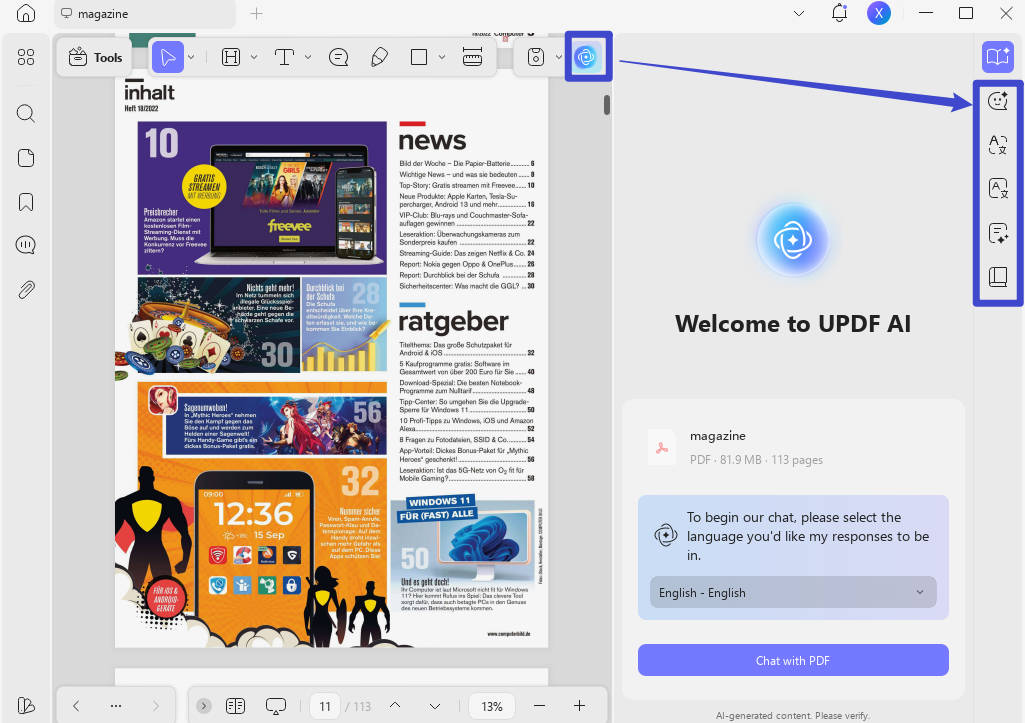
- Chat with PDF: Open the UPDF AI panel and ask the book direct questions as you read — "What is the author's main argument in this chapter?" or "What evidence does the author use to support this claim?" This is particularly useful for dense academic texts or books written in a style that requires unpacking.
- PDF to Mind Map: After finishing the book, ask UPDF AI to convert it into a visual mind map. This gives you an instant structural overview of the book's key ideas, arguments, and connections between concepts — making it much easier to write an analytical review that addresses the book's architecture rather than just its surface content.
- AI Bookmark Generator: Many PDF books — especially downloaded study materials or academic texts — have no built-in table of contents. Click the AI Bookmarks > Generate to automatically create a navigable chapter outline in one click. This makes it far easier to jump back to specific sections while writing your review.
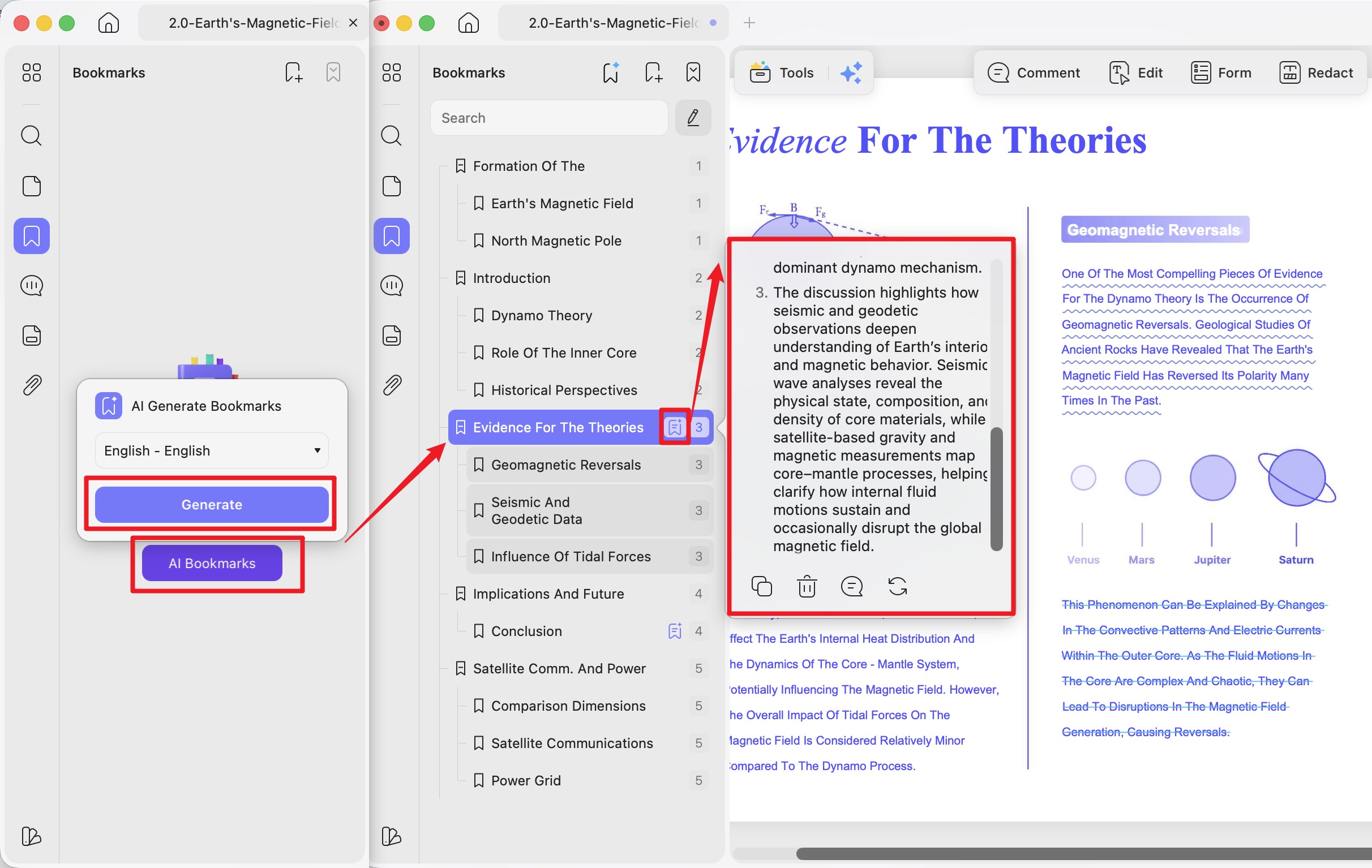
- AI Bookmark Summarizer: Once chapters are bookmarked, this generates a concise summary of each chapter's key points — a useful reference when you need to accurately represent what the author argues in Chapter 4 without re-reading the whole chapter.
Windows • macOS • iOS • Android 100% secure
3. Outline the Book Review
Before writing, use the notes and AI summaries to draft a quick outline. This prevents the most common book review mistake — spending too much space on summary and too little on analysis.
| Section | Content | Approximate length |
|---|---|---|
| Introduction | Book title, author, publication context; your thesis (overall assessment) | 1 short paragraph |
| Summary | Brief plot or argument overview — enough for context, not a retelling | 1–2 paragraphs |
| Analysis | Examine 2–3 specific aspects: writing style, characterization, argument quality, themes | 3–4 paragraphs (the core of the review) |
| Personal Assessment | Your recommendation, supported by reasons | 1 paragraph |
| Conclusion | Final verdict, suitable audience, significance | 1 short paragraph |
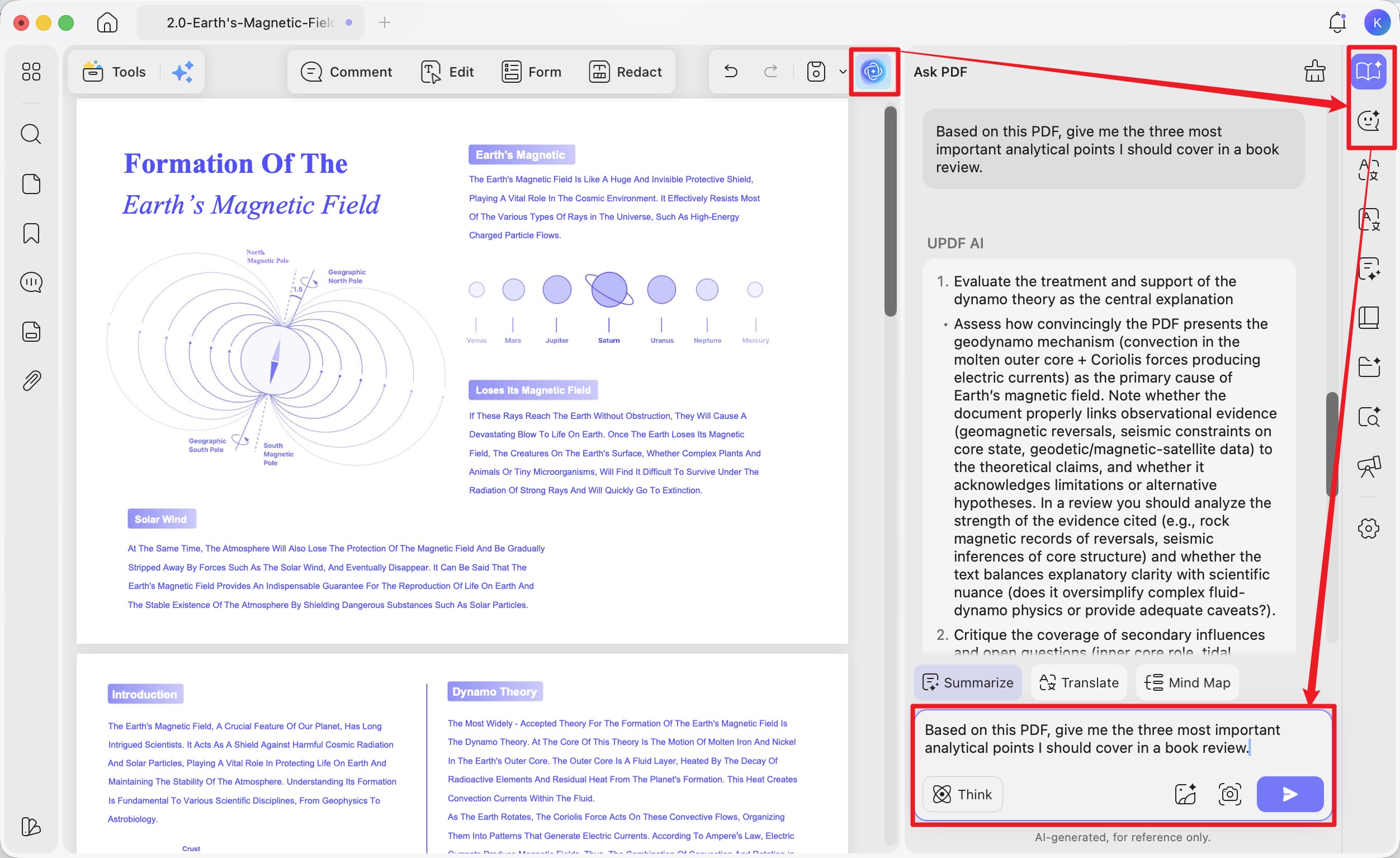
Step 1. You can use UPDF AI to build your outline: Open the UPDF AI panel > Choose Ask PDF/Chat in UPDF and type: "Based on this PDF, give me the three most important analytical points I should cover in a book review." The AI will surface the book's most significant elements, giving you a ready starting point for your analysis section.
Windows • macOS • iOS • Android 100% secure
Step 2. Before writing, read 2–3 examples from Part 3 that are most similar in genre and style to the book you're reviewing. As you read, notice:
- How much of the review is summary vs. analysis (ideally 20% summary, 80% analysis)
- How the reviewer opens — with a strong thesis, a provocative statement, or a key quote
- How the reviewer handles weaknesses — acknowledging them without letting them dominate
- The tone — academic but not dry, personal but not self-indulgent
Then use UPDF AI to check if there are dimensions of the book that existing reviews have overlooked: ask "What aspects of this book are rarely discussed in reviews?" to find angles that will make your review stand out.
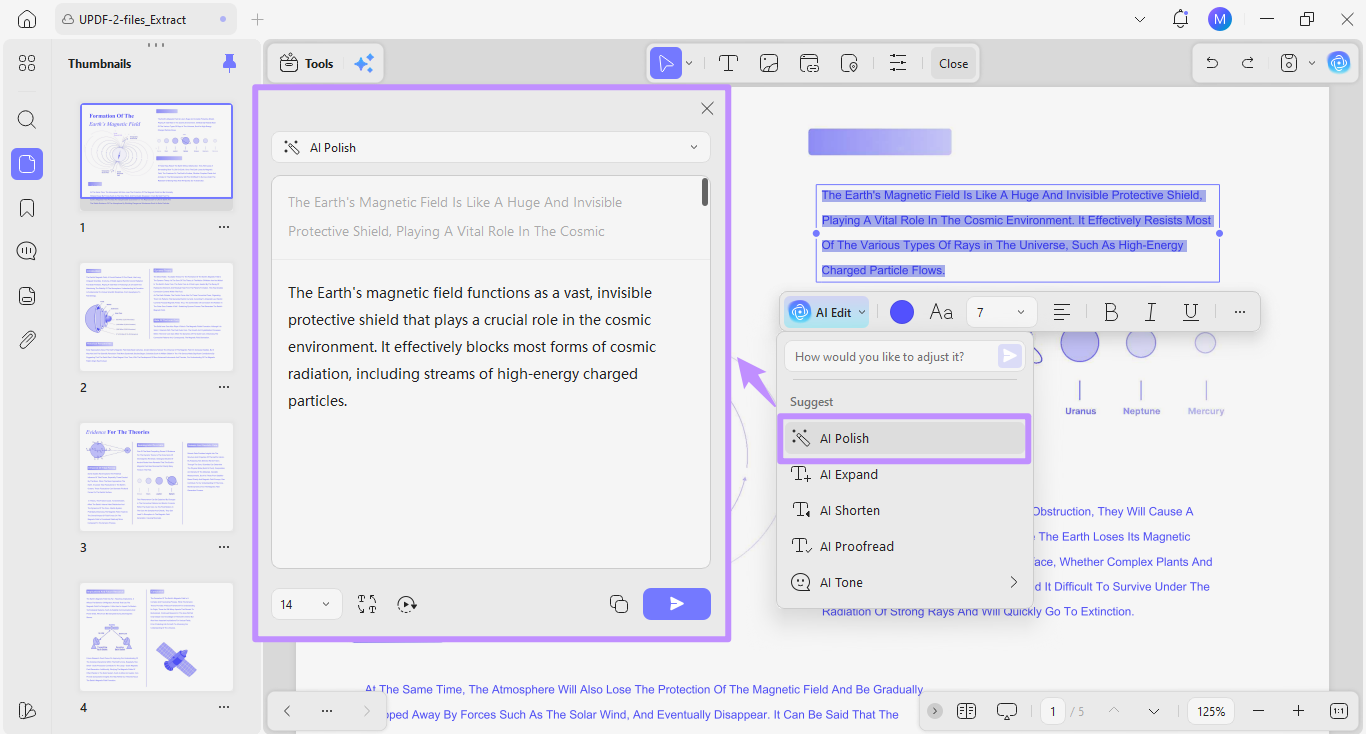
Step 3. If you're drafting in UPDF and have written a paragraph that doesn't read clearly, the UPDF AI Editing Suite lets you select the text and request a rewrite, tone adjustment, or grammar correction directly inside the document. Useful for tightening academic prose without changing the substance of your argument.
A few practical reminders:
- Start with your thesis — your overall assessment of the book — before diving into summary or analysis. This gives your entire review a clear through-line.
- Quote selectively — one or two well-chosen quotes per analytical point. Follow your citation format (MLA, APA, or Chicago) from the start; retrofitting citations is tedious.
- Write analysis before summary — if you find yourself writing more than one paragraph of summary before your analysis begins, restructure.
And UPDF does not only have the features mentioned above. You can know all its features by reading this UPDF review article from Laptopmedia or watching the below video tutorial.
4. Reread The Book Review and Update
Once you have written the first draft of your book review, it is important to reread it and make any necessary updates. Pay close attention to any grammar, spelling, and punctuation mistakes. Additionally, ensure that all the points you mentioned in your review are accurate and true to the book's content. Make sure you have written in an organized and coherent manner that is easy for the reader to follow.
Finally, check citation format, page numbers (if required), and word count against your assignment rubric before submitting.
Conclusion
A strong book review is equal parts careful reading and structured analysis. The 10 examples in Part 3 show what that looks like in practice — notice how the best reviews always argue a clear position, back it up with specific evidence from the text, and give readers a definitive recommendation.
For the writing process itself, UPDF turns the most time-consuming stages into manageable ones: the AI Bookmark Generator and AI Bookmark Summarizer make navigating and recapping long books effortless; Chat with PDF helps you interrogate the book's arguments while reading; PDF to Mind Map gives you the structural overview you need for analytical writing; and the AI Editing Suite sharpens your prose.
Download UPDF for free and open your next assigned book with it — no subscription required to get started.
Windows • macOS • iOS • Android 100% secure








 Enola Miller