 UPDF
UPDF
 UPDF for Windows
 UPDF for Mac
 UPDF for iPhone/iPad
 UPDF for Android
 Nomostar
 UPDF AI Online
 UPDF Sign
 IvyCraft
 Edit PDF
 Annotate PDF
 Create PDF
 PDF Form
 Edit links
 Convert PDF
 OCR
OCR PDF to Word
 PDF to Image
 PDF to Excel
 Organize PDF
 Merge PDF
 Split PDF
 Crop PDF
 Rotate PDF
 Protect PDF
 Sign PDF
 Redact PDF
 Sanitize PDF
 Remove Security
 Read PDF
 UPDF Cloud
 Compress PDF
 Print PDF
 Batch Process
 About UPDF AI
 UPDF AI Solutions
 AI User Guide
 FAQ about UPDF AI
 Summarize PDF
 Translate PDF
 Chat with PDF
 Chat with AI
 Chat with image
 PDF to Mind Map
 Explain PDF
 PDF AI Tools
 Image AI Tools
 AI Chat Tools
 AI Writing Tools
 AI Study Tools
 AI Working Tools
 Other AI Tools
 AI Bookmark Generation
 AI Bookmark Summary
 AI Watermark Generation
 AI Background Generation
 AI Sticker Generation
 AI Stamp Generation
 AI Editing Suite
 UPDF Copilot
 AI Page Management
 AI Semantic Search
 PDF to Word
 PDF to Excel
 PDF to PowerPoint
 Enterprise Solution
 Enterprise Sign
 Enterprise AI
 Enterprise Plan
 Enterprise User Guide
 Enterprise Webinar
 Banking
 Healthcare
 Insurance
 Legal
Legal Manufacturing
 Government
 Researchers & PhDs
 Solopreneurs & Freelancers
 Lawyers & Legal Professionals
 Real Estate Agents & Brokers
 Education Solution
 Customer Stories
 User Guide
 UPDF Tricks
 FAQs
FAQs UPDF Reviews
 Download Center
 Blog
Blog Newsroom
 Tech Spec
 Updates
 UPDF vs. Adobe Acrobat
 UPDF vs. Foxit
 UPDF vs. PDF Expert

Quick answer: First identify why the PDF looks unclear. If it is only blurry on screen, reset the zoom or open it in another PDF reader. If a scanned page has text you cannot select, use OCR to create a searchable or editable copy. If the page image itself is faint, noisy, or out of focus, enhance the scan or rescan the source. OCR recognizes text, but it cannot restore image detail that was never captured.
A blurry PDF does not always need the same fix. The problem may come from the viewer, a poor scan, low-resolution images, aggressive compression, or the way the source file was exported. This guide helps you choose the right method before changing the document.
If the main problem is scanned text that cannot be searched, copied, or edited, UPDF can use OCR to make the document more usable while keeping your work in one PDF editor. Download UPDF and test the OCR workflow on a copy of your file.
Windows • macOS • iOS • Android 100% secure
Part 1. Find Out Why the PDF Is Blurry
Before using an enhancer or OCR tool, run two quick tests: set the zoom to 100%, and try to select one sentence. Then use the table below to identify the likely cause.
| What you see | Likely cause | Best first action |
|---|---|---|
| The PDF is clear at 100% but blurry when enlarged | Normal raster-image limits or viewer rendering | Use a suitable zoom level or another reader |
| The whole page selects as one image | Scanned or image-only PDF | Use OCR if you need searchable or editable text |
| The page is gray, skewed, speckled, or faint | Poor scan conditions | Enhance the scan or rescan the source |
| Only pictures become pixelated | Low-resolution embedded images | Replace or extract and improve the original images |
| The file became blurry after compression | Image data was discarded | Return to the original and export again at higher quality |
| It is clear on screen but blurry in print | Print quality or scaling settings | Check print preview, paper size, and quality settings |
Important: No tool can reliably reconstruct details missing from a severely out-of-focus or heavily compressed source. When the original paper or source document is available, rescanning or exporting it again usually produces the best result.
Part 2. Make PDF Text Searchable and Editable with UPDF
UPDF is best used here when the visible page is a scan and its text cannot be selected, searched, copied, or corrected. Its OCR tool can create an editable PDF, retain text and pictures, or place a searchable text layer beneath the original page image. If you need more background before starting, see how to recognize text in a scanned PDF.
Best for: Scanned contracts, notes, forms, and archived documents whose text needs to be searchable or editable.
Not for: Restoring a severely blurred photo or increasing the true resolution of a low-quality image. OCR recognizes characters; it does not sharpen the original pixels.
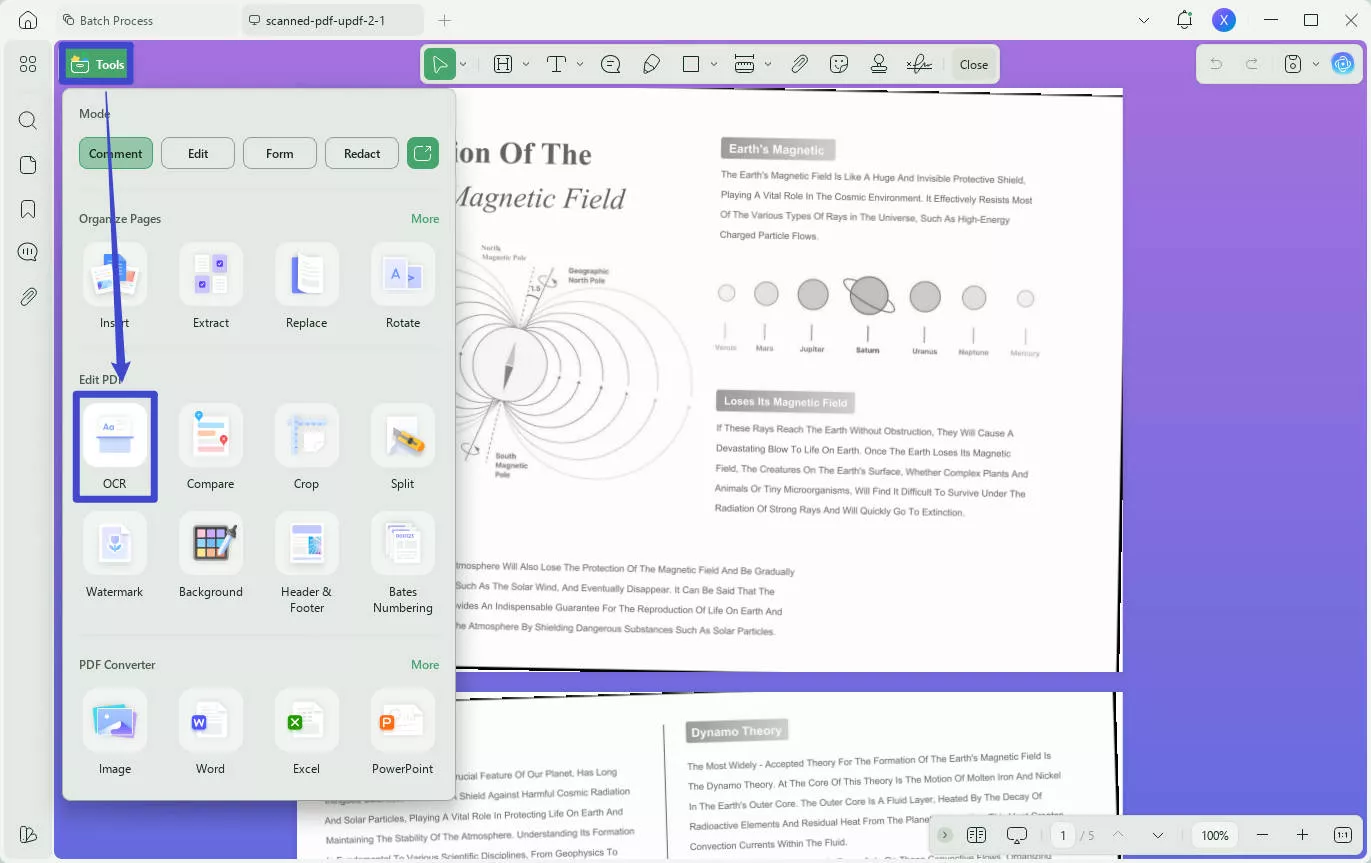
Step 1. Open the PDF and check the text
Open a copy of the PDF in UPDF and try to drag across a sentence. If individual characters can be selected, OCR may not be necessary. If the whole page behaves like an image, select OCR from Tools.
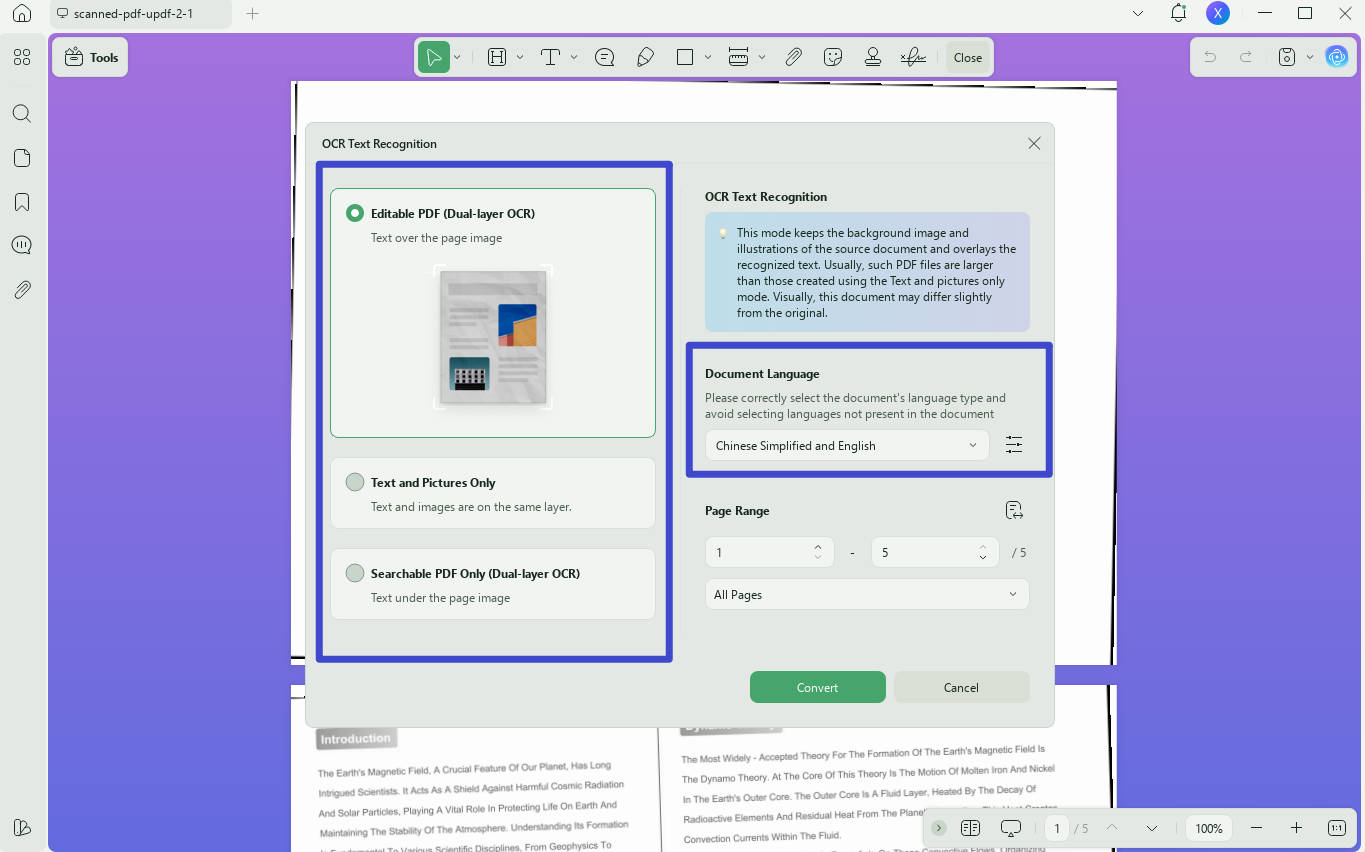
Step 2. Choose the right OCR output
- Editable PDF: Use this when you need to correct or replace recognized text.
- Text and Pictures Only: Use this to rebuild the page with recognized text and retained illustrations.
- Searchable PDF Only: Use this when you want the page to keep its scanned appearance while gaining a searchable text layer.
Select the document language and page range before converting. The correct language improves recognition, especially for names, accented characters, and mixed text.
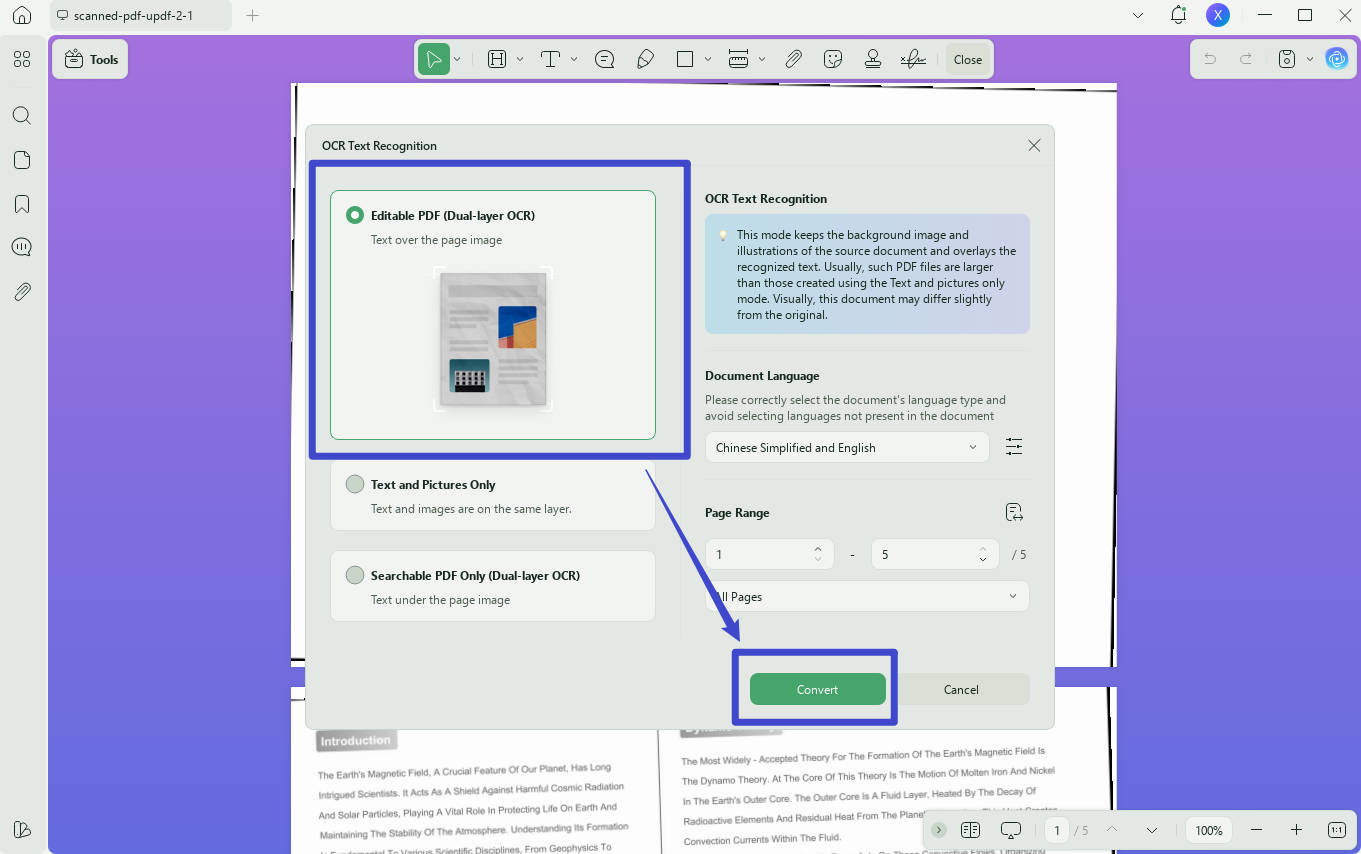
Step 3. Verify and edit the recognized text
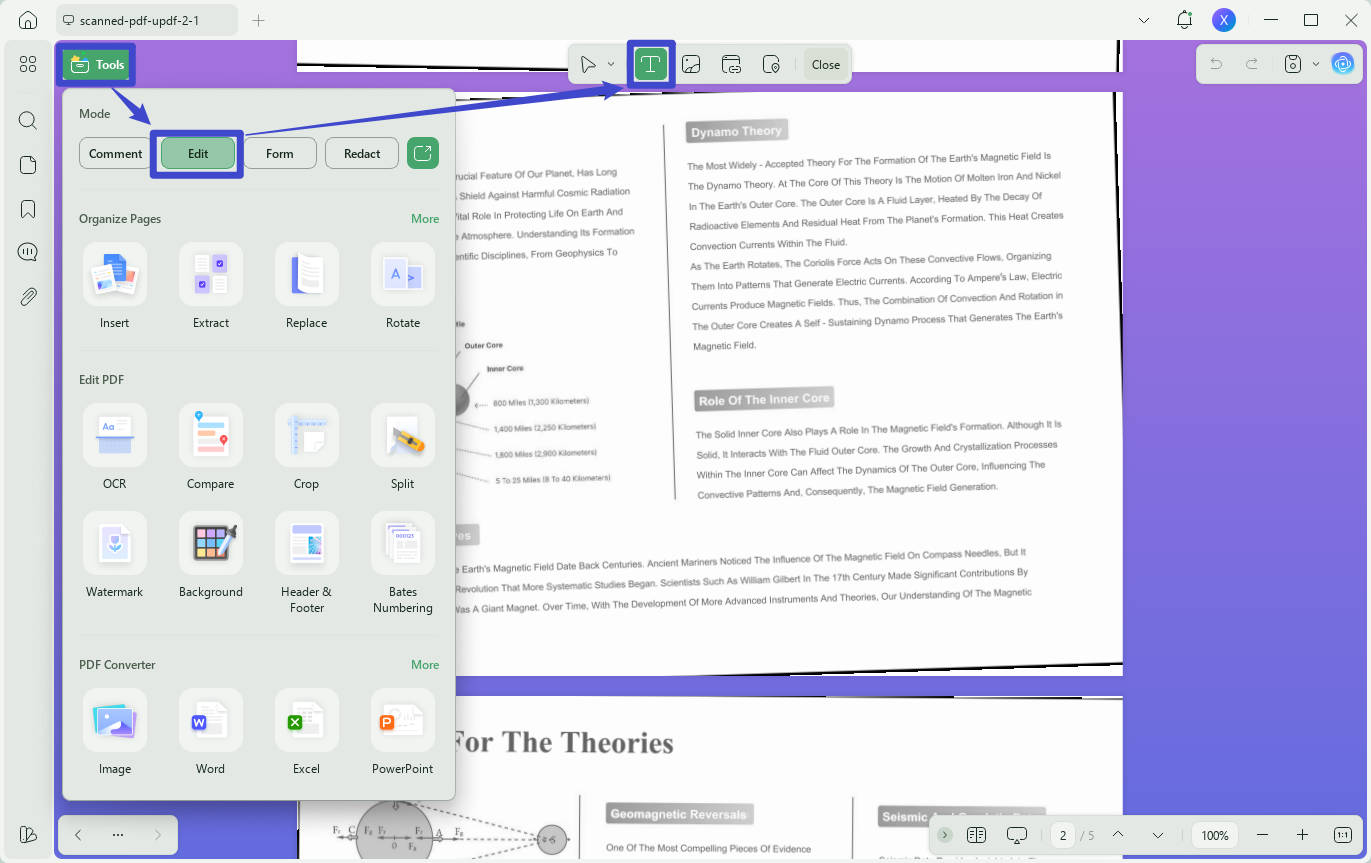
Open the converted copy and check names, numbers, punctuation, and tables against the original scan. If you chose Editable PDF, select Edit in Tools to correct recognition errors. This makes unclear scanned text easier to use, but the original page image may still look the same in Searchable PDF Only mode.
If searchable text is what you need, download UPDF and test the workflow on a duplicate of your scanned file.
Windows • macOS • iOS • Android 100% secure
Beyond OCR, UPDF also provides many other features for PDF tasks such as annotation, AI summarization/translation, and more. The video below demonstrates UPDF 2.0. UPDF has since been updated, so some interface details may differ, but the general PDF workflow remains similar.
Part 3. How to Make a Blurry PDF Clear Online
Online enhancers can improve the appearance of scanned pages by sharpening edges, increasing contrast, reducing shadows, or cleaning the background. Because these services require an upload, avoid using them for confidential, financial, medical, identity, or legally sensitive files unless you have reviewed their current privacy terms.
1. Aspose PDF Image Sharpener
Best for: Sharpening the first page of a short, image-based PDF and exporting the result as a raster image.
Aspose provides a browser-based sharpen control and output choices such as PNG and JPG. Its official page states that PDF support is partial and limited to the first page. Free users can upload files up to 20 MB, and uploaded files and links remain available on its servers for 24 hours.

- Upload the PDF and adjust the sharpen control.
- Preview the result and choose a supported image output.
- Download the processed raster file.
2. ScanWritr
Best for: Correcting shadows, uneven backgrounds, distortion, and weak contrast in photographed or scanned documents.
ScanWritr says its online editor can detect margins, improve contrast, convert a document to grayscale or black and white, crop and rotate pages, and remove unwanted background areas. Import the document, apply the relevant cleanup controls, inspect the page, and export the result.

3. i2PDF Enhance Scanned PDF
Best for: Improving the visual readability of scanned handwritten notes, checklists, and meeting records.
i2PDF processes PDF pages as images, enhances them, and rebuilds them as a PDF. The resulting file is not editable and may not remain searchable, so run OCR afterward if you need selectable text. Upload the scan, apply the enhancement, review the result, and download the new PDF.

Part 4. Fix a PDF That Looks Blurry Only on Screen
- Reset the zoom: Compare 100%, Fit Page, and Fit Width. A raster page will naturally pixelate when enlarged beyond its captured resolution.
- Download the actual PDF: Email, cloud-drive, and website previews may show a lower-resolution image instead of the full document.
- Try another reader: Open the same local file in UPDF or another PDF reader. If it is clear there, the original file is probably intact.
- Check another device: Display scaling and graphics rendering can affect how thin fonts and scanned text appear.
- Compare print preview: If only the printed page is blurry, select the correct paper size, avoid unnecessary scaling, and use a higher print-quality setting.
Part 5. Fix Blurry Images Inside a PDF
If the text is sharp but a photo, chart, or logo is pixelated, OCR is not the right tool. First try to extract the image from the PDF in its embedded format rather than taking a screenshot. A screenshot captures only the displayed resolution and may make the quality worse.
- Open the PDF in UPDF and choose Edit from Tools.
- Right-click the image and select Extract Image.
- Inspect the extracted file at 100%. If it is already low resolution, enhance it in an image editor or obtain the original asset.
- Replace the blurry image in the PDF with the improved or original version.
When the source Word, PowerPoint, design, or publishing file is available, replacing the image there and exporting a new PDF usually preserves layout and quality better than repairing the finished PDF.
Part 6. Prevent PDF Quality Loss
- Scan normal text documents at about 300 DPI; use a higher setting when tiny type or detailed illustrations require it.
- Keep an untouched original before running OCR, enhancement, editing, or compression.
- Export from the source application instead of repeatedly printing one PDF into another.
- Embed fonts when the export software provides that option.
- Use lossless, maximum-quality, or high-quality compression when readability matters. UPDF provides multiple quality options; see how to compress a PDF without unnecessary quality loss.
- Open the exported file and check small text, images, and print preview before sharing it.
FAQs About Making a PDF Clearer
Can you really make a blurry PDF clear?
Sometimes. Viewer and contrast problems are often fixable, and OCR can make scanned text searchable or editable. However, software cannot reliably restore details that were never captured in a severely blurred or heavily compressed source.
Does OCR make a PDF image sharper?
No. OCR recognizes characters and creates a text layer; it does not increase the true resolution or sharpen the original page image. Use scan enhancement or rescan the source when the visual page itself is unclear.
How can I make a blurry document clear online?
Use an online scan enhancer to adjust sharpness, contrast, brightness, or background cleanup, then inspect the output before downloading it. Avoid uploading sensitive documents unless you have reviewed the service’s privacy terms.
Why does my PDF look blurry only on screen?
The browser preview, zoom level, display scaling, or PDF renderer may be responsible. Download the actual PDF, view it at 100%, and open the same file in another reader before changing the document.
Why is my PDF clear on screen but blurry when printed?
Check the print preview, paper size, scaling, printer resolution, and print-quality setting. Use the original PDF rather than a screenshot or low-resolution preview.
What resolution is best for scanning a PDF?
About 300 DPI is normally suitable for text documents. Small type, detailed illustrations, or archival material may benefit from a higher setting, but larger resolutions also increase file size.
Conclusion
To make a PDF clear, match the fix to the problem. Adjust the viewer when only the display is blurry, enhance or rescan a visually poor page, and return to the source file when compression has removed detail. For image-only documents whose text needs to be searchable or editable, UPDF OCR provides a practical workflow without claiming to sharpen the original pixels.
Download UPDF and try OCR, image extraction, editing, and quality-controlled compression on a copy of your document.
Windows • macOS • iOS • Android 100% secure






 Enid Brown
 Enola Miller

 Delia Meyer