 UPDF
UPDF
 UPDF for Windows
 UPDF for Mac
 UPDF for iPhone/iPad
 UPDF for Android
 Nomostar
 UPDF AI Online
 UPDF Sign
 IvyCraft
 Edit PDF
 Annotate PDF
 Create PDF
 PDF Form
 Edit links
 Convert PDF
 OCR
OCR PDF to Word
 PDF to Image
 PDF to Excel
 Organize PDF
 Merge PDF
 Split PDF
 Crop PDF
 Rotate PDF
 Protect PDF
 Sign PDF
 Redact PDF
 Sanitize PDF
 Remove Security
 Read PDF
 UPDF Cloud
 Compress PDF
 Print PDF
 Batch Process
 About UPDF AI
 UPDF AI Solutions
 AI User Guide
 FAQ about UPDF AI
 Summarize PDF
 Translate PDF
 Chat with PDF
 Chat with AI
 Chat with image
 PDF to Mind Map
 Explain PDF
 PDF AI Tools
 Image AI Tools
 AI Chat Tools
 AI Writing Tools
 AI Study Tools
 AI Working Tools
 Other AI Tools
 AI Bookmark Generation
 AI Bookmark Summary
 AI Watermark Generation
 AI Background Generation
 AI Sticker Generation
 AI Stamp Generation
 AI Editing Suite
 UPDF Copilot
 AI Page Management
 AI Semantic Search
 PDF to Word
 PDF to Excel
 PDF to PowerPoint
 Enterprise Solution
 Enterprise Sign
 Enterprise AI
 Enterprise Plan
 Enterprise User Guide
 Enterprise Webinar
 Banking
 Healthcare
 Insurance
 Legal
Legal Manufacturing
 Government
 Researchers & PhDs
 Solopreneurs & Freelancers
 Lawyers & Legal Professionals
 Real Estate Agents & Brokers
 Education Solution
 Customer Stories
 User Guide
 UPDF Tricks
 FAQs
FAQs UPDF Reviews
 Download Center
 Blog
Blog Newsroom
 Tech Spec
 Updates
 UPDF vs. Adobe Acrobat
 UPDF vs. Foxit
 UPDF vs. PDF Expert

Miro is the AI-powered innovation workspace that is enabling cross-functional teams to accelerate innovation. It brings ideas, data, and collaboration into one shared visual space. It helps teams turn customer insights into structured plans using AI-powered clustering, real-time collaboration, intelligent templates, and integrations with tools like Jira and Azure DevOps.
Today, over 100 million users in 250,000 organizations, including Cisco, WPP, Deloitte, IKEA, and Nike, rely on Miro to improve product development. In this report, we will perform a complete Miro business breakdown, including company background, user data, financials, market position, trends, and more.
Considering the growth of remote/hybrid work, the rising importance of collaboration tools, and the competitive landscape, this analysis will help you decide if Miro is the collaboration platform you need.
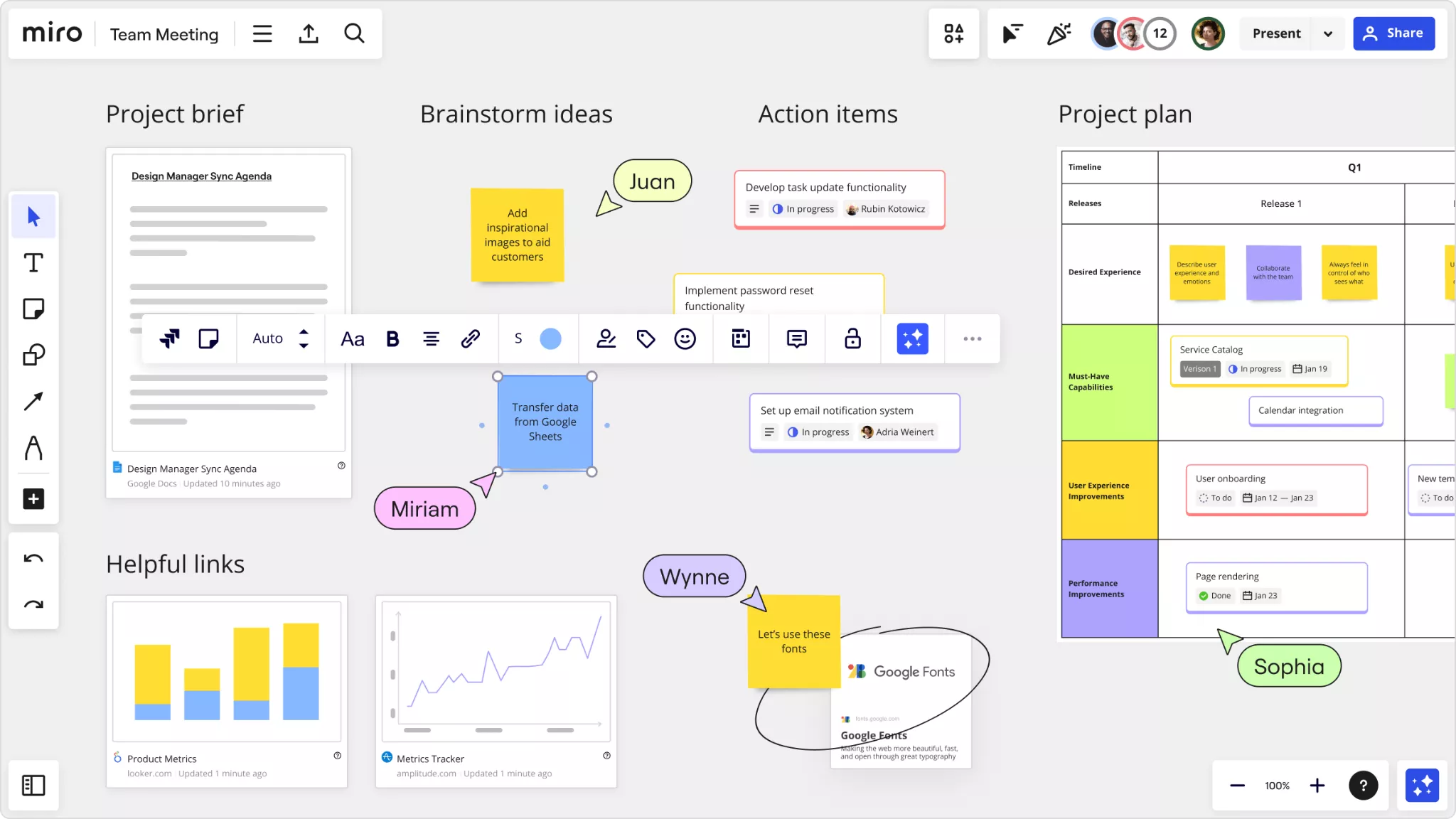
Miro Company Overview
| Founded in | 2011 |
| Founders | Andrey Khusid and Oleg Shardin |
| Origin | Started in Perm, Russia, as RealtimeBoard. |
| Industry | Software as a Service |
| Purpose | To provide an online whiteboard for distributed teams to brainstorm and work together. |
| Company Type | Private |
| Mission & Core Product | Miro's mission is to "empower teams to create the next big thing". It provides a visual workspace for innovation through an infinite digital canvas that enables distributed teams to brainstorm, plan, design, build, and manage projects. |
| Headquarters & Global Presence | Co-headquartered in San Francisco, California, USA, and Amsterdam, Netherlands. It has 13 hubs around the world, including Austin, Berlin, Amsterdam, London, Munich, etc. |
| Team & Employees | Global, distributed team of 1,600+ people in 14 hubs. |
| Revenue | Revenue information is not publicly available since Miro is a private company. It hit $560M in annualized recurring revenue (ARR) in 2023. |
| Valuation | Miro's valuation reached $17.5 billion in 2022 after raising $400 million in a Series C funding round. |
| Market Share | Ranks 2nd amongst 92 active competitors (according to Tracxn). |
User Base & Customers

Total Users & Organizations Served
- Miro's market share shows that it serves over 100 million users across 250,000+ organizations in over 180+ countries.
- These organizations solve complex problems using Miro, such as startup product development, enterprise digital transformation, etc.
- The platform supports 1 billion+ collaborative actions monthly.
Notable Clients & Enterprise Penetration
- Miro's enterprise penetration is significant, with the company stating that 99% of the Fortune 100 are among its users.
- Notable clients include Nike, IKEA, Deloitte, Cisco, Warner Bros. Discovery, Oracle, Dropbox, Fujitsu, Dell, Shopify, PepsiCo, Ubisoft, and many more.
- The company offers an Enterprise Plan with advanced features customized for large organizations.
User & Customer Growth Over Time
- Miro statistics show steady growth before the pandemic, followed by a significant boost during the pandemic and the surge in remote work.
- Today, Miro is used in 180+ countries.
| Date | Reported Users |
| 2017 | ~1 million |
| 2018 (Series A funding time) | ~2 million |
| 2020 (amid the early pandemic) | ~ 10 million by October 2020 |
| 2021 | ~ 15 million |
| 2022 | ~ 30 million |
| 2023 | ~ 50+ million |
| 2024-2025 | Continued strong growth (estimated by 100 million+ across 250,000 companies; no official figures) |
Top Industries that Use Miro
- Information Technology and Services
- Computer Software
- Higher Education
- Internet
- Financial Services
- Banking
- Design
- Education Management
- Marketing and Advertising
- Retail
Top Countries that Use Miro
- United States
- France
- United Kingdom
- Canada
- India
- Spain
- Ukraine
- Germany
- Russian Federation
- Finland
Business Model & Revenue/Financials

Revenue Model
Miro is a subscription-based SaaS business. It offers a freemium tier for casual users, which includes unlimited team members but limited boards. Paid Starter / Business plans are for small to large-sized teams where revenue scales with the number of seats/licenses.
It sells enterprise licensing via its Flexible Licensing Program (FLP) (licenses scale with usage). It includes advanced security features, dedicated support, and SSO integration. However, this licensing starts from a minimum of 30 members. In addition, it drives incremental revenue through add-ons and AI features. The pricing of Miro as of December 2025 is:
| Free | $0 (3 editable boards) |
| Starter | $10/month/member |
| Business | $20/month/member |
| Enterprise | Custom price from 30 members |
Recent Financials
Since Miro is not a publicly traded company, it does not openly disclose all its financial data. Still, we have done extensive research on Miro's business breakdown, and here's what we know about the recent financial position:
Consistent Revenue Growth Since Launch
- Miro has had consistent revenue growth since its launch in 2011. It was due to its growing user base and adoption.
Revenue Surge from 2020
- Miro experienced significant growth in 2020. We can attribute it to the pandemic and the need for remote working.
- The revenues from 2020-2022 were (statistics from GetLatka):
- $57.2 million in 2020
- $111.1 million in 2021
- $420 million in 2022
Estimated 2023 ARR
- According to one private-market data tracker, Miro's annual recurring revenue (ARR) in 2023 was about $560 million, which was a ~33% year-over-year growth.
2024 Revenue Estimate
- A widely cited estimate indicates Miro did $290 million in revenue in 2024. However, this doesn't seem right because the company had $560M ARR in 2023, which would suggest flat or growing revenue. This suggests that the 2024 $290M number may reflect a narrower revenue definition rather than full ARR
The Funding History and The Valuation
Miro has raised a total of $476 million across four major funding rounds:
Key Funding Rounds
- Seed: $1.3 million (2017)
- Series A: $25 million (2018)
- Series B: $50 million (2020)
- Series C: $400 million (2022)
The funding is raised from prominent investors, including GitLab, Salesforce Ventures, GIC, Dragoneer, Atlassian, Accel, ICONIQ Capital, Datadog, Intercom, and others.
Valuation
The Series C funding round in January 2022 established a valuation of $17.5 billion. This made Miro one of the fastest-growing private companies.
Financial Health
Miro publicly stated at the time of its Series C that its business model was profitable. It has been reported that Miro generates over $500 million in annual recurring revenue (ARR). However, the company also laid off 18% of staff (257) in 2024 to simplify the organization and reduce costs.
Considering all these Miro business breakdown elements, we can say that the company has generated large and recurring revenues and previously reported profitability. But like many fast-scale SaaS firms, it has also taken cost-cutting measures in response to market conditions.
Market Position & Competitive Landscape
Market Size and Growth Trends
Miro's market share operates within the rapidly expanding collaborative whiteboards and broader productivity management software markets. The company holds a dominant market share and is experiencing significant user and revenue growth.
The collaborative whiteboard software market is valued at approximately $3.17 billion in 2025 and is projected to grow at a CAGR of 20.85% between 2025 and 2030. Miro competitor report shows that it holds a solid position here due to its large global user base, deep enterprise adoption, and continuous innovation in AI-powered collaboration features.
The primary growth trends are:
- Rapid growth of hybrid and remote work
- Rising enterprise demand for collaboration tools
- Increasing use of AI in productivity platforms
- Strong demand from product, design, and agile teams
- Expansion in global and emerging markets
- Greater focus on security and compliance
Miro's Position vs Competitors
Miro markets itself as the #1 visual collaboration platform and is widely used across enterprises. It is positioned around an "AI innovation workspace".
Miro has grabbed a solid position in some key areas:
- It is the fastest-growing app by customer count in the finance and banking industry, with 44% growth (unverified claims).
- It is the #1 fastest-growing app in Australia with 43% growth (unverified claims).
- Miro continues to scale in heavily regulated industries by strengthening enterprise-grade security, compliance, and governance features.
Miro is named to the 2025 Forbes Cloud 100.
Miro competitor report highlights that it is in the marketplace where many other top names are competing for market shares. Its top competitors are:
- Mural
- Lucidspark
- FigJam (Figma)
- Microsoft Whiteboard
- Zoom Whiteboard
- And emerging niche tools
Larger platform incumbents (Microsoft, Zoom, Adobe/Figma) create strong bundling pressure because they can add whiteboard capabilities into existing suites. Despite that, Miro competitor reports claim that Miro ranks 2nd among 92 active competitors. It is due to Miro's broad ecosystem, strong enterprise features, brand momentum, rapid AI integration, and other factors.
Use Cases and Target Segments
The primary use cases of Miro are:
- Ideation and brainstorming
- Design sprints and workshops
- Product discovery
- Customer journey mapping
- Retrospectives and Agile ceremonies
- Process mapping
- Stakeholder workshops
- Asynchronous documentation
The target user segments for Miro are:
- Enterprises & Product Orgs: Product management, UX/design teams, strategy, and innovation teams that need cross-functional alignment and governance features.
- MBs & Agencies: Teams that benefit from templates, rapid workshops, and client-facing collaboration.
- Education & Training: Classrooms and corporate training for interactive sessions and lesson plans (reported as a growing vertical in market reports).
- Consulting & Professional Services: Firms using Miro for client workshops, mapping, and deliverable co-creation.
Bonus Tip:
Windows • macOS • iOS • Android 100% secure

Growth Drivers & Strategic Highlights
- AI-First Platform: Miro has embedded AI across the canvas to generate ideas, synthesize workshops, analyze, and automate tasks. All these make the product an "AI Innovation Workspace".
- Broad Adoption & Enterprise Traction: Miro's product messaging and press milestones emphasise large-scale adoption and enterprise use cases. As of 2023, Miro claimed to serve 99% of the Fortune 100 and to be used by hundreds of thousands of companies worldwide. The smooth interface, product acceleration, extensive templates, and secure enterprise features are all the reasons that drive seat/enterprise licence sales and expansion.
- Market Recognition & Credibility: Industry assessments name Miro a leader in team-collaboration/vendor evaluations, which is useful for enterprise procurement and GTM.
- Rich Integrations & Ecosystem: Continuous product launches and integrations reduce switching costs and improve retention.
Risks, Challenges, & Considerations
- Intense Competition and Feature Overlap: Looking at Miro's business breakdown, it competes with native whiteboards and design/collaboration rivals, such as Microsoft Whiteboard, FigJam, Lucidspark, Mural, etc. Many of which are bundled into large suites or design tools. This pressures pricing and enterprise deals.
- Margin & Cost Pressure: Miro has very large ARR and user counts, yet the company laid off ~18% of its workforce in 2024. The goal was to simplify the organization and cut costs. This is a sign of profit/margin optimization under market pressure.
- Free-User Volume: Miro is not different from other freemium collaboration tools. It also has a large share of users who are free or occasional collaborators. So, converting and expanding paid seats (and limiting churn) remains critical to sustain ARR growth.
- Security/Compliance Risk: As Miro deepens its presence in the enterprise, customers demand strict security and compliance features. The company cannot afford to make a mistake here, as it will lead to higher security risks.
Future Outlook & Predictions
- Deeper AI Integration and Monetization: Over the past few months, Miro has expanded its AI capabilities and is integrating more AI-driven features into its infinite canvas. So, expect Miro to continue productizing AI and pushing premium AI features into higher-tier plans or add-ons.
- Enterprise Expansion + Localized Go-to-Market: Growth will probably come from deeper enterprise penetration (security, SLAs, procurement) and regional sales expansion rather than pure consumer growth.
- Competitive Consolidation: Large platform owners (Microsoft, Adobe, Figma) will keep integrating whiteboard/collaboration features, so Miro's advantage will be feature depth + ecosystem.
- Cautious Financial Trajectory: Given the reported ARR scale and past profitability claims, Miro should be able to invest in AI and enterprise go-to-market. However, near-term growth may prioritize margin discipline (hiring freezes / structure simplification) until macro demand stabilizes.
Conclusion
The Miro business breakdown has shown its evolution from a simple online whiteboard into one of the most influential AI-powered collaboration platforms in the world. The rapid user growth, strong enterprise adoption, and continuous investment in AI features have all placed the company in a solid position in the competitive collaboration software market. Overall, it is in a strong position for long-term growth due to its loyal customer base and enterprise-focused strategy.








 Enya Moore
 Engelbert White

 Enola Miller