 UPDF
UPDF
 UPDF for Windows
 UPDF for Mac
 UPDF for iPhone/iPad
 UPDF for Android
 Nomostar
 UPDF AI Online
 UPDF Sign
 IvyCraft
 Edit PDF
 Annotate PDF
 Create PDF
 PDF Form
 Edit links
 Convert PDF
 OCR
OCR PDF to Word
 PDF to Image
 PDF to Excel
 Organize PDF
 Merge PDF
 Split PDF
 Crop PDF
 Rotate PDF
 Protect PDF
 Sign PDF
 Redact PDF
 Sanitize PDF
 Remove Security
 Read PDF
 UPDF Cloud
 Compress PDF
 Print PDF
 Batch Process
 About UPDF AI
 UPDF AI Solutions
 AI User Guide
 FAQ about UPDF AI
 Summarize PDF
 Translate PDF
 Chat with PDF
 Chat with AI
 Chat with image
 PDF to Mind Map
 Explain PDF
 PDF AI Tools
 Image AI Tools
 AI Chat Tools
 AI Writing Tools
 AI Study Tools
 AI Working Tools
 Other AI Tools
 AI Bookmark Generation
 AI Bookmark Summary
 AI Watermark Generation
 AI Background Generation
 AI Sticker Generation
 AI Stamp Generation
 AI Editing Suite
 UPDF Copilot
 AI Page Management
 AI Semantic Search
 PDF to Word
 PDF to Excel
 PDF to PowerPoint
 Enterprise Solution
 Enterprise Sign
 Enterprise AI
 Enterprise Plan
 Enterprise User Guide
 Enterprise Webinar
 Banking
 Healthcare
 Insurance
 Legal
Legal Manufacturing
 Government
 Researchers & PhDs
 Solopreneurs & Freelancers
 Lawyers & Legal Professionals
 Real Estate Agents & Brokers
 Education Solution
 Customer Stories
 User Guide
 UPDF Tricks
 FAQs
FAQs UPDF Reviews
 Download Center
 Blog
Blog Newsroom
 Tech Spec
 Updates
 UPDF vs. Adobe Acrobat
 UPDF vs. Foxit
 UPDF vs. PDF Expert

Standard evolution is critical for global supply chains. The upcoming release of ISO 9001:2026 represents the most radical paradigm shift in quality management systems (QMS) in over a decade. While the ISO working group has reached a technical consensus on Clauses 1 through 10, global national bodies like the BSI and ANSI warn that the final text remains in a state of rigorous pre-release refinement.
For compliance officers, internal auditors, and supply chain directors, this transitional phase is a regulatory minefield. You are tasked with preparing for structural updates (such as explicit climate-aligned governance and supply chain risk protocols) using incomplete draft files, fragmented industry briefs, and multi-language standard updates.
Navigating hundreds of pages of evolving compliance texts without draining your quality team's bandwidth requires agile, industrial-grade software. Before dissecting the regulatory anatomy, Download UPDF for Free to instantly deploy an ISO 27001-secured AI workdesk designed to streamline your 2026 gap analysis.
Windows • macOS • iOS • Android 100% secure
Part 1. Sourcing the Standard: Where to Download the ISO 9001 Version 2026 PDF
The first step in your compliance workflow is obtaining the official text. The ISO 9001 Version 2026 PDF is a controlled document, which means that it cannot be legally sourced from unofficial mirrors or file-sharing platforms without violating intellectual property agreements. An unauthorized copy also creates audit liability because you cannot verify the version's integrity.
The following are the verified and authorized distribution channels where you can purchase and download the standard:
- ISO Store: The primary source is purchasing directly from the International Organization for Standardization. You can purchase it in different languages and PDF + ePub or Paper format.
- ANSI Webstore: The U.S. national distribution point that sells official ISO standards.
- BSI Shop: The British Standards Institution's storefront, widely used across European and Commonwealth markets.
- DIN Media: Preferred channel for organizations operating under German regulatory frameworks.
- Your National Standards Body: Many countries have official ISO member bodies (AFNOR in France, IRAM in Argentina, BIS in India, etc.) that distribute localized editions.
After obtaining the file, the next step is to establish a rigorous framework to manage revisions, access permissions, and team approvals. For a deep dive into maintaining a compliant ecosystem, refer to our guide on ISO 9001 document control, which focuses on architecture, whereas this guide covers digesting the 2026 textual updates.
Part 2. What's New in ISO 9001:2026? Rapid Analysis via AI
Manual gap analysis is a time-consuming phase of any standard transition. Comparing the full text of ISO 9001:2026 against ISO 9001:2015 clause by clause can take days of a quality team's bandwidth before a single corrective action is drafted.
The cleaner workflow is to use AI as a review accelerator. Just upload the previous edition and the new draft and ask for structured differences. Then convert the results into an internal checklist for auditors and process owners.
Let's give you a step-by-step walkthrough on how to have a rapid analysis of the ISO 9001 Version 2026 PDF with UPDF AI:
Step 1: Document Ingestion
Install and launch UPDF on your desktop or mobile device.
Windows • macOS • iOS • Android 100% secure
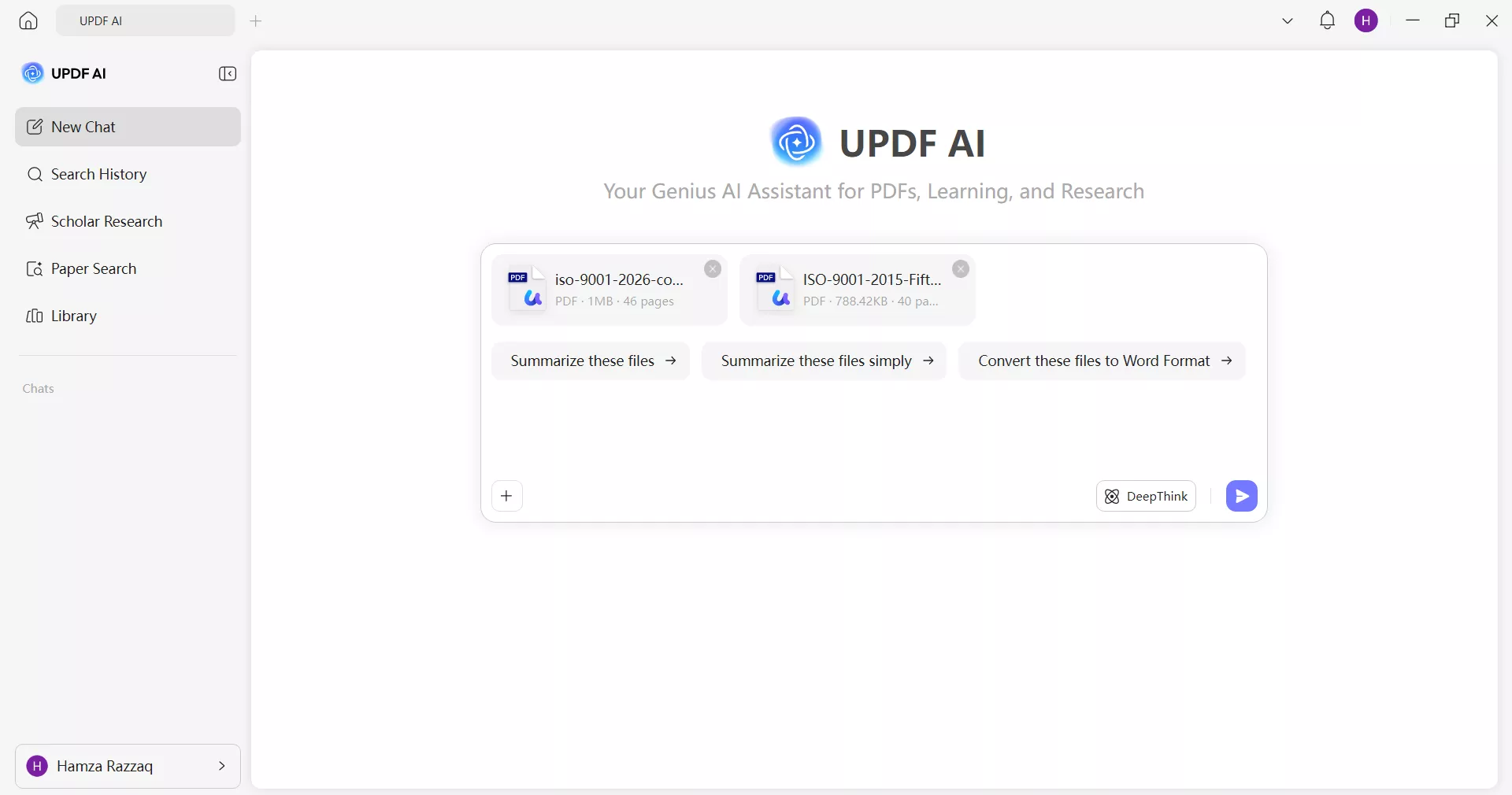
Open UPDF's AI and upload the old and new ISO 9001 PDFs. UPDF AI supports multi-document sessions, which means it holds both files in a shared context window and can reference either during your conversation. You can also access UPDF AI through your browser if you do not want any installation.
Step 2: Instant Gap Analysis
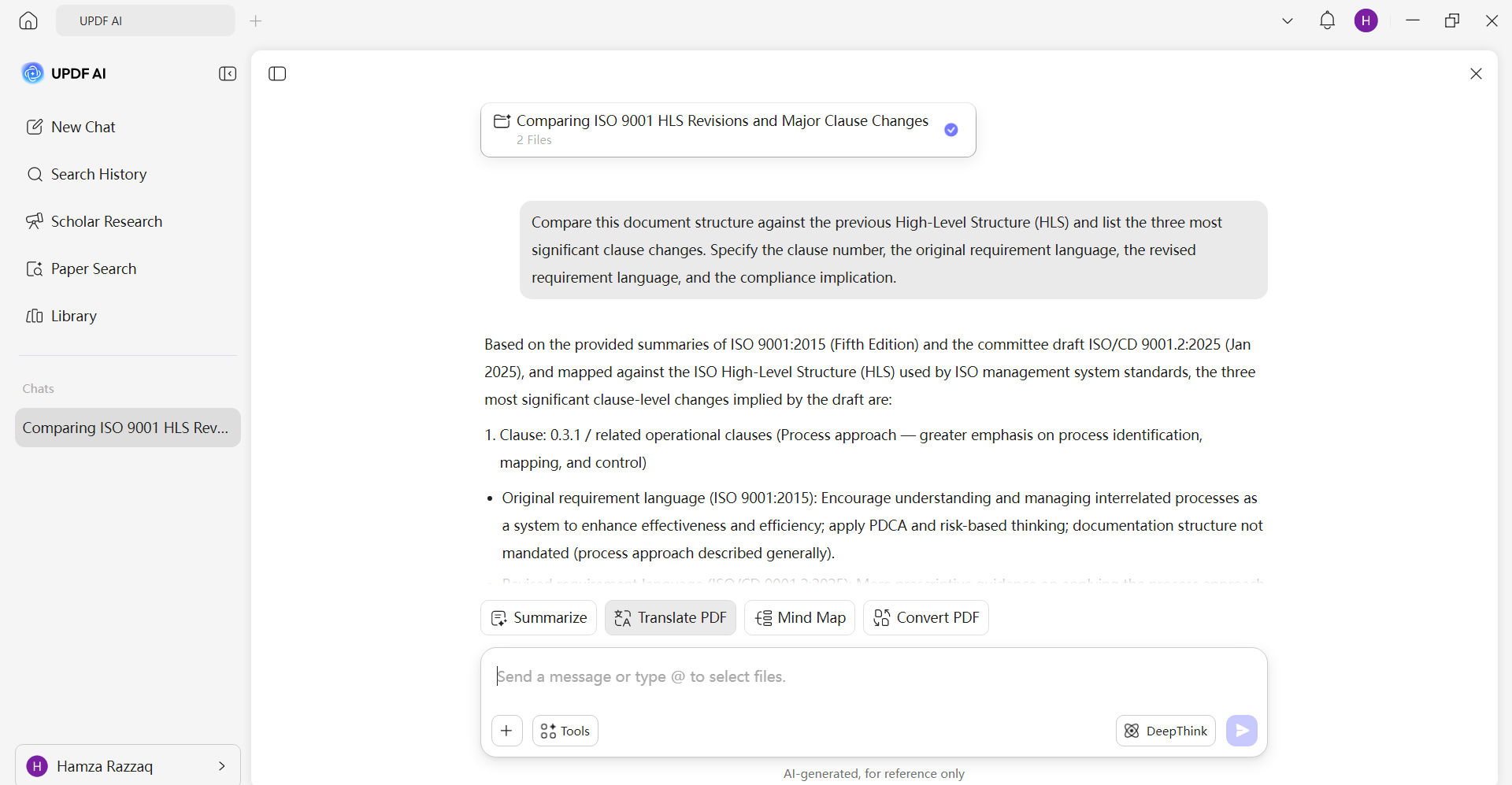
Now that both documents are loaded, use structured and objective prompts to perform comparisons. The recommended prompt is:
“Compare this document structure against the previous High-Level Structure (HLS) and list the three most significant clause changes. Specify the clause number, the original requirement language, the revised requirement language, and the compliance implication.”
UPDF AI will cross-reference both documents and surface substantive changes.
Step 3: Extracting Actionable Audit Checklists
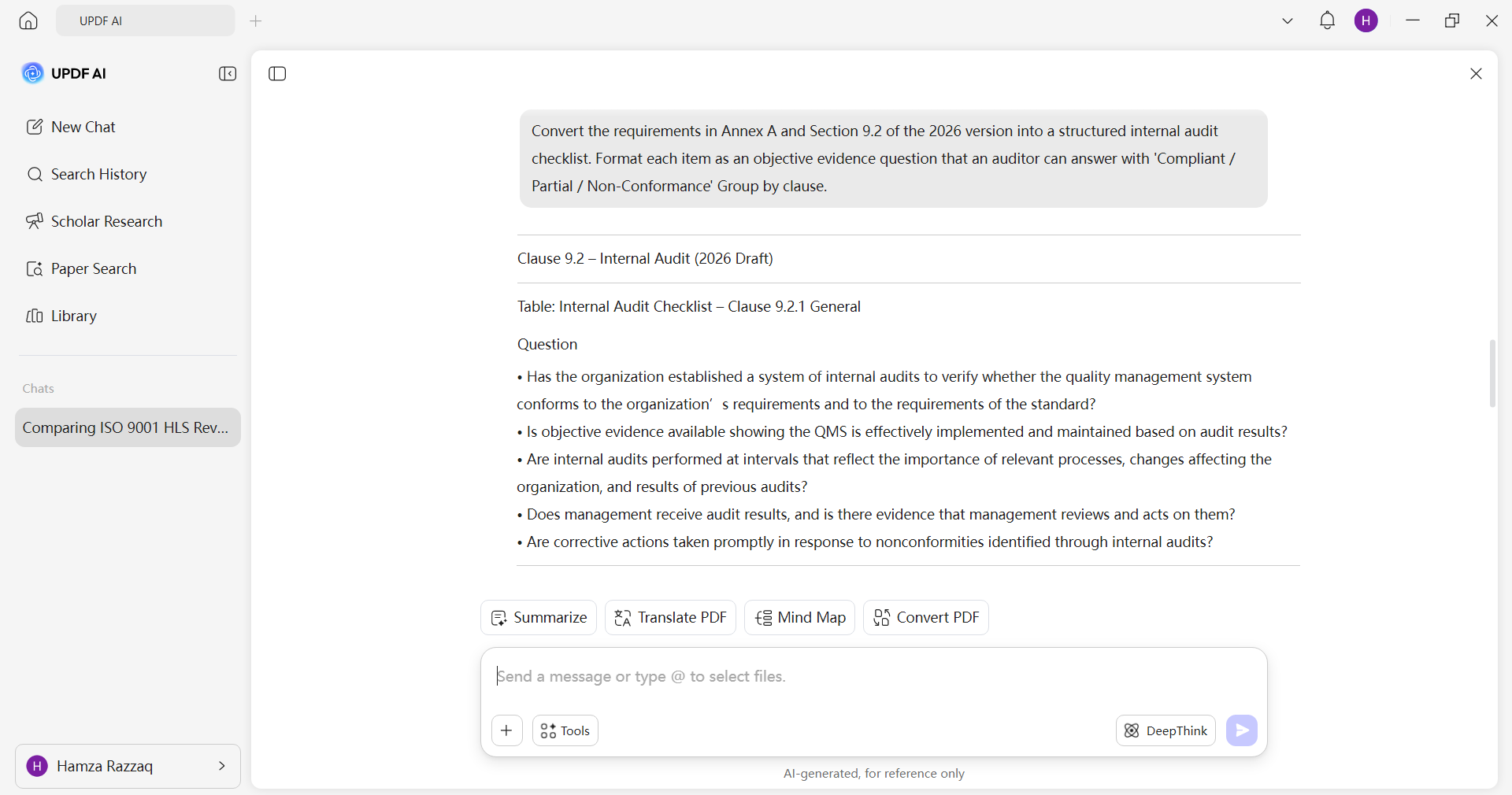
Raw clause language isn't usable on an audit floor. The next prompt converts dense annex paragraphs into operational checklists your internal auditors can carry into process reviews. The recommended prompt is:
“Convert the requirements in Annex A and Section 9.2 of the 2026 version into a structured internal audit checklist. Format each item as an objective evidence question that an auditor can answer with 'Compliant / Partial / Non-Conformance' Group by clause.”
The output is a ready-to-use checklist that quality managers can export as a working document.
Part 3. The Unified ISO Compliance Workflow in UPDF
Analyzing the standard modification with AI queries is just the starting point. A full ISO 9001:2026 readiness across a complex organization requires a multi-phase and coordinated document workflow. UPDF's feature set supports that broader workflow at enterprise scale.
Phase 1: Cross-Language Standardization (PDF Translation)
If your supply chain spans multinational boundaries, regulatory documents will exist in multiple languages. Localized interpretations of ISO standards vary between national bodies. So, mistranslation of clause intent can cause real audit failures.
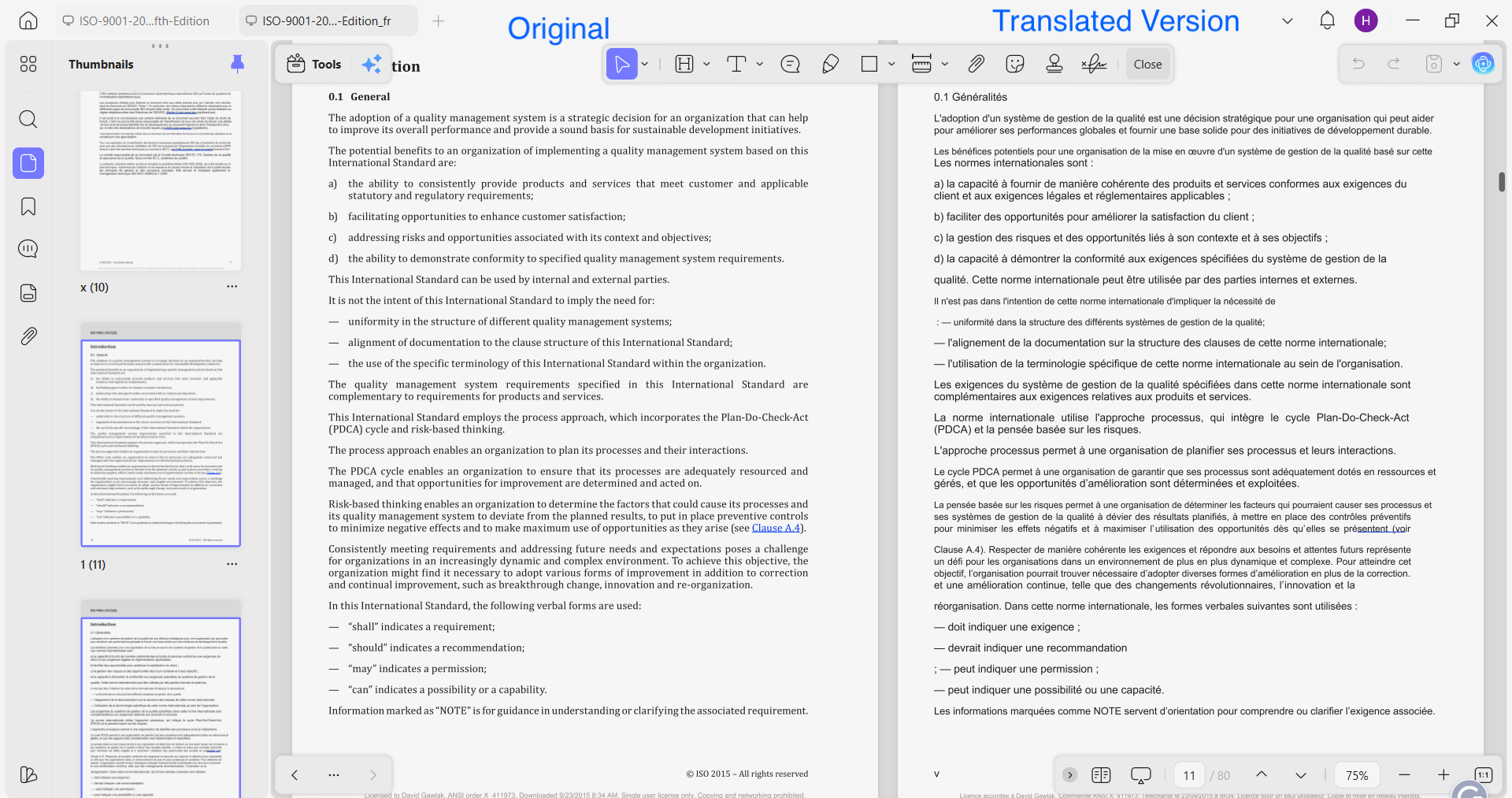
UPDF AI's native translation engine can translate the original ISO 9001 Version 2026 PDF into the required localized language while preserving the original formatting. The clause structure and multi-column layout remain strictly intact.
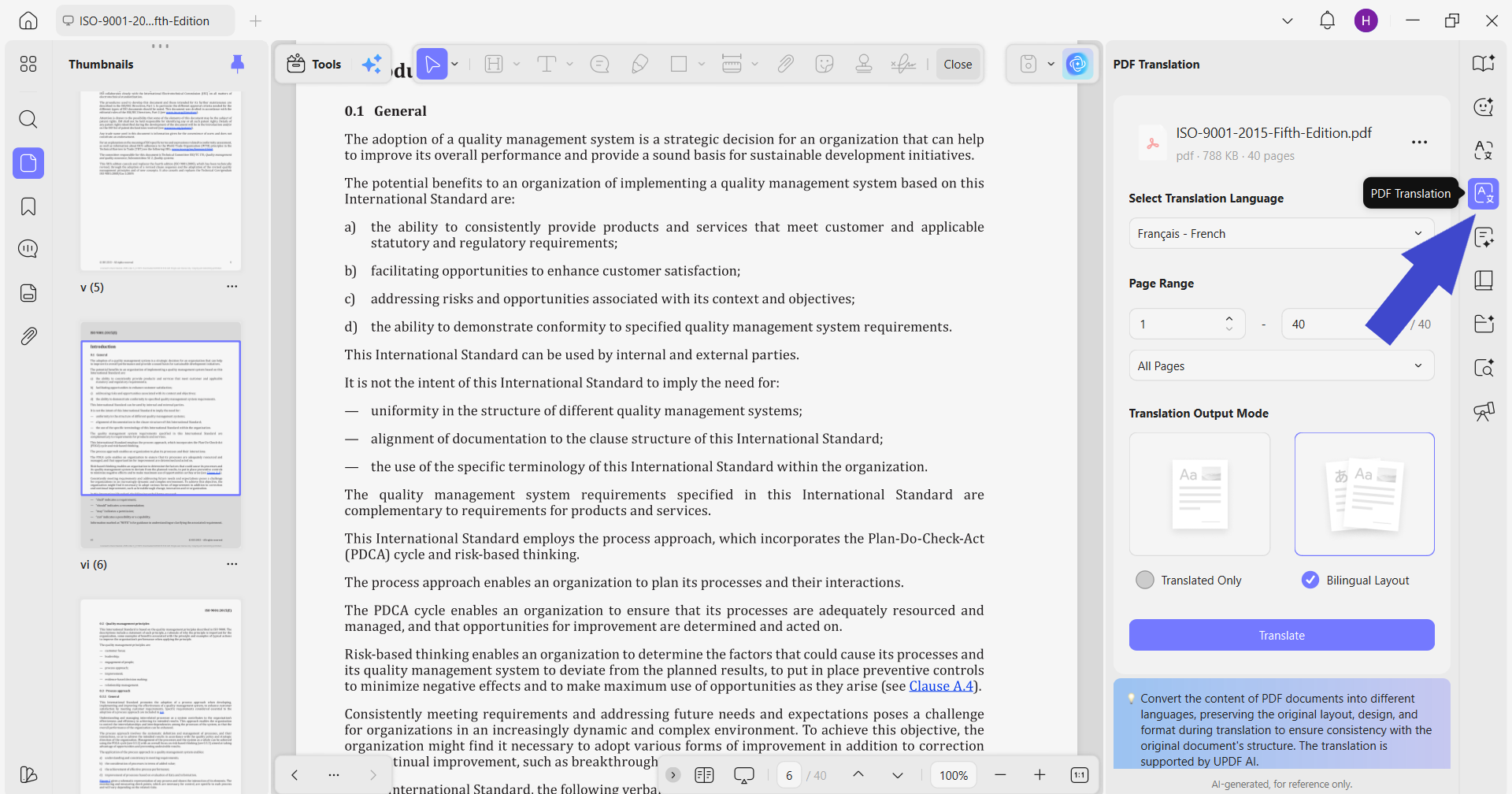
All it requires is selecting the PDF Translation option from the right panel, selecting the page range and language, and getting the translation. You can even use the original and translated versions side-by-side.
Phase 2: Group Auditing & Team Alignment (Annotation Tools)
ISO 9001:2026 compliance is not a solo activity. Gap analysis with corrective action planning and management review requires structured collaboration between quality teams, process owners, department leads, and external auditors.
UPDF offers an extensive annotation toolkit, including highlighters, strikethroughs, dynamic text boxes, comment threads, and more. Quality managers can pin compliance status notes directly onto individual clauses. Similarly, process owners can flag sections requiring operational input.
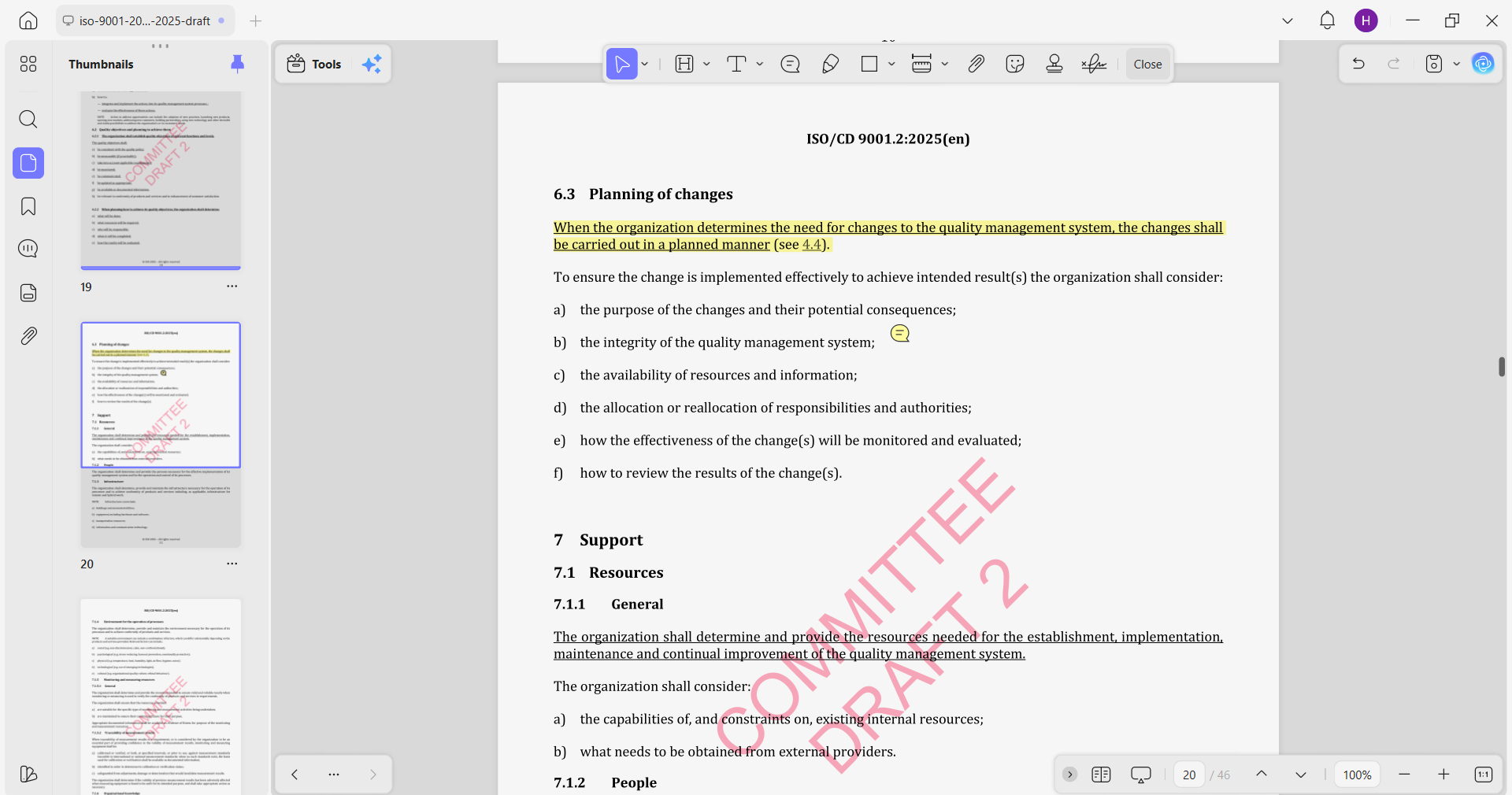
The audit leads can strike through superseded requirements, and mark confirmed conformances in real time during stakeholder review sessions. The annotation layer sits above the original document and eases the entire review process.
Phase 3: Corporate Security & Enterprise Scaling (ISO 27001 & Enterprise Plan)
Quality managers handle proprietary operational procedures. It can involve process maps, supplier evaluations, corrective action records, and management review outputs. Handling this material requires a security posture that matches its sensitivity.
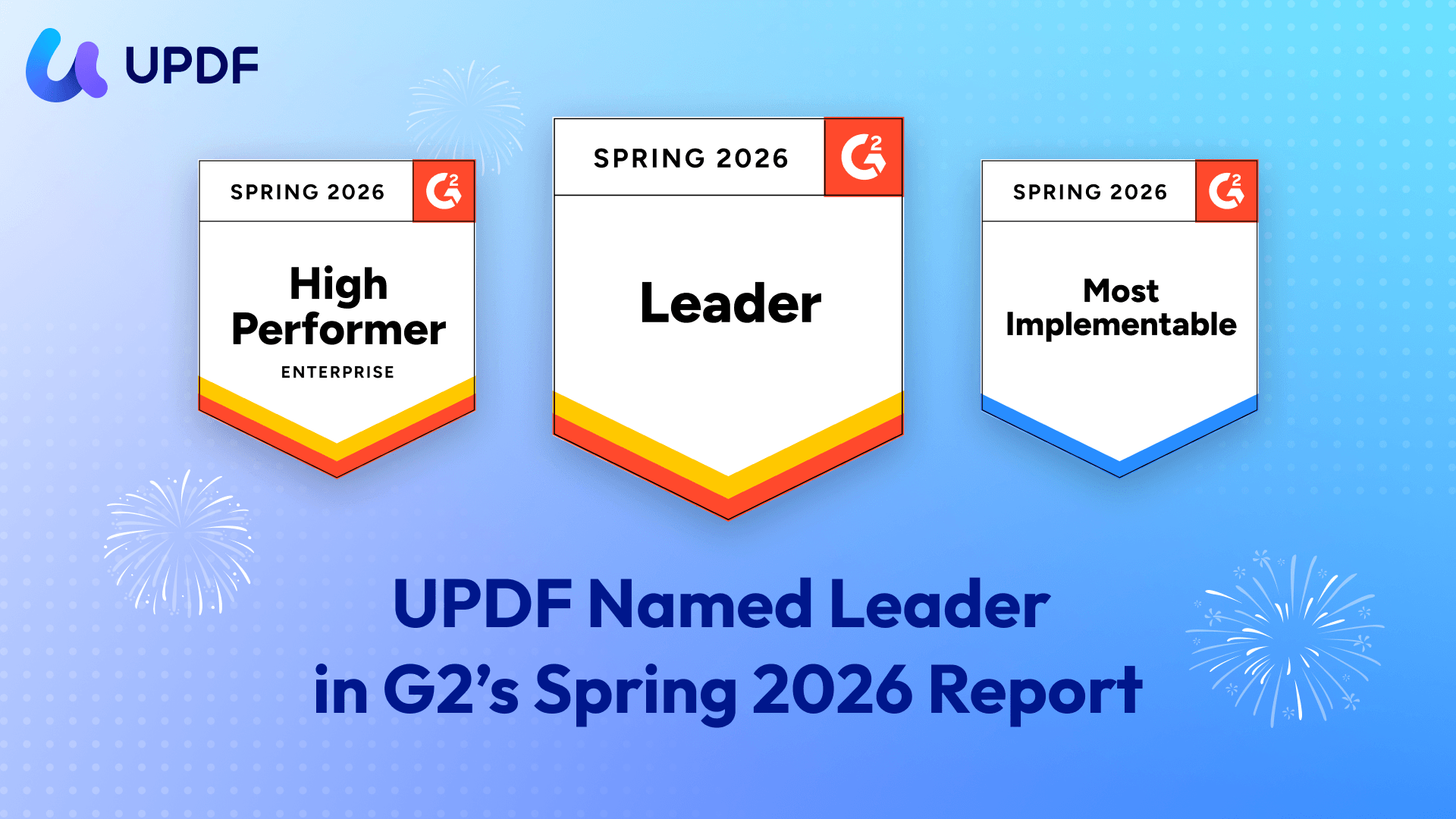
UPDF operates within an ISO 27001-certified secure framework, which means the platform itself is audited against the same family of international standards that govern your QMS. Your uploaded documents don't become training data. File access is controlled and subject to the same information security management disciplines your auditors expect to see in your own systems. Moreover, UPDF has gained G2's following awards in 2026.
For organizations scaling this workflow across global quality teams in multiple sites and dozens of auditors, the UPDF Enterprise Plan is for them. It provides centralized license management, virtualized deployment, and absolute organizational data control. A quality director in Singapore and a compliance manager in Stuttgart can operate within the same UPDF environment, with access permissions and audit trails managed from a single administrative console.
Unlock UPDF's Rates of Q3 Now >>
See the following video to learn why UPDF enterprise will bring benefits to you:
Summary and Next Steps
ISO 9001:2026 is restructuring the management of supply chain risk, digital documentation, and climate-related quality considerations. Audit bodies will be prepared to evaluate conformance against those higher expectations from the moment of certification.
Therefore, starting ahead of the 2026 revision is crucial for both compliance and competitive advantage. The organizations that begin their gap analysis now will be the ones that reach conformance without operational disruption.
Don't let compliance paperwork slow your operations down. Download UPDF today to revolutionize how your enterprise handles regulatory audits.
Windows • macOS • iOS • Android 100% secure






 Enid Brown