 UPDF
UPDF
 UPDF for Windows
 UPDF for Mac
 UPDF for iPhone/iPad
 UPDF for Android
 Nomostar
 UPDF AI Online
 UPDF Sign
 IvyCraft
 Edit PDF
 Annotate PDF
 Create PDF
 PDF Form
 Edit links
 Convert PDF
 OCR
OCR PDF to Word
 PDF to Image
 PDF to Excel
 Organize PDF
 Merge PDF
 Split PDF
 Crop PDF
 Rotate PDF
 Protect PDF
 Sign PDF
 Redact PDF
 Sanitize PDF
 Remove Security
 Read PDF
 UPDF Cloud
 Compress PDF
 Print PDF
 Batch Process
 About UPDF AI
 UPDF AI Solutions
 AI User Guide
 FAQ about UPDF AI
 Summarize PDF
 Translate PDF
 Chat with PDF
 Chat with AI
 Chat with image
 PDF to Mind Map
 Explain PDF
 PDF AI Tools
 Image AI Tools
 AI Chat Tools
 AI Writing Tools
 AI Study Tools
 AI Working Tools
 Other AI Tools
 AI Bookmark Generation
 AI Bookmark Summary
 AI Watermark Generation
 AI Background Generation
 AI Sticker Generation
 AI Stamp Generation
 AI Editing Suite
 UPDF Copilot
 AI Page Management
 AI Semantic Search
 PDF to Word
 PDF to Excel
 PDF to PowerPoint
 Enterprise Solution
 Enterprise Sign
 Enterprise AI
 Enterprise Plan
 Enterprise User Guide
 Enterprise Webinar
 IT
IT Education
 Construction
 Financial Service
 Healthcare
 Insurance
 Legal
Legal Manufacturing
 Government
 Researchers & PhDs
 Solopreneurs & Freelancers
 Lawyers & Legal Professionals
 Real Estate Agents & Brokers
 Education Solution
 Customer Stories
 User Guide
 UPDF Tricks
 FAQs
FAQs UPDF Reviews
 Download Center
 Blog
Blog Newsroom
 Tech Spec
 Updates
 UPDF vs. Adobe Acrobat
 UPDF vs. Foxit
 UPDF vs. PDF Expert

 UPDF AI
Discussion Post Generator
— Stop Staring at a Blank Screen
UPDF AI lets you skip the 'blank screen paralysis' and jump straight to writing. It can actually understand your course materials, cites its sources, and helps you build a post that sounds like you with the advanced AI models including GPT-5.6 and DeepSeek R1.
Powered by
 GPT-5.6 |
  DeepSeek R1
5000+ Reviews
 4.8
4.8
UPDF AI available on


 Desktop & mobile app
4M+ Users, 11M+ Posts Generated, Trusted by Leading Medias:






How to Generate Discussion Post in 3 Simple Steps
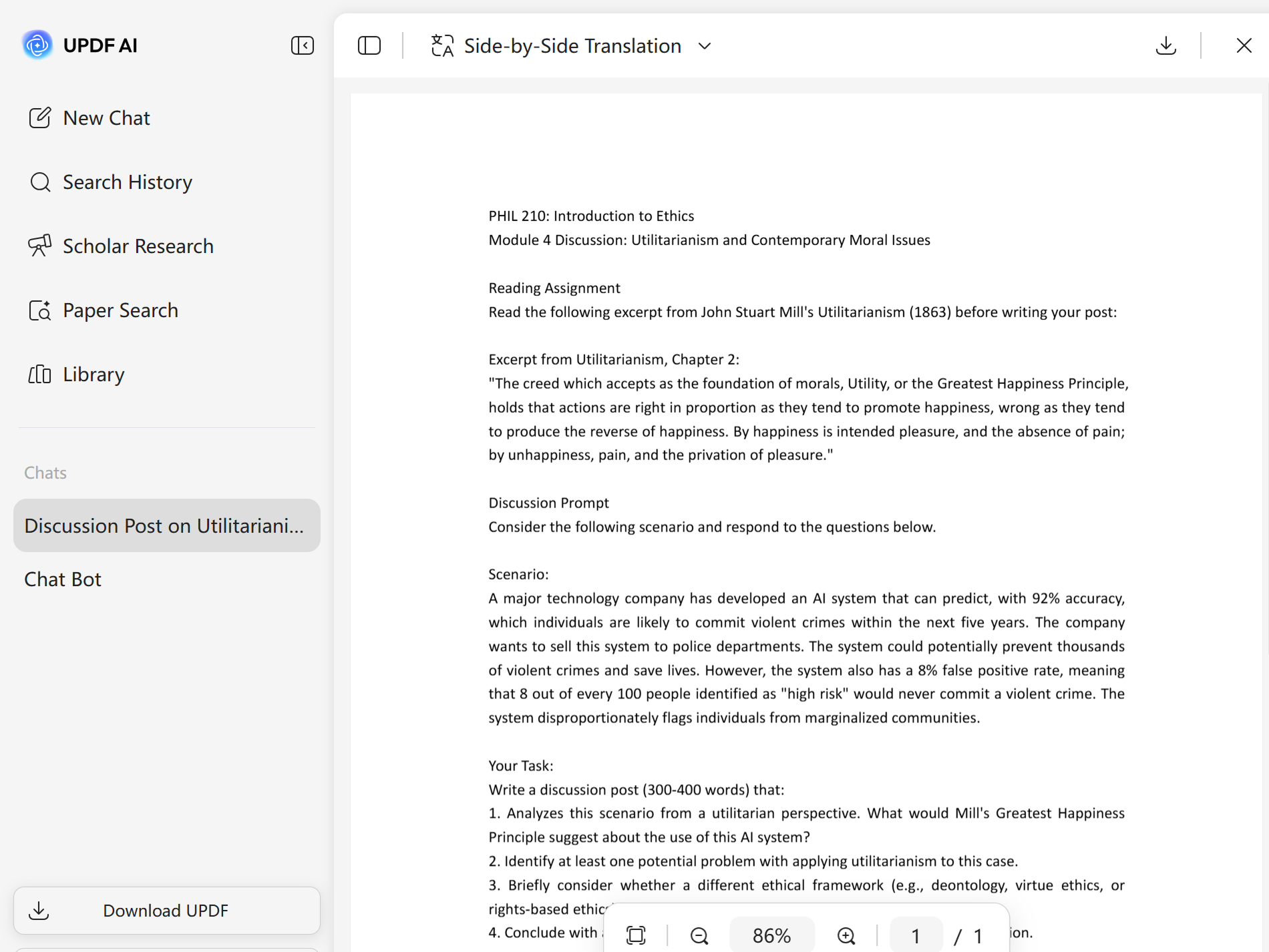
Upload Your Materials
Upload the images or PDFs you need — lecture slides, readings, research papers, or your own notes. UPDF AI can also search for academic papers directly if you need additional sources.Generate Discussion Posts
Tell UPDF AI what you need: "Write a 300-word discussion post arguing that [your position]." "Reply to this peer post: [paste the post] with a thoughtful counterpoint." "Generate 3 discussion questions based on this week's reading."Review & Edit
UPDF AI generates a draft with clear structure: introduction → argument → evidence → conclusion. Review it, personalize it, and make it yours. Copy, paste, and submit.

Why Choose UPDF AI to Generate Discussion Posts?
Grounded in Your Actual Course Materials, Not General Knowledge
Most AI chatbots generate responses from a vast but shallow pool of general internet knowledge. They don't know what your professor emphasized in last week's lecture, the specific argument in Tuesday's reading, or the data from the case study you just analyzed. UPDF AI lets you upload your actual course materials — lecture slides, assigned readings, research papers, or your own notes — and generates discussion posts that are directly anchored in your content, not a generic approximation of it.

Simultaneously Analyze Multiple Sources
UPDF AI can simultaneously analyze multiple papers, extract key arguments, and integrate scattered research suggestions into clear, coherent research questions. This allows you to write posts that demonstrate true synthesis, not just summary — the hallmark of advanced academic thinking.

Turn Vague Ideas into Focused Arguments
UPDF AI transforms broad, fuzzy notions into structured, defensible positions. It can add population, platform, behavior, outcome, setting, and timeframe to help you craft an argument that aligns with your assignment and available evidence. What starts as a vague hunch becomes a precise, arguable thesis.

Generate Posts That Actually Contribute to the Conversation
UPDF AI analyzes the prompt and your materials to generate posts that don't just respond — they contribute. It helps you identify what's been said, what hasn't, and what you can add. Your posts become the ones that professors point to as examples of strong engagement.

Overcome Writer's Block Without Sacrificing Quality
UPDF AI gives you a draft in seconds — not a final product, but a structured starting point that overcomes the initial inertia. You're no longer starting from zero; you're refining and improving. This turns the writing process from a dreaded obstacle into a manageable task.

UPDF AI vs. Other AI Discussion Post Generators
UPDF AI
Other AI Discussion Post Generators
Upload your own materials
Upload lecture slides, readings, notes
Relies on general knowledge only
Cite sources from your materials
Traceable page references
Cannot cite specific sources
Academic tone
Natural, student-like voice
Requires careful prompt engineering
Post types supported
Original post, peer reply, discussion questions
One-size-fits-all
AI model
GPT-5.6 + DeepSeek
GPT-4 / Claude
Free Tier
Generous - 5 PDFs and 100 AI prompts
Limited - restricted to 2 PDFs per day
Privacy & Security
Encrypted transmission
Unclear data handling policies
FAQs About Discussion Post Generator
1. Will my professor know I used AI to write my discussion post?
2. What if I don't have any materials to upload?
3. Is my data private?
4. How much does UPDF AI cost?
5. What AI model does UPDF AI use?
6. Does UPDF AI work for graduate-level seminars?
Other Popular UPDF AI Tools